Buda Tower Entrance
Budapest, Hungary
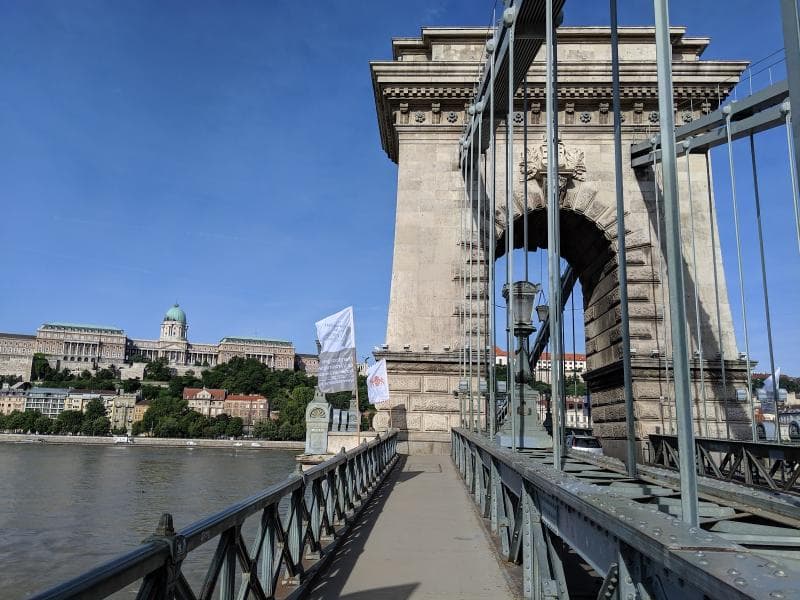
Explore the historic Buda Tower Entrance of Budapest's Széchenyi Chain Bridge, famed for its lion statues and pivotal role in connecting Buda and Pest, Hungary.
Overview
The Buda Tower Entrance to the Széchenyi Chain Bridge is not a standalone structure but rather refers to the magnificent architectural ensemble that marks the western terminus of Budapest's most iconic bridge. Situated at the foot of Buda Castle Hill, this area serves as a ceremonial gateway, connecting the historic Buda side with the bustling Pest side across the Danube River. It encompasses the grand stone pillars of the bridge, the famous lion sculptures, and the vibrant Clark Ádám Square, a focal point of activity and a starting point for exploring Buda's many attractions.
Standing here, visitors are immediately immersed in a blend of history, engineering prowess, and breathtaking cityscapes. The colossal stone towers, which anchor the bridge's suspension chains, frame picturesque views of the Danube, the Parliament Building, and the Pest embankment. It is a place where every glance reveals layers of Budapest's rich past and its enduring spirit.
History & Cultural Background
The Széchenyi Chain Bridge, and by extension its Buda entrance, represents a pivotal moment in Hungarian history. Before its construction, crossing the Danube between Buda and Pest was a challenging endeavor, often reliant on ferry services or hazardous winter ice. Count István Széchenyi, often called 'the Greatest Hungarian', championed the bridge's construction after being unable to attend his father's funeral due to impassable river conditions in 1820.
Designed by English engineer William Tierney Clark and built under the supervision of Scottish engineer Adam Clark (no relation), construction began in 1839 and concluded in 1849. The bridge was a monumental achievement for its time, becoming the first permanent bridge to span the Danube in Hungary and one of the world's largest suspension bridges. It was instrumental in fostering unity between the autonomous cities of Buda and Pest, ultimately leading to their unification into Budapest in 1873.
During World War II, the retreating German forces tragically blew up the bridge in 1945, leaving only the stone towers standing. However, it was meticulously rebuilt to its original design and reopened in 1949, precisely one hundred years after its initial inauguration, symbolizing Budapest's resilience and rebirth.
What Makes It Special
The Buda Tower Entrance is distinguished by its classicist architectural style and symbolic elements. The massive stone pillars on the Buda side are not merely structural but are adorned with decorative elements, including the coats of arms of the Széchenyi and Sina families, who were significant benefactors of the bridge's construction.
However, the most captivating features are undoubtedly the four monumental lion statues, two on each side of the bridge's entrance. Carved from stone by sculptor János Marschalkó and installed in 1852, these majestic beasts appear to guard the bridge with silent vigilance. Their imposing presence adds a layer of grandeur and mythology to the bridge, making them an inseparable part of its identity. The design of the bridge itself, with its robust chain links and elegant suspension, was a marvel of 19th-century engineering, setting new standards for bridge construction.
Stories, Fun Facts & Local Details
Perhaps the most famous legend associated with the Chain Bridge's lions is the tale that they have no tongues. According to this popular urban myth, the sculptor, János Marschalkó, was so ashamed of this oversight that he jumped into the Danube. In reality, the lions do possess tongues, though they are intricately carved and not easily visible from street level. Marschalkó also lived for several decades after the bridge's opening.
Just steps away from the Buda entrance, in Clark Ádám Square, you'll find the 'Zero Kilometre Stone'. This small, oval-shaped sculpture marks the point from which all road distances to Budapest are measured throughout Hungary, adding another unique local detail to the area. The square itself is named after Adam Clark, the Scottish engineer who oversaw the bridge's construction and also built the tunnel beneath Buda Castle, which aligns perfectly with the bridge.
Visitor Perspective
Approaching the Chain Bridge from the Buda side offers a powerful sense of arrival. As you step onto Clark Ádám Square, the majestic stone towers rise before you, inviting you to cross this historic link. The detailed carvings and the sheer scale of the bridge provide ample opportunities for contemplation and photography. Walking across the bridge, recently reopened to pedestrians after extensive renovations, offers unparalleled panoramic views. To one side, the majestic Parliament Building dominates the Pest skyline, while on the other, Buda Castle, Fishermen's Bastion, and Matthias Church crown the hill, creating a truly unforgettable vista. Whether by day, when the sunlight glints off the Danube, or at night, when the bridge and surrounding landmarks are beautifully illuminated, the experience of the Buda Tower Entrance and the Chain Bridge is a quintessential Budapest moment, connecting you physically and historically to the heart of this magnificent city.
Coordinates: 19.02361, 47.49889
View on Google Maps💬 How Travelers Describe This Place
Based on community votes
Must See
726Beautiful
717Photogenic
449Unique
335Interesting
22
Traveler Stories
Discover memorable experiences shared by travelers who have visited this place.
No traveler stories yet.
Be the first traveler to share what made this place memorable.

Tour
By
Spot
Discover amazing places around the world. Your journey starts here.
Explore
© 2026 TourBySpot. All rights reserved.