Danube Views
Budapest, Hungary
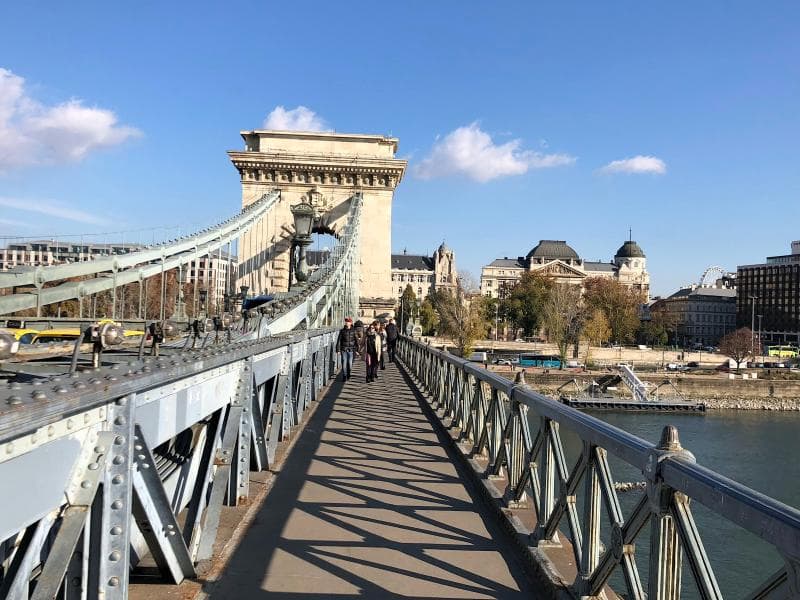
Experience the iconic Danube Views from Budapest's Chain Bridge. Discover its rich history, unique features, and panoramic cityscape in Hungary.
Overview
The 'Danube Views' from Budapest's iconic Chain Bridge, or Széchenyi Lánchíd, offer a breathtaking panorama of the Hungarian capital, where history and grandeur converge across the magnificent Danube River. This isn't a single viewpoint, but rather the collective experience of witnessing the city's splendor as the river bisects Buda's historic hills from Pest's vibrant plains. The Chain Bridge itself is more than a mere crossing; it's a prominent landmark that frames these unforgettable vistas, connecting two distinct halves of a storied city. Walking across its span provides an immersive perspective on Budapest's UNESCO World Heritage cityscape, a view that has captivated travelers for generations.
History & Cultural Background
The genesis of the Chain Bridge dates back to the early 19th century, driven by the vision of Count István Széchenyi, often hailed as 'the Greatest Hungarian'. Frustrated after being unable to cross the Danube due to ice to attend his father's funeral in 1820, Széchenyi championed the idea of a permanent bridge. Until then, ferries and temporary pontoon bridges were the only means of crossing the river. Designed by English engineer William Tierney Clark and constructed under the local supervision of Scottish engineer Adam Clark (no relation), the bridge's construction began in 1839. It was inaugurated on November 20, 1849, becoming the first permanent link between Buda and Pest. This monumental achievement not only facilitated trade and communication but also symbolized national unity and progress, especially in the wake of the 1848 Hungarian Revolution. Tragically, the Chain Bridge, along with other Budapest bridges, was destroyed by retreating German troops during World War II in January 1945. However, its cultural significance ensured its swift reconstruction, reopening in 1949, precisely 100 years after its original inauguration.
What Makes It Special
At the time of its completion, the Chain Bridge was considered an engineering marvel, boasting one of the largest central spans in the world at 202 meters (663 feet). Its elegant classicist design features two grand stone towers from which its distinctive iron chains are suspended, giving the bridge its name. Guarding each entrance are four colossal stone lion statues, sculpted by János Marschalkó in 1852, which have become an iconic part of its identity. The bridge's strategic location offers unparalleled views, making it a living postcard of Budapest. From its walkways, visitors can admire the sweeping curve of the Danube, with the majestic Hungarian Parliament Building on the Pest side and the historic Buda Castle and Fisherman's Bastion perched on the Buda hills. Its role in unifying the once-separate cities of Buda, Pest, and Óbuda into modern Budapest further cements its special place in the city's heart and history.
Stories, Fun Facts & Local Details
One of the enduring local legends surrounding the Chain Bridge concerns its lion statues. A popular tale suggests that the sculptors forgot to carve tongues for the lions, leading to public ridicule. However, a closer inspection reveals their tongues are indeed present, though perhaps not immediately obvious. This fun fact is often shared by local guides. The bridge's name, Széchenyi Lánchíd, translates directly to 'Széchenyi Chain Bridge', honoring its principal initiator. For decades, the bridge graced countless postcards and travel guides, solidifying its image as the quintessential symbol of Budapest. Remarkably, until 1918, even nobility had to pay a toll to cross the bridge. The bridge has recently undergone extensive renovations, reopening in 2023. A significant change is that it is now largely car-free, allowing greater pedestrian access and an even more serene experience for those wishing to soak in the views.
Visitor Perspective
Walking across the Chain Bridge is an essential Budapest experience. The gentle sway and the refreshing breeze from the Danube enhance the feeling of truly being in the heart of the city. From the Pest side, as you walk towards Buda, you're greeted by an unfolding panorama of Buda Castle and the Gellért Hill, often crowned by the Citadel. Looking back towards Pest, the ornate Hungarian Parliament Building dominates the skyline, a grand architectural masterpiece reflected in the river. The experience is transformative at night, when the bridge itself and the surrounding landmarks are beautifully illuminated, casting a golden glow over the Danube. The walk itself is relatively short, about 375 meters (1,230 feet), but many travelers find themselves lingering, captivated by the stunning vistas and the sense of history underfoot. It's a place for quiet reflection, romantic strolls, and capturing indelible memories of Budapest's dynamic beauty.
Coordinates: 19.0437, 47.49896
View on Google Maps💬 How Travelers Describe This Place
Based on community votes
Unique
623Photogenic
545Interesting
343Beautiful
302Must See
88
Traveler Stories
Discover memorable experiences shared by travelers who have visited this place.
No traveler stories yet.
Be the first traveler to share what made this place memorable.

Tour
By
Spot
Discover amazing places around the world. Your journey starts here.
Explore
© 2026 TourBySpot. All rights reserved.