Castel Sant'Angelo
Rome, Italy
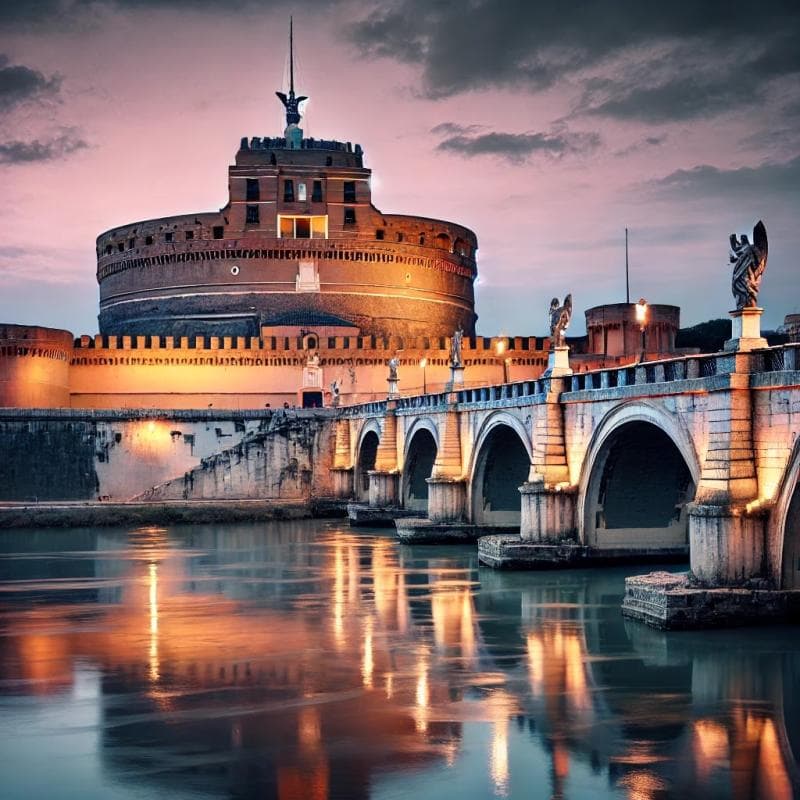
Explore Castel Sant'Angelo in Rome, Italy: an ancient imperial mausoleum, fortress, papal residence, and now a museum with panoramic city views.
Overview
Perched majestically on the right bank of the Tiber River in Rome, Italy, Castel Sant'Angelo stands as a profound testament to the Eternal City's layered history. Originally conceived as an imperial mausoleum, this iconic cylindrical structure has transformed through centuries, serving successively as a formidable fortress, a papal residence, a notorious prison, and, finally, the captivating national museum it is today. Its unique evolution reflects Rome's own complex story, making it a powerful symbol of endurance and transformation. Connected to the Vatican City by the fortified Passetto di Borgo and gracefully linked to the city's historic center by the Ponte Sant'Angelo, the castle invites visitors to traverse nearly two millennia of human history within its walls.
History & Cultural Background
Castel Sant'Angelo began its monumental journey between 123 and 139 AD, commissioned by Emperor Hadrian as a grand mausoleum for himself and his family. This impressive sepulchre, known as the Mole Adriana, was designed to house the remains of Roman emperors up to Caracalla, featuring a massive cylindrical drum and an ingenious spiral ramp leading to the burial chambers.
By the 5th century, its purpose shifted dramatically. Emperor Honorius incorporated the mausoleum into Rome's Aurelian Walls, transforming it into a vital military fortress. This strategic conversion was crucial in defending Rome and the burgeoning Vatican settlement from invaders like the Visigoths and Vandals.
During the Middle Ages, the castle's fate became intrinsically linked with the Papacy. Transferred to church control around 1365, it served as a secure refuge for popes during periods of conflict, a temporary residence, a court, and a notorious state prison. A remarkable feature from this era is the Passetto di Borgo, an elevated, fortified corridor built by Pope Nicholas III, providing a secret escape route from the Vatican to the safety of the castle. Pope Clement VII famously utilized this passageway during the devastating Sack of Rome in 1527.
Following the unification of Italy and Rome's annexation in 1870, Castel Sant'Angelo transitioned from papal hands to the Italian State. By 1901 and officially in 1925, it was designated as a national museum, preserving its rich history and diverse collections for future generations.
What Makes It Special
What truly sets Castel Sant'Angelo apart is its unparalleled architectural and functional evolution. Few structures worldwide encapsulate such a sweeping panorama of history, transitioning seamlessly from an imperial tomb to a military stronghold, then a luxurious papal palace, a dark prison, and finally, a vibrant museum.
The ingenuity of Hadrian's original spiral ramp, still navigable today, offers a tangible connection to its ancient origins. Above, the panoramic terrace provides one of Rome's most breathtaking viewpoints, offering sweeping vistas of the Tiber, the Vatican City, and countless other landmarks, particularly stunning in the late afternoon.
The elegant Ponte Sant'Angelo, adorned with ten exquisite marble angels sculpted by Gian Lorenzo Bernini and his pupils, creates a dramatic approach to the castle, each angel bearing an instrument of Christ's Passion.
Stories, Fun Facts & Local Details
The very name Castel Sant'Angelo, meaning 'Castle of the Holy Angel,' stems from a compelling legend. In 590 AD, during a severe plague that gripped Rome, Pope Gregory the Great led a penitential procession. As he crossed the Aelian Bridge, he reportedly witnessed a vision of Archangel Michael atop Hadrian's mausoleum, sheathing his sword. This symbolic act was interpreted as a sign that the plague would soon end, giving the castle its enduring name and leading to the placement of an angelic statue at its summit.
The castle's past is filled with dramatic tales. It has inspired Giacomo Puccini's opera 'Tosca,' where its battlements serve as a tragic backdrop, and featured prominently in Dan Brown's novel 'Angels and Demons.' Even Renaissance masters left their mark, with Michelangelo contributing to its design.
Beneath the opulent papal apartments lie grim prison cells, which once held famous figures, including the sculptor Benvenuto Cellini.
Visitor Perspective
Today, Castel Sant'Angelo welcomes visitors to explore its many layers. It is conveniently accessible on foot from major Roman attractions like St. Peter's Basilica and Piazza Navona. The museum is generally open Tuesday through Sunday from 9:00 AM to 7:30 PM, with the last admission at 6:30 PM, and is closed on Mondays.
Exploring the castle involves navigating the ancient spiral ramp and various staircases, which can present challenges for those with mobility issues. However, audio guides are available and highly recommended to fully appreciate the intricate history embedded in its every stone. A visit culminates in the breathtaking panoramic terrace, offering unparalleled views of Rome's historical tapestry.
Coordinates: 12.46628, 41.90325
View on Google Maps💬 How Travelers Describe This Place
Based on community votes
Must See
995Unique
839Beautiful
388Interesting
289Photogenic
141
Traveler Stories
Discover memorable experiences shared by travelers who have visited this place.
No traveler stories yet.
Be the first traveler to share what made this place memorable.
Things to see at Castel Sant'Angelo



Tour
By
Spot
Discover amazing places around the world. Your journey starts here.
Explore
© 2026 TourBySpot. All rights reserved.