Big Almaty Lake
Almaty, Kazakhstan
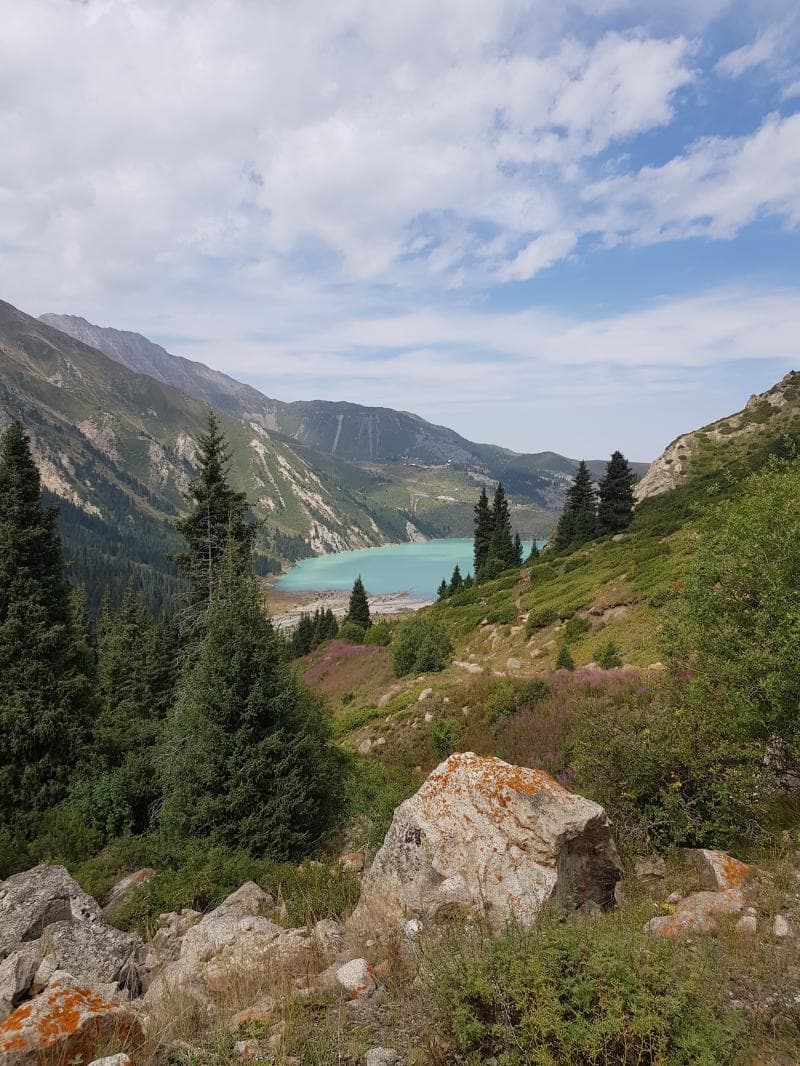
Discover Big Almaty Lake, a stunning alpine reservoir in Kazakhstan's Tian Shan mountains, known for its changing colors and dramatic peaks.
Overview
High in the embrace of the Trans-Ili Alatau mountains, a stunning section of the grand Tian Shan range, lies Big Almaty Lake, a natural alpine reservoir that captivates with its ever-changing hues. Located approximately 15 to 30 kilometers south of Almaty, Kazakhstan, this majestic lake sits at an impressive altitude of 2,511 meters (8,235 feet) above sea level. It stretches about 1.6 kilometers long, is between 0.75 and 1 kilometer wide, and reaches depths of 30 to 40 meters.
Big Almaty Lake is a glacial marvel, born thousands of years ago from the powerful forces of tectonic shifts, seismic activity, and the slow, persistent melt of glaciers. Today, it holds immense importance as the primary source of drinking water for the city of Almaty and also contributes to hydroelectric power generation. This pristine body of water is cradled within the protected boundaries of the Ile-Alatau National Park, safeguarding its ecological integrity.
History & Cultural Background
The origins of Big Almaty Lake trace back approximately 10,000 years, a testament to the dynamic geological history of the region. It was forged by significant tectonic movements and the sculpting power of Quaternary glaciers. Long before its current name, the lake was known as 'Zhosalykol,' which in Kazakh means 'ocher-colored lake,' a descriptive nod to the reddish mountain slopes that once descended directly into its waters. Its current name is attributed to the Big Almatinka River, which feeds it.
Beyond its geological story, Big Almaty Lake is woven into the cultural fabric of the local Kazakh people. It is a place rich in folklore and tales passed down through generations, with its serene and mystical landscape inspiring poets and artists alike. One enchanting legend recounts that the lake was formed from the tears of a giant who once dwelled in these mountains. Historically, the area surrounding the lake also played a role along the ancient Silk Road, likely serving as a vital water source for caravans traversing Central Asia. During the Soviet era, the high-altitude environment fostered scientific exploration, leading to the establishment of the Tien Shan Astronomical Observatory nearby, utilizing the clear skies for cosmic research.
What Makes It Special
The allure of Big Almaty Lake lies in its breathtaking natural artistry, primarily its mesmerizing ability to change color. Depending on the season, the intensity of sunlight, and the weather, its waters can shift from brilliant turquoise and milky blue to vibrant light green and deep azure. This captivating phenomenon is a result of the high mineral content in the water, derived from glacial erosion.
The lake is dramatically framed by a majestic amphitheater of surrounding peaks from the Trans-Ili Alatau mountains, including the towering Sovetov Peak (4,317 meters), Ozyorny Peak (4,110 meters), and Turist Peak (3,954 meters). The pyramid-shaped Big Almaty Peak (3,681 meters), visible from Almaty city, also adds to this stunning backdrop. As a jewel within the Ile-Alatau National Park, the lake and its surroundings are a haven for unique flora and fauna, including the elusive snow leopard, contributing to its protected status. Moreover, the clear, high-altitude skies above the lake make it an exceptional location for scientific endeavors, hosting both a scientific research station and the renowned Tien Shan Astronomical Observatory.
Stories, Fun Facts & Local Details
The lore around Big Almaty Lake adds to its mystique. The evocative legend of the lake being formed from a giant's tears speaks to the deep connection locals feel to this natural wonder. Its former Kazakh name, 'Zhosalykol,' meaning 'ocher-colored lake,' offers a glimpse into how its appearance impressed early inhabitants. The water itself is exceptionally pure and clear, fed directly by glacial melt from the surrounding peaks.
Despite its inviting appearance, the lake's water remains remarkably cold throughout the year, typically not rising above 10°C, and in July, it rarely exceeds 8°C. Due to its critical role as a drinking water source for Almaty, strict regulations are in place: swimming, camping, and building open fires around the lake are all strictly prohibited. However, this doesn't deter a unique group of enthusiasts known as 'ivanovezchs,' who embrace the frigid waters for their winter swims. The diverse ecosystem within Ile-Alatau National Park means that the area around the lake is also home to a variety of wildlife, including marmots, ibex, and numerous bird species.
Visitor Perspective
A journey to Big Almaty Lake offers a refreshing escape and is a popular half-day to full-day excursion from Almaty. Visitors are drawn to the pristine mountain air, the panoramic vistas, and the endless photographic opportunities presented by the lake's dynamic colors and the dramatic peaks. Access to the lake has evolved, and as of 2025, private vehicles are restricted. Most travelers now opt for organized tours or transfers to a designated access point, followed by a hike of approximately 8 kilometers one way, or by e-bike. Public transport is available via bus number 28 to the Kokshoky stop.
The best time to experience the lake's splendor is generally from May to October, when the weather is most favorable for exploration. However, the brightest turquoise hues are often seen in September and early October. Regardless of the season, it is advisable to wear comfortable shoes and bring a warm layer and a windbreaker, as mountain weather can be unpredictable. There is a modest entry fee to the Ile-Alatau National Park, which helps in the conservation efforts of this incredible natural treasure.
Coordinates: 76.985, 43.0506
View on Google Maps💬 How Travelers Describe This Place
Based on community votes
Beautiful
551Must See
547Photogenic
421Unique
298Interesting
212
Traveler Stories
Discover memorable experiences shared by travelers who have visited this place.
No traveler stories yet.
Be the first traveler to share what made this place memorable.
Things to see at Big Almaty Lake



Tour
By
Spot
Discover amazing places around the world. Your journey starts here.
Explore
© 2026 TourBySpot. All rights reserved.