Basilica Cistern
Istanbul, Turkey

Discover Istanbul's Basilica Cistern, a 6th-century Byzantine underground marvel. Explore its history, unique columns, and enigmatic Medusa heads in Turkey's vibrant heart.
Overview
Deep beneath the bustling streets of Istanbul, Turkey, lies an ancient wonder known as the Basilica Cistern, or 'Yerebatan Sarnıcı' in Turkish, often translated as the 'Sunken Palace.' This subterranean marvel is the largest of several hundred ancient cisterns that once supplied water to the city of Constantinople. Today, it stands as a captivating museum and a poignant testament to Byzantine engineering and artistry, drawing visitors into its mysterious, dimly lit depths.
History & Cultural Background
The construction of the Basilica Cistern was commissioned by the Byzantine Emperor Justinian I in the 6th century AD, around 532 CE. Its primary purpose was to serve as a massive water reservoir, ensuring a steady supply for the Great Palace of Constantinople and the surrounding imperial buildings, especially crucial during times of siege or drought. Water was transported to the cistern via an intricate network of aqueducts, most notably the Valens Aqueduct, from sources such as the Belgrade Forest, located approximately 19 kilometers away.
Following the Ottoman conquest of Constantinople in 1453, the cistern continued to supply water for a period, including to the Topkapi Palace, but eventually fell into disuse and was largely forgotten by the public. Its existence was famously rediscovered in 1545 by the Dutch scholar Petrus Gyllius, who reportedly learned of its presence from locals drawing water from holes in their basements.
Over centuries, the Basilica Cistern has undergone several restoration efforts to preserve its structural integrity and historical grandeur. Significant work was carried out during the Ottoman era. More recently, a major restoration project was completed in 2022 by the Istanbul Metropolitan Municipality. This effort not only strengthened the structure but also uncovered original Byzantine floors, removed incompatible additions, and installed modern, light-weight walkways and dynamic lighting, enhancing the visitor experience while respecting the cistern's ancient atmosphere.
What Makes It Special
The sheer scale and architectural ingenuity of the Basilica Cistern are what truly set it apart. Spanning approximately 140 meters in length and 70 meters in width, it covers an area of nearly 10,000 square meters and has a staggering capacity to hold 80,000 cubic meters (or tons) of water. The ceiling is supported by a 'forest' of 336 marble columns, each standing about 9 meters tall, meticulously arranged in 12 rows of 28. These columns showcase a variety of styles, including Doric and Corinthian, and many were repurposed from earlier Roman and Byzantine structures, highlighting the resourcefulness of the builders.
The current setup, with raised platforms allowing visitors to walk just above the shallow, reflective water, creates an exceptionally atmospheric and almost otherworldly experience. The soft, artistic lighting illuminates the ancient columns, casting long shadows and creating a sense of tranquil mystery that transports visitors back in time.
Stories, Fun Facts & Local Details
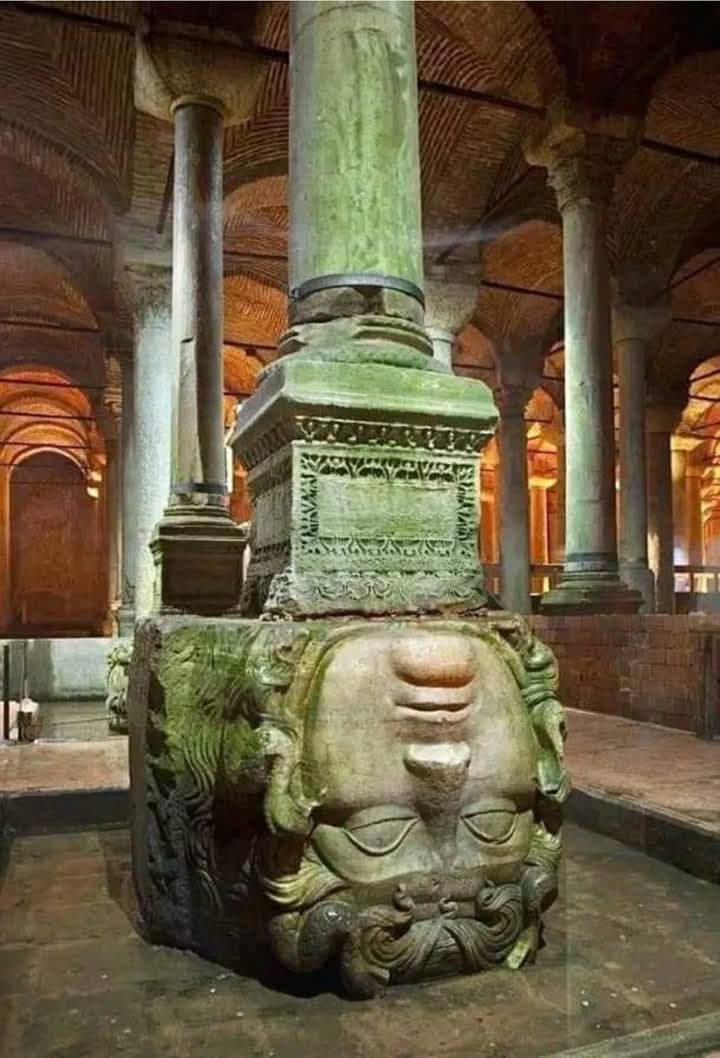
- The Medusa Heads: Perhaps the most enigmatic feature of the cistern are the two colossal Medusa heads, repurposed as column bases in the northwestern corner. One is inverted, and the other is placed sideways. Their exact origin is unknown, believed to be salvaged from older Roman ruins. Legends abound regarding their unusual orientation; some suggest it was to negate Medusa's petrifying gaze, while others propose it was simply a pragmatic choice to achieve the correct column height. Whatever the reason, they add a profound layer of myth and intrigue to the site.
- The Weeping Column: Another intriguing column, known as the 'Column of Tears' or 'Crying Column,' features intricate carvings resembling peacock eyes and branches. It is often damp, leading to the popular belief that it weeps for the hundreds of slaves said to have perished during the cistern's arduous construction.
- The Sunken Palace: Locals often refer to the cistern as 'Yerebatan Sarayı' or 'Sunken Palace' because of the grand appearance of its columns seemingly rising from the water, evoking the image of a submerged royal residence.
- Pop Culture Appearance: The Basilica Cistern's unique and dramatic setting has made it a favorite backdrop for various cultural works, including a scene in the James Bond film 'From Russia With Love' and as a key location in Dan Brown's novel 'Inferno' and its film adaptation.
- Acoustic Marvel: The cistern's excellent acoustics have led it to be occasionally used as a venue for classical music concerts and other cultural events, blending ancient history with contemporary art.
Visitor Perspective
Stepping into the Basilica Cistern is like entering a forgotten world, a subterranean sanctuary that offers a profound escape from the modern metropolis above. The cool, damp air and the soft sounds of dripping water create a serene and contemplative atmosphere. Walking along the illuminated pathways, surrounded by the symmetrical grandeur of the columns, one can't help but feel a deep connection to Istanbul's layered past. It's an experience that highlights the incredible ingenuity of the Byzantine Empire and provides a unique perspective on the city's rich historical tapestry. The combination of ancient architecture, mythological elements, and the palpable sense of history makes it an unforgettable visit for any curious traveler.
Coordinates: 28.9778, 41.0084
View on Google Maps💬 How Travelers Describe This Place
Based on community votes
Beautiful
545Must See
343Interesting
211Photogenic
74Unique
20
Traveler Stories
Discover memorable experiences shared by travelers who have visited this place.
No traveler stories yet.
Be the first traveler to share what made this place memorable.
Things to see at Basilica Cistern



Tour
By
Spot
Discover amazing places around the world. Your journey starts here.
Explore
© 2026 TourBySpot. All rights reserved.