Hen’s Eye Column
Istanbul, Turkey
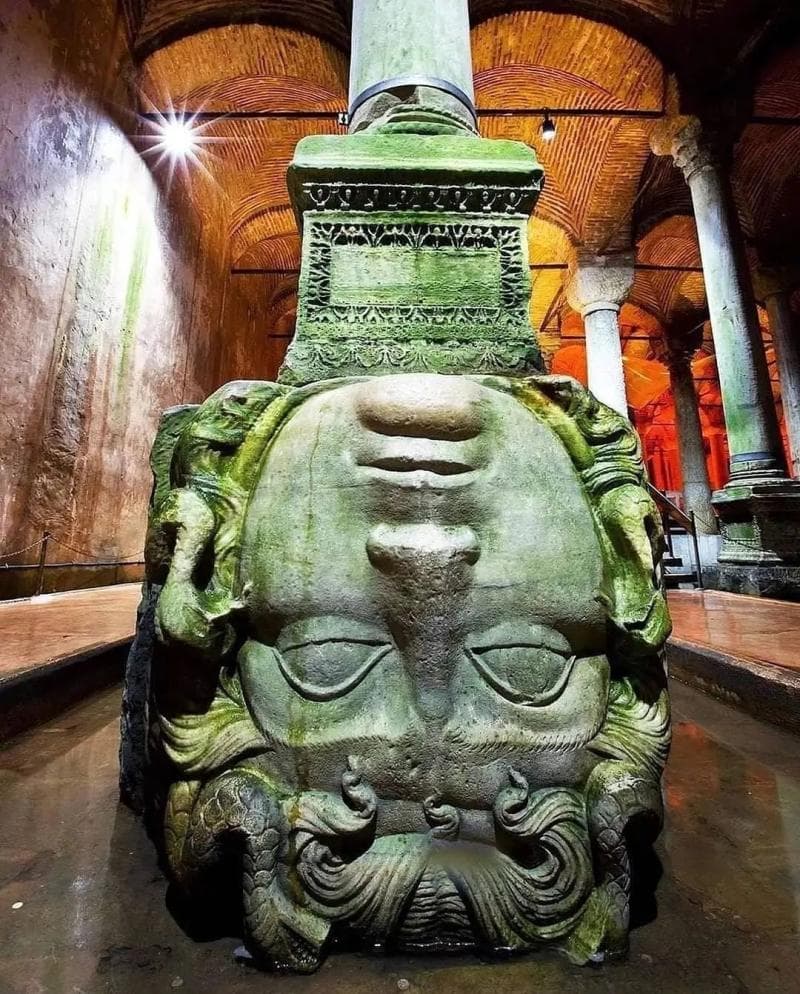
Discover the mysterious Hen's Eye Column within Istanbul's ancient Basilica Cistern. Unravel its history, legends, and unique carvings in Turkey's sunken palace.
Overview
Deep beneath the bustling streets of Istanbul, Turkey, lies a mesmerizing subterranean world known as the Basilica Cistern. Among its 336 ancient columns, one stands out with a unique and poignant design: the Hen's Eye Column, also referred to as the Crying Column or Weeping Column. This distinctive pillar draws visitors into a realm of historical mystery and evocative folklore. Rather than being a mere structural support, the Hen's Eye Column is a captivating focal point within the cistern, inviting contemplation of the past and the narratives woven around its intriguing carvings.
Its surface is adorned with raised patterns that resemble teardrops, slanted branches, and what are often interpreted as hen's eyes or peacock eyes. The column often appears perpetually damp, contributing to its 'weeping' moniker. It serves as a powerful symbol, steeped in legends that speak to the human cost of the cistern's monumental construction. Visiting this column offers a moment of reflection amidst the grandeur of the underground reservoir, connecting modern travelers with ancient stories and the impressive engineering of the Byzantine era.
History & Cultural Background
The Basilica Cistern itself, known in Turkish as 'Yerebatan Sarnıcı' meaning 'Sunken Cistern' or 'Sunken Palace,' is the largest of several hundred ancient cisterns beneath Istanbul. It was constructed in the 6th century during the reign of the Byzantine Emperor Justinian I, specifically to supply filtered water to the Great Palace and surrounding buildings.
The columns within the cistern, including the Hen's Eye Column, were largely repurposed from older structures throughout the Byzantine Empire, a practice known as 'spoliation'. This means many columns were not originally created for the cistern but were brought from various parts of the empire and reused.
Stylistically, the carvings on the Hen's Eye Column bear a resemblance to those found on the 4th-century Triumphal Arch of Theodosius I, which was located in the 'Forum Tauri' (today's Beyazıt Square). This suggests the column likely originated from that earlier structure or a similar one of that period, predating the cistern's construction. Therefore, while its emotional significance within the cistern is profound, the column was not initially carved to commemorate the cistern's laborers.
What Makes It Special
What sets the Hen's Eye Column apart from the other 335 columns in the Basilica Cistern is its unique and intricate carving. Unlike most of the other columns, which are relatively plain, this one features distinct raised patterns of teardrop shapes, slanted branches, and circular motifs resembling eyes, often interpreted as a hen's or peacock's eye.
This distinctiveness has allowed it to become a canvas for deep cultural and emotional narratives. Its perpetually wet appearance enhances the imagery of 'weeping', which, combined with the teardrop carvings, lends it a powerful and melancholic aura.
The column stands as a silent testament to the layers of history that form Istanbul. It's not just an architectural element but a piece of repurposed art, carrying echoes of an even older past within its stone. Its artistic detail and the rich traditions associated with it transform a simple pillar into a focal point of historical and emotional intrigue within the vast underground space.
Stories, Fun Facts & Local Details
The most enduring and touching legend associated with the Hen's Eye Column is that its teardrop carvings commemorate the thousands of laborers, including slaves, who are believed to have died during the arduous construction of the Basilica Cistern in the 6th century. It is said that up to 7,000 individuals worked on this monumental undertaking. While historical accuracy might suggest this interpretation emerged after the cistern's initial construction, perhaps during the Byzantine or Ottoman periods, it remains a powerful and widely accepted tale that imbues the column with immense emotional weight.
Another popular local detail involves a small hole in the column. Visitors often partake in a tradition of inserting their thumb into this hole and rotating their hand 360 degrees while making a wish, believing it will come true. This adds a layer of interactive magic and hope to the column's somber historical narrative.
The column is also known by several names, including the Crying Column, Weeping Column, and Teardrop Column, all of which reflect its distinctive appearance and the folklore surrounding it. Its 'peacock-eye' or 'hen's eye' patterns are thought by some to have symbolic significance that has been lost to time.
Visitor Perspective
A visit to the Basilica Cistern is an immersive journey into a dimly lit, atmospheric underground world, and encountering the Hen's Eye Column is a highlight for many. As you navigate the raised wooden platforms through the forest of 336 columns, the air is cool, and the sound of dripping water creates an echoing tranquility.
The Hen's Eye Column stands out visually, its unique carvings catching the soft, often colorful, illumination. Its presence evokes a sense of both ancient craftsmanship and human struggle. Travelers often pause here, drawn by the legends and the column's distinct appearance. The opportunity to participate in the wish-making tradition offers a personal, memorable moment in a place brimming with shared history.
It's a powerful experience to stand before this column and consider the lives that contributed to the cistern's creation, connecting on a deeper level with the enduring legacy of Istanbul's Byzantine past. The Hen's Eye Column serves not only as a structural marvel but as a touching memorial and a point of profound cultural engagement within this magnificent subterranean palace.
Coordinates: 28.977878, 41.008388
View on Google Maps💬 How Travelers Describe This Place
Based on community votes
Photogenic
996Must See
953Beautiful
658Interesting
585Unique
69
Traveler Stories
Discover memorable experiences shared by travelers who have visited this place.
No traveler stories yet.
Be the first traveler to share what made this place memorable.

Tour
By
Spot
Discover amazing places around the world. Your journey starts here.
Explore
© 2026 TourBySpot. All rights reserved.