Arthur’s Seat
Edinburgh, United Kingdom
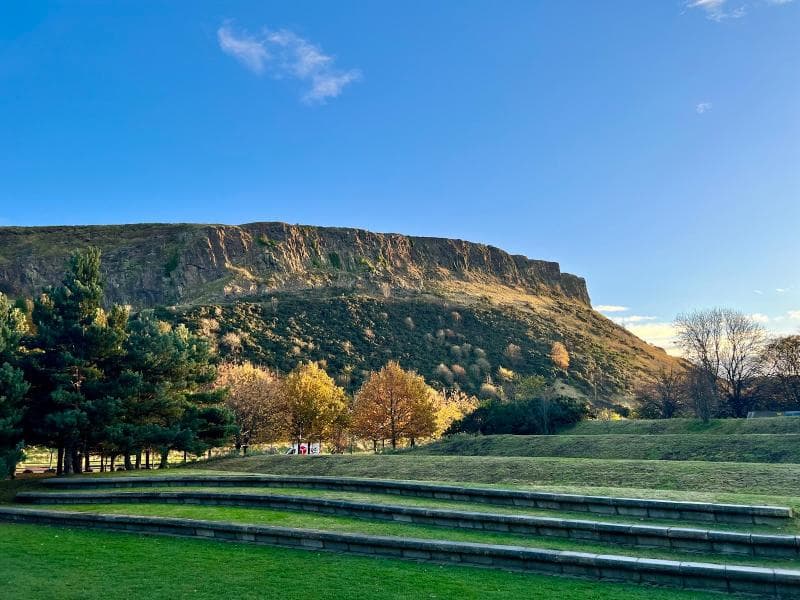
Discover Arthur's Seat in Edinburgh, United Kingdom. Hike this ancient volcano for panoramic city views and uncover its rich history and legends.
Overview
Arthur's Seat, an iconic landmark in Edinburgh, United Kingdom, stands proudly as the main peak of the group of hills forming Holyrood Park. This ancient volcano, rising 251 meters (823 feet) above sea level, offers breathtaking panoramic views across Scotland's capital city and beyond. Situated just a mile east of Edinburgh Castle, it provides a remarkable natural wilderness within the urban landscape, easily accessible for those seeking a refreshing escape and an invigorating walk.
Often described as 'a hill for magnitude, a mountain in virtue of its bold design' by Robert Louis Stevenson, Arthur's Seat is a popular destination for locals and visitors alike, drawing them with its dramatic scenery and accessible trails.
History & Cultural Background
The dramatic landscape of Arthur's Seat was forged through immense geological processes, originating as an active volcano approximately 340 to 350 million years ago. At that ancient time, Scotland's position near the equator shaped its environment, with subsequent glacial activity sculpting the terrain into the distinctive cliffs and valleys visible today.
This site holds a special place in the history of science. In the late 18th century, James Hutton, often regarded as the 'father of modern geology,' made significant observations at Salisbury Crags, part of Holyrood Park. His studies of igneous and sedimentary rocks here contributed to his groundbreaking theory of 'deep time,' suggesting the Earth's immense age and continuous change, influencing other scientists like Charles Darwin.
Arthur's Seat is also steeped in legend and historical events. Tradition links the founding of Holyrood Abbey to a vision experienced by Scotland's 12th-century King David I at the foot of the hill, where a stag inexplicably turned away from him during a hunt.
A more curious discovery occurred in 1836 when seventeen miniature coffins containing small wooden figures were found in a cave. The purpose of these mysterious artifacts remains debated, with theories ranging from witchcraft to a possible connection with the infamous Burke and Hare murders of 1828.
What Makes It Special
What sets Arthur's Seat apart is its unique position as a vast, wild, and rugged natural space right in the heart of a bustling capital city. It offers an unparalleled opportunity to experience a piece of countryside without ever leaving Edinburgh. The rocky slopes and cliffs of Arthur's Seat and the adjacent Salisbury Crags create a spectacular natural backdrop, providing a striking contrast to the city's historic architecture.
The hike to its summit rewards visitors with truly spectacular 360-degree views, encompassing the entire city of Edinburgh, the distant Firth of Forth, and even the hills of the Kingdom of Fife and beyond on a clear day. It provides a rare chance to 'walk into the heart' of an ancient volcano, offering tangible evidence of geological forces that shaped the Earth millions of years ago.
Stories, Fun Facts & Local Details
The very name 'Arthur's Seat' is shrouded in mystery and speculation. While popular folklore often connects it to the legendary King Arthur and his fabled castle, Camelot, there is little concrete evidence to support this. Other theories suggest a derivation from the Scots Gaelic 'Àrd-na-Said,' meaning 'height of arrows,' or 'Ard-thir Suidhe' for 'place on high ground.'
One enchanting legend tells of a sleeping dragon. It is said that a dragon once terrorized the city, consuming livestock, until one day it ate so much that it lay down for a deep sleep and never woke up, its body transforming into the very hill we see today.
A charming local tradition for centuries, still observed by some, involves young maidens climbing Arthur's Seat before sunrise on the first day of May. They wash their faces with the morning dew, believing it will grant them eternal youthfulness.
Visitor Perspective
Arthur's Seat is open year-round and free to access, making it a flexible attraction for any Edinburgh itinerary. While multiple paths lead to the summit, varying in difficulty, the ascent from the east, particularly above Dunsapie Loch, is generally considered the easiest due to its gentle grassy slope.
The walk to the summit typically takes one to two hours, though allowing two to three hours for the entire visit provides ample time to enjoy the views and explore Holyrood Park. It is advisable to wear sturdy walking shoes, as trails can be rocky, uneven, and potentially slippery, especially near the summit. Visitors should also be prepared for strong winds, even during warmer months, so bringing a jacket is recommended.
For those seeking a quieter and particularly magical experience, climbing at sunrise offers dramatic skies and a serene atmosphere. While suitable for families, supervision is advised near the summit due to rocky sections. Toilet facilities are available near Holyrood Palace at the base of the park.
Coordinates: -3.1572, 55.9398
View on Google Maps💬 How Travelers Describe This Place
Based on community votes
Must See
915Unique
873Photogenic
477Interesting
422Beautiful
53
Traveler Stories
Discover memorable experiences shared by travelers who have visited this place.
No traveler stories yet.
Be the first traveler to share what made this place memorable.
Things to see at Arthur’s Seat



Tour
By
Spot
Discover amazing places around the world. Your journey starts here.
Explore
© 2026 TourBySpot. All rights reserved.