Salisbury Crags
Edinburgh, United Kingdom
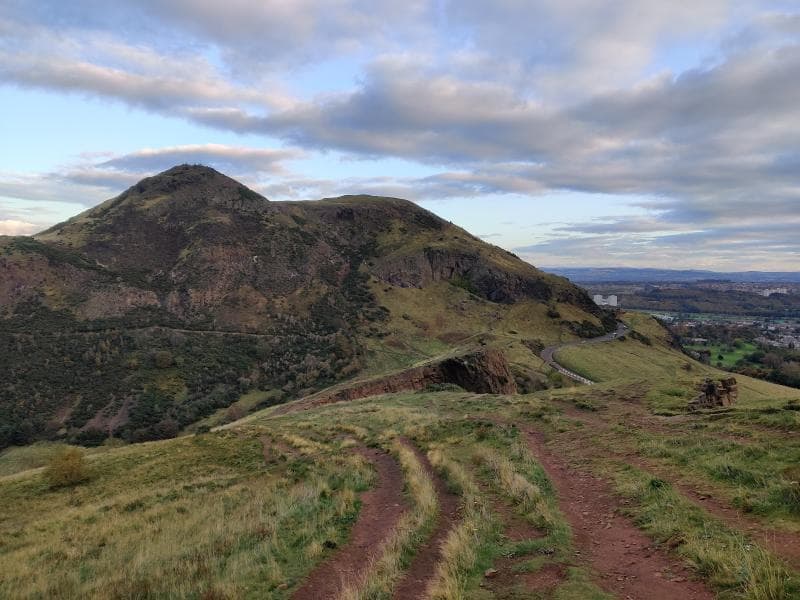
Explore Salisbury Crags in Edinburgh, United Kingdom – ancient volcanic cliffs offering stunning city views and geological history insights.
Overview
Nestled within Edinburgh's iconic Holyrood Park, Salisbury Crags stand as a dramatic and ever-present feature of the city's unique skyline. These striking basalt cliffs form a natural amphitheater, curving below the higher peak of Arthur's Seat. They offer a rugged, wild landscape just moments from the bustling city center, providing a remarkable blend of urban charm and raw natural beauty. Visitors are often captivated by the sheer scale and geological prominence of the Crags, which offer a different, yet equally breathtaking, perspective of Edinburgh's historic heart.
The Crags rise steeply from the park floor, their dark, rocky faces a testament to ancient geological forces. Part of the larger Arthur's Seat volcanic complex, they are not a separate volcano but rather an integral part of its formation. A well-known path, the Radical Road, hugs the base of these impressive cliffs, providing accessible routes for exploration and spectacular views. Salisbury Crags serve as a tranquil escape and a powerful visual landmark, inviting curious travelers to delve into their rich past and diverse offerings.
History & Cultural Background
The story of Salisbury Crags is etched deep within the Earth's history, beginning around 325 to 340 million years ago. While Arthur's Seat represents the remnants of an ancient volcano, Salisbury Crags were formed by a horizontal intrusion of molten rock, known as a dolerite sill, that pushed its way between existing sedimentary layers deep underground. This process occurred long after the initial volcanic eruptions that shaped Arthur's Seat.
The Crags hold immense significance in the history of science. In the late 18th century, Scottish geologist James Hutton, now hailed as the 'Father of Modern Geology', made groundbreaking observations here. By studying the exposed rock layers, particularly at what is now known as Hutton's Section, he recognized that igneous rock had intruded into sedimentary rock, demonstrating that the Earth's formation was a continuous, ancient process. His work at Salisbury Crags profoundly influenced the understanding of geological time and Earth's dynamic nature, shaping scientific thought for centuries to come and even inspiring figures like Charles Darwin.
Beyond their geological fame, the Crags also bear witness to centuries of human activity. Prehistoric or early historic forts once occupied sites on Salisbury Crags, indicating its strategic importance to ancient communities. The Radical Road, a path at the base of the cliffs, earned its name after the Radical War of 1820. It was built in the 1820s by unemployed weavers from western Scotland as part of a public works project, reportedly suggested by Sir Walter Scott, providing them with work in a time of social unrest. Throughout the centuries, stone from the Crags was quarried for construction, including paving Edinburgh's streets and potentially for Holyrood Palace itself.
What Makes It Special
Salisbury Crags are exceptional for several compelling reasons, foremost among them being their profound geological significance. They are a living classroom, showcasing 'Hutton's Section', a site crucial to the development of modern geology. The clear evidence of a dolerite sill intruding into older sedimentary rocks provides a tangible link to James Hutton's revolutionary theories of deep time and uniformitarianism. This makes the Crags not just a scenic spot, but a place where scientific history was made.
Furthermore, the Crags offer some of the most spectacular panoramic views of Edinburgh. From their elevated vantage points, visitors can feast their eyes on the medieval rooftops of the Old Town, the majestic Edinburgh Castle, the distinctive dome of the Royal Observatory, and the expansive blue waters of the Firth of Forth stretching towards the horizon. These vistas are arguably among the best in the city, providing unparalleled photographic opportunities and moments of quiet contemplation.
Within the bustling capital, Salisbury Crags provide a unique sense of wilderness and a natural sanctuary. They offer a tranquil escape, inviting visitors to connect with nature and experience a slice of Scotland's rugged landscape without leaving the city limits. While Arthur's Seat draws many, the Crags often present a slightly less crowded alternative, allowing for a more serene experience while still delivering equally stunning views.
Stories, Fun Facts & Local Details
The legacy of James Hutton is perhaps the most captivating story tied to Salisbury Crags. His 'discovery of unconformity' at the Crags revealed that Earth's processes were incredibly slow and continuous, challenging prevailing beliefs and extending the perceived age of the Earth far beyond biblical chronology. His revolutionary ideas laid the foundation for modern geology and influenced other great scientific minds, including Charles Darwin's understanding of evolution over vast timescales.
The 'Radical Road' itself tells a tale of resilience and social change. Built by unemployed weavers in the aftermath of the 1820 'Radical War', this path reflects a significant period of social unrest and the efforts to provide work for struggling communities. It's a poignant reminder of the human history woven into the natural landscape. While specific ancient myths tied directly to Salisbury Crags are less documented than those for Arthur's Seat, the entire Holyrood Park area is steeped in history. For instance, Mary Queen of Scots once ordered a re-enacted naval battle on a loch created in Hunter's Bog, between the Crags and Arthur's Seat.
The name 'Salisbury Crags' itself has a debated origin, with some theories linking it to the first Earl of Salisbury, who accompanied Edward III, and others suggesting a derivation from Anglo-Saxon words meaning 'waste or dry habitation'. These cliffs have inspired artists and writers throughout history, their dramatic form frequently captured in paintings and literature, further cementing their place in Scotland's cultural tapestry.
Visitor Perspective
Exploring Salisbury Crags offers a truly rewarding experience for any traveler seeking both natural beauty and historical insight in Edinburgh. The paths, particularly the Radical Road, provide an excellent hiking opportunity, allowing visitors to walk at the base of the towering cliffs and ascend to various viewpoints. While parts of the Radical Road have, at times, experienced closures due to rockfall, other routes still offer access to the Crags' splendor.
It's highly recommended to wear sturdy footwear, as the paths can be rocky and, in wet weather, potentially slippery. Many find the walk a less strenuous alternative to climbing the full height of Arthur's Seat, yet it still delivers equally dramatic and extensive vistas. The views are particularly captivating at sunset when the golden light bathes the city and the Crags themselves, creating an almost otherworldly glow. For a different perspective, wandering through Holyrood Park's lower paths can offer beautiful reflections of the Crags in St. Margaret's Loch, adding another layer to their scenic charm.
Visitors often describe the experience as a breath of fresh air, a chance to immerse oneself in a wild landscape while remaining within the heart of Scotland's capital. From identifying city landmarks to simply feeling the raw basalt beneath your hands, a visit to Salisbury Crags is about connecting with both the geological and cultural origins of this remarkable place.
Coordinates: -3.1752, 55.94532
View on Google Maps💬 How Travelers Describe This Place
Based on community votes
Unique
639Interesting
526Must See
421Beautiful
366Photogenic
181
Traveler Stories
Discover memorable experiences shared by travelers who have visited this place.
No traveler stories yet.
Be the first traveler to share what made this place memorable.

Tour
By
Spot
Discover amazing places around the world. Your journey starts here.
Explore
© 2026 TourBySpot. All rights reserved.