Holyrood Park Trails
Edinburgh, United Kingdom
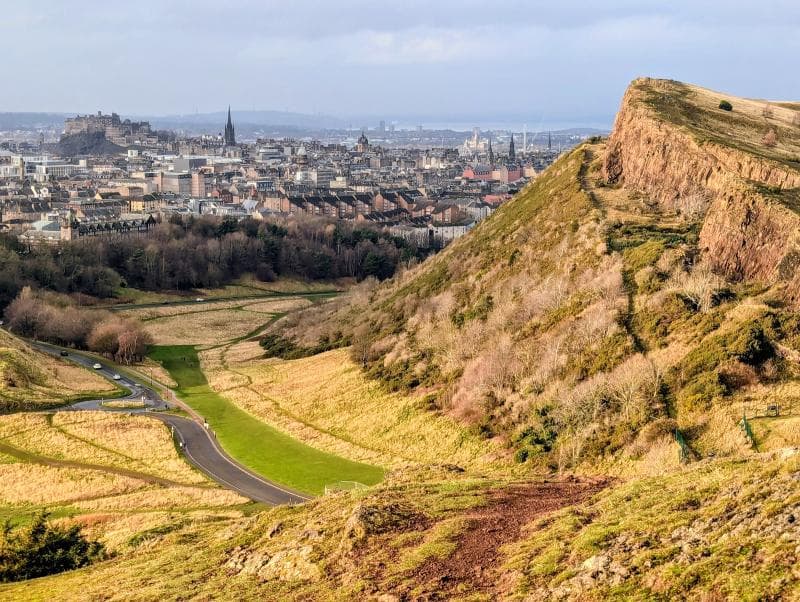
Explore Holyrood Park Trails and Arthur's Seat in Edinburgh, United Kingdom. Discover ancient geology, rich history, and stunning views of the city.
Overview
Holyrood Park, an expansive and remarkably wild space nestled in the heart of Edinburgh, United Kingdom, offers a captivating escape into nature and history. Dominated by the ancient volcanic peak of Arthur's Seat, the park is a tapestry of rugged hills, dramatic cliffs like Salisbury Crags, tranquil lochs, and winding trails. It spans approximately 650 acres and provides an immediate sense of wilderness, belying its central urban location. The park's varied landscape invites exploration, from gentle strolls around its lochs to more challenging ascents up its commanding peaks, all while offering breathtaking panoramic views of the Scottish capital and beyond. Holyrood Park is not merely a recreational area; it is a protected landscape brimming with geological, archaeological, and historical significance, making it a truly unique destination for any curious traveler.
History & Cultural Background
The story of Holyrood Park stretches back hundreds of millions of years, beginning with its dramatic geological formation. Arthur's Seat and the Salisbury Crags are the remnants of a powerful volcanic system that erupted approximately 340 to 342 million years ago, when Scotland was situated near the equator. Over immense timescales, glacial movements during the Quaternary period sculpted the landscape, eroding the softer rocks and exposing the rugged crags and peaks we see today.
Long before Edinburgh existed, humans discovered this compelling landscape. Archaeological evidence points to hunter-gatherer activity in the park as far back as 8,000 years ago, with flint tools and worked stone found in the area. By the Bronze Age, people had begun to farm the land, and traces of agricultural terraces can still be observed on the eastern slopes of Arthur's Seat. Iron Age hillforts, including one on the summit of Arthur's Seat itself, indicate significant occupation.
The park's royal connections are equally profound. Legend attributes the founding of Holyrood Abbey in 1128 to King David I, following a miraculous encounter with a stag in the park that inspired a vision of a holy cross. This tale cemented the area's spiritual importance. In 1541, King James V officially enclosed the park as a royal hunting ground, although it was also likely used for provisioning the nearby Palace of Holyroodhouse. The palace, which stands adjacent to the park, has served as a principal royal residence since the 16th century.
During the 18th century, Holyrood Park played a pivotal role in the development of modern geology. James Hutton, often regarded as the 'Father of Modern Geology', studied the rock formations at Salisbury Crags. His observations here contributed significantly to his groundbreaking theory of 'deep time', which established that Earth's processes unfold over vast periods, radically changing scientific understanding of our planet's age.
The park also underwent significant re-landscaping in the Victorian era, particularly under the guidance of Prince Albert in the 1840s, transforming parts of its rugged terrain to create more accessible pathways and viewpoints, thus shaping it into the recreational haven it is today.
What Makes It Special
Holyrood Park stands out as a truly exceptional natural space due to its unique blend of dramatic geological history, rich archaeological tapestry, and its position as a wild oasis within a bustling capital city. Its designation as a Site of Special Scientific Interest (SSSI) underscores its importance for diverse geology, flora, and fauna, attracting scientists globally.
The park's most striking feature, Arthur's Seat, is a 340-million-year-old extinct volcano, a geological marvel visible for miles around. Climbing its slopes offers not just physical exercise but a journey through deep time, showcasing volcanic rock formations like basalt and agglomerate. The adjacent Salisbury Crags, with their sheer basalt cliffs, are equally impressive and provide stunning views over Edinburgh.
Beyond its geological grandeur, the park is a living museum. Traces of human activity from the Stone Age, Bronze Age agricultural terraces, and Iron Age hillforts are embedded in the landscape, offering tangible connections to millennia of human history. This concentration of prehistoric and historic sites within an urban park is rare and deeply enriching.
Furthermore, the panoramic views from Arthur's Seat and Salisbury Crags are unparalleled. Visitors are rewarded with expansive vistas that encompass the city's historic skyline, Edinburgh Castle, the Firth of Forth, and the surrounding Scottish countryside. It offers a perspective that seamlessly connects urban grandeur with untamed natural beauty.
Stories, Fun Facts & Local Details
Holyrood Park is rich with captivating tales and fascinating tidbits. One of the most enduring legends is that of King David I and the founding of Holyrood Abbey. As the story goes, in 1128, while hunting in the royal forest that would become the park, David was attacked by a stag. A vision of a holy cross appeared between the stag's antlers, saving him and inspiring him to establish the abbey, giving the park its 'holy rood' (holy cross) name.
Another curious tale involves Mary, Queen of Scots, who is believed to have ordered the flooding of an area in the park in 1562 to create an artificial loch. This unique 'naval pageant' was reportedly for the wedding celebrations of her lady-in-waiting, Elizabeth Ross, complete with replica boats.
The park also holds a darker legend in Muschat's Cairn, a humble pile of stones marking the site of a brutal 1720 murder. Nichol Muschat, a surgeon, murdered his wife after failed attempts to poison her and frame her for adultery. This tragic event was even referenced by Sir Walter Scott in his novel, 'The Heart of Midlothian', giving the cairn a place in literary history.
A lesser-known fact is the park's sanctuary status. From at least the 16th century and well into the 19th century, Holyrood was one of Scotland's largest sanctuaries, offering refuge to debtors and fugitives, reflecting a unique aspect of its historical role.
Visitor Perspective
Holyrood Park is an incredibly accessible natural haven, open 24 hours a day, year-round, and completely free to visit. Its trails cater to a wide range of abilities and preferences. For those seeking a substantial hike, the ascent to the summit of Arthur's Seat (251 meters) typically takes about two hours round trip, offering moderately strenuous paths that reward climbers with unparalleled panoramic views. There are various routes to the summit, some steeper and more direct, others more gradual.
A popular alternative is a walk along Salisbury Crags, which provides equally spectacular views of Edinburgh's Old Town and is generally a shorter and less arduous climb, often taking between 20 to 40 minutes to reach the top. For easier options, visitors can enjoy leisurely strolls around the park's lochs, such as St Margaret's Loch or Duddingston Loch, which are ideal for birdwatching and offer picturesque scenery. The Queen's Drive, a paved road circling Arthur's Seat and Salisbury Crags, also has footpaths alongside it, offering an accessible circuit of the park.
While much of the park is freely explorable, visitors should be aware that the terrain can be uneven and rugged in places. Comfortable footwear is highly recommended. Parking is available at various locations, including St Margaret's Loch, Dunsapie Loch, and Duddingston Loch car parks, with paid parking also available at Broad Pavement near Holyrood Palace. Public toilets are located at the Education Centre, behind Holyrood Palace. Ranger-guided tours are occasionally available, offering deeper insights into the park's geology and history.
Coordinates: -3.1572, 55.9398
View on Google Maps💬 How Travelers Describe This Place
Based on community votes
Unique
639Interesting
526Must See
421Beautiful
366Photogenic
181
Traveler Stories
Discover memorable experiences shared by travelers who have visited this place.
No traveler stories yet.
Be the first traveler to share what made this place memorable.

Tour
By
Spot
Discover amazing places around the world. Your journey starts here.
Explore
© 2026 TourBySpot. All rights reserved.