Akershus Fortress
Oslo, Norway
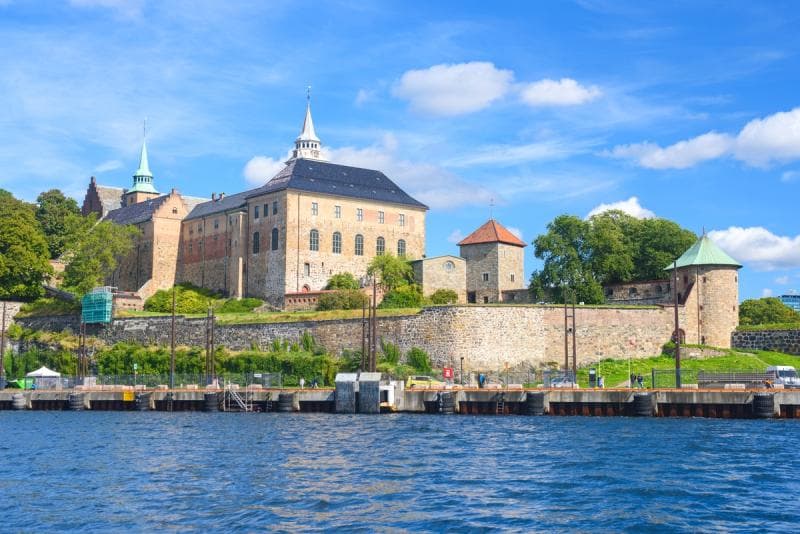
Explore Akershus Fortress, Oslo, Norway's medieval castle and royal residence, guarding the city for over 700 years. Discover its history, museums, and stunning fjord views.
Overview
Perched majestically on a promontory overlooking the Oslofjord, Akershus Fortress (Akershus Festning) in Oslo, Norway, stands as a powerful symbol of the nation's rich history. This medieval castle and stronghold, with its imposing stone walls and towers, has guarded Oslo's harbor since its construction began in the late 1290s under King Haakon V. Originally conceived as both a defensive bulwark and a royal residence, the fortress has adapted through centuries of change. Over time, it has transitioned from a medieval castle to a Renaissance palace, a military base, and even a notorious prison. Today, Akershus Fortress is a vibrant cultural arena, an active military site, and one of Oslo's most significant historical landmarks, inviting curious travelers to step back in time.
History & Cultural Background
The origins of Akershus Fortress are rooted in necessity. Following a devastating attack on Oslo in 1287 by Earl Alv Erlingsson, it became clear that the city's existing defenses were insufficient. King Haakon V initiated the fortress's construction around 1299 to provide a stronger defensive heart for the capital, replacing Tønsberg as a primary royal stronghold. This strategic move also played a pivotal role in establishing Oslo as Norway's capital, shifting importance from Bergen.
Throughout its long history, Akershus Fortress proved to be remarkably resilient. It successfully withstood numerous sieges, predominantly by Swedish forces, and earned a reputation as an impregnable fortress. A notable instance was in 1716 when King Karl XII of Sweden invaded Norway, occupied Christiania (as Oslo was then known), but ultimately failed to conquer Akershus, forced to retreat after 39 days. The fortress underwent significant modernization after the great fire of Oslo in 1624. King Christian IV rebuilt the city closer to the fortress and transformed Akershus into a grand Renaissance castle, complete with Italian-inspired bastions.
Its role extended beyond defense and royalty. For centuries, parts of the fortress served as a prison, infamous for a section known as 'The Slavery,' where inmates were rented out for forced labor in the city. In a darker chapter of its history, Akershus Fortress tragically surrendered to Nazi Germany without combat in 1940 during World War II. During the German occupation, it was used as a prison and execution site for Norwegian resistance fighters. After its liberation on May 11, 1945, the fortress became the site where eight Norwegian traitors, including the notorious Vidkun Quisling, faced execution.
What Makes It Special
Akershus Fortress offers a unique blend of breathtaking vistas and profound historical resonance. Its commanding position provides unparalleled panoramic views of the Oslofjord, making it a favorite spot for locals and visitors alike. Architecturally, it showcases a fascinating evolution from a robust medieval stronghold to an elegant Renaissance palace, a testament to centuries of changing needs and styles.
Within the castle walls lies the solemn Royal Mausoleum, the final resting place for several Norwegian monarchs, including King Haakon VII and King Olav V, underscoring its continued significance to the Norwegian monarchy. The fortress also hosts two significant museums: the Norwegian Armed Forces Museum, which is free to enter, and Norway's Resistance Museum. These institutions vividly recount Norway's military history and its valiant struggle during World War II, offering deep insights into the nation's character. Beyond its historical weight, the sprawling grounds are a beloved recreational area, and the fortress continues to be a venue for official government functions and state ceremonies.
Stories, Fun Facts & Local Details
Beyond the formal history, Akershus Fortress is rich with captivating stories and local lore. It is often cited as one of Norway's most haunted locations, with staff and visitors reporting eerie whisperings in corridors and the unsettling sound of rattling chains in the night. These tales often link back to its long history as a prison and execution site, contributing to its mystical aura.
Intriguingly, Akershus Fortress holds a special place in popular culture, believed by many to be one of the inspirations for Arendelle Castle in Disney's animated film 'Frozen'. Furthermore, the fortress's name itself carries historical weight: 'Akershus' derives from the Old Norse words 'ákr,' meaning 'field,' and 'hus,' meaning 'house,' referencing the farm that once occupied the strategic headland. It is also noteworthy that Akershus was a pioneering structure, recognized as the first significant stone building in the region during an era when most Scandinavian constructions were made from wood and earth.
Visitor Perspective
Visiting Akershus Fortress offers a layered experience for every traveler. The expansive grounds are open daily, typically from 06:00 to 21:00, and are completely free to explore. Guests can wander the ancient ramparts, enjoy the scenic views, and even picnic on the grass, soaking in centuries of history.
While the outdoor areas and the Norwegian Armed Forces Museum provide free admission, a small fee is required to enter the Akershus Castle interior and Norway's Resistance Museum. Inside the castle, visitors can discover vaulted halls, royal chambers, and the historically significant Royal Mausoleum. For those seeking deeper understanding, guided tours are often available, especially during the summer months. It's advisable to wear comfortable shoes due to uneven surfaces, and in winter, spikes might be beneficial. The Visitor Centre, conveniently located near the main gate, serves as an excellent starting point for any exploration. Akershus Fortress is easily accessible, with the Kontraskjæret tram stop being the closest public transport option.
Coordinates: 10.736178, 59.906606
View on Google Maps💬 How Travelers Describe This Place
Based on community votes
Photogenic
846Must See
564Beautiful
201Unique
121Interesting
87
Traveler Stories
Discover memorable experiences shared by travelers who have visited this place.
No traveler stories yet.
Be the first traveler to share what made this place memorable.
Things to see at Akershus Fortress



Tour
By
Spot
Discover amazing places around the world. Your journey starts here.
Explore
© 2026 TourBySpot. All rights reserved.