St. Stephen’s Basilica
Budapest, Hungary
Explore St. Stephen's Basilica in Budapest, Hungary. Discover its stunning Neoclassical architecture, the Holy Right Hand relic, and panoramic city views.
Overview
St. Stephen's Basilica, or Szent István-bazilika in Hungarian, stands as a magnificent Roman Catholic basilica in the heart of Budapest, Hungary. Named in honor of Stephen I, the first King of Hungary and the patron saint of the nation, it is an iconic landmark dominating the city's skyline. The basilica's grandeur is immediately apparent, showcasing a harmonious blend of Neoclassical and Neo-Renaissance architectural styles. Its monumental dome soars to a height of 96 meters, intentionally matching the elevation of the Hungarian Parliament Building. This equal height symbolically represents the balance between worldly and spiritual significance in Hungary. As the largest church in Budapest and the third largest church building in Hungary, it serves as the co-cathedral of the Roman Catholic Archdiocese of Esztergom-Budapest and attracts approximately one million visitors annually.
History & Cultural Background
The origins of St. Stephen's Basilica are rooted in a story of gratitude and resilience. The area where the basilica now stands was once home to the Hetz-Theater, a venue known for animal fights in the 18th century. However, a devastating flood in Budapest in 1838 led to hundreds finding refuge on the elevated ground of this future site. Survivors, attributing their salvation to a divine miracle, began fundraising for a church to be built there.
Construction commenced in 1851 under the direction of architect József Hild, who envisioned a Neoclassical design. Following Hild's death in 1867, Miklós Ybl took over, introducing Neo-Renaissance elements to the plans. A major setback occurred in 1868 when the partially built dome collapsed, necessitating a complete demolition and rebuilding of the damaged sections. After Ybl's passing in 1891, József Kauser completed the project, finally consecrating the basilica in 1905, 54 years after construction began. The basilica also played a significant role during World War II, its sturdy structure providing refuge for valuable documents and artworks from the Hungarian National Archives, as well as many refugees, in its cellars. It later underwent extensive restoration from 1983 to 2003 to preserve its splendor.
What Makes It Special
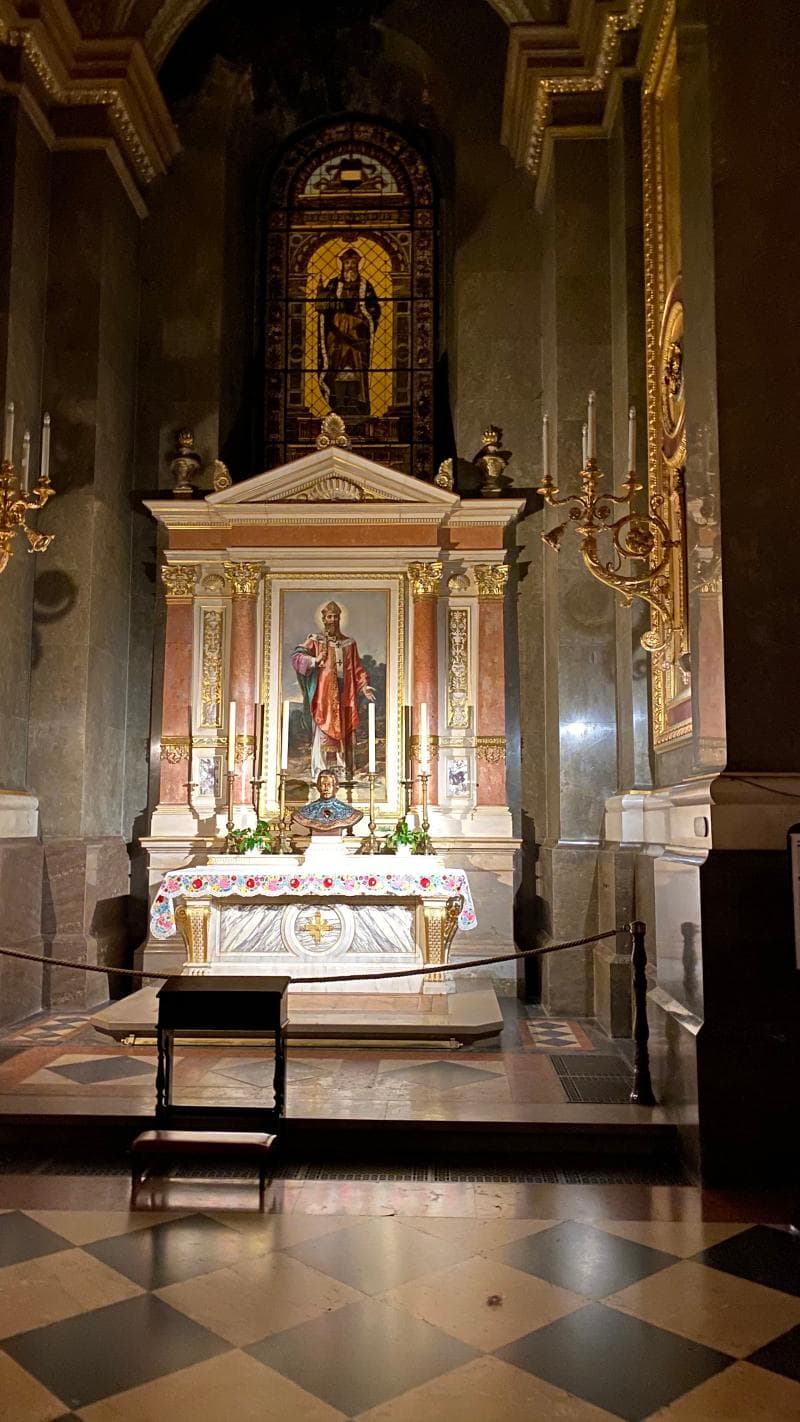
The basilica's interior is a testament to artistic brilliance and religious devotion. Upon entering, visitors are greeted by a vast nave adorned with towering Corinthian columns and an intricately designed vaulted ceiling. The main altar, embellished with gilded ornaments and elaborate statues, serves as a central focal point. The interior showcases opulent marble work, stunning mosaics depicting scenes from the life of St. Stephen, and gold leaf detailing, creating an atmosphere of quiet opulence.
Beyond its architectural beauty, St. Stephen's Basilica is renowned for housing Hungary's most treasured national relic: the Holy Right Hand. This naturally mummified right hand belongs to King St. Stephen, the nation's first Christian king. Housed in a specially designed reliquary, this artifact holds profound historical and spiritual significance for the Hungarian people. Climbing to the dome's observation deck, accessible by elevator or 364 steps, offers breathtaking 360-degree panoramic views of Budapest, including the Danube River, the Parliament Building, and Buda Castle.
Stories, Fun Facts & Local Details
The story of the Holy Right Hand is one of enduring reverence. Legend has it that when St. Stephen's body was exhumed prior to his canonization, his right hand was found miraculously preserved and incorrupt, interpreted as a divine sign. This relic has had an adventurous history, being hidden, stolen, rediscovered, and eventually returned to Hungary, now permanently housed and displayed in a neo-Gothic reliquary within the basilica. Every year on August 20th, St. Stephen's Day, the relic is carried in a solemn procession through the streets of Budapest, a tradition revived after being banned during the communist era.
The basilica is also home to six bells, including Hungary's largest, the 9.2-ton St. Stephen Bell, which only rings on significant Catholic holidays, on August 20th, and New Year's Eve. Its magnificent organ, considered one of the finest in Hungary with 93 registers and 6507 pipes, regularly hosts popular classical music and organ concerts, filling the grand space with resonant melodies. Interestingly, the remains of Ferenc Puskás, Hungary's legendary football player, are interred within the basilica, adding another layer of national pride to its hallowed halls. The square in front, Szent István tér, transforms into a vibrant Christmas market in winter and hosts various cultural festivities throughout the year, making it a lively hub for locals and visitors alike.
Visitor Perspective
Visiting St. Stephen's Basilica offers a multi-faceted experience. For quiet contemplation and admiring the main nave, entry is generally free, though a small fee might be requested for maintenance. To fully appreciate its treasures, consider tickets that include access to the dome, the treasury, and the chapel housing the Holy Right Hand. The dome climb, whether by stairs or elevator, provides unparalleled panoramic views, best enjoyed during calmer weekday mornings or towards sunset.
As an active place of worship, visitors are encouraged to dress modestly, covering shoulders and knees, and maintain a quiet atmosphere, especially during services. Attending an organ or classical music concert within the basilica is a memorable experience, offering superb acoustics in a breathtaking setting. Plan for about 60-90 minutes to explore the interior, dome, and treasury. The basilica's central location makes it an easy and essential stop when exploring Budapest.
Coordinates: 19.05399, 47.50085
View on Google Maps💬 How Travelers Describe This Place
Based on community votes
Must See
623Unique
545Beautiful
343Photogenic
211Interesting
20
Traveler Stories
Discover memorable experiences shared by travelers who have visited this place.
No traveler stories yet.
Be the first traveler to share what made this place memorable.
Things to see at St. Stephen’s Basilica



Tour
By
Spot
Discover amazing places around the world. Your journey starts here.
Explore
© 2026 TourBySpot. All rights reserved.