Main Nave
Budapest, Hungary
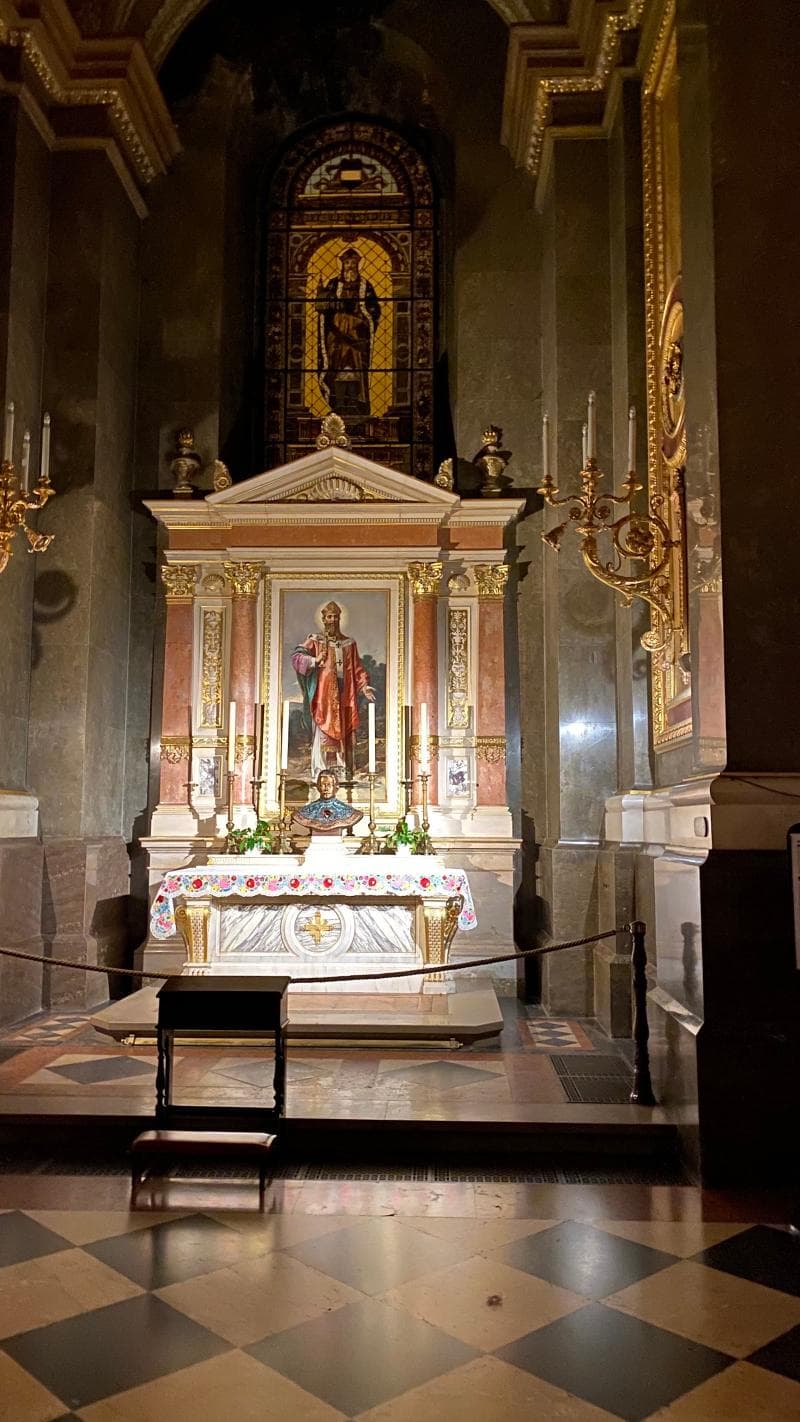
Explore the Main Nave of St. Stephen's Basilica in Budapest, Hungary, a neoclassical marvel housing the Holy Right Hand of St. Stephen.
Overview
Stepping into the Main Nave of St. Stephen’s Basilica in Budapest, Hungary, is an experience that immediately conveys grandeur and deep historical resonance. This monumental Roman Catholic basilica, dedicated to Hungary's first king, St. Stephen, stands as a prominent architectural masterpiece in the city. Its neoclassical and neo-Renaissance design, characterized by a Greek cross floor plan, culminates in a soaring dome that reaches 96 meters, symbolically matching the height of the Hungarian Parliament Building. This equal height was deliberately chosen to represent the balance between worldly and spiritual power within Hungary. The basilica is not only the largest church in Budapest but also among the largest in Hungary, capable of accommodating around 8,500 people. The sheer scale and intricate detailing of the Main Nave, with its towering columns, elaborate mosaics, and rich adornments, immediately capture a visitor's attention, offering a powerful sense of awe and reverence.
History & Cultural Background
The construction of St. Stephen's Basilica was a monumental undertaking, spanning over 50 years from its commencement in 1851 to its consecration in 1905. The project was led by three prominent architects: József Hild, Miklós Ybl, and József Kauser. Hild began with a neoclassical design, but after his death in 1867, Miklós Ybl took over, introducing significant neo-Renaissance elements. A dramatic setback occurred in 1868 when the partially built dome collapsed due to construction faults and inferior materials, requiring extensive demolition and reconstruction. Following Ybl’s death in 1891, József Kauser completed the project, focusing on the interior design. The basilica’s origin is also rooted in gratitude; after a devastating flood in 1838, the high ground where the basilica now stands offered refuge, leading survivors to donate towards building a church there.
What Makes It Special
The Main Nave is the central artery of this magnificent edifice, leading to the breathtaking main altar, which is adorned with gilded ornaments and elaborate statues. One of the basilica's most sacred treasures, the mummified right hand of St. Stephen – known as the Holy Right Hand or Szent Jobb – is housed in a specially designed reliquary within a chapel accessible from the nave. This nearly 1,000-year-old relic holds immense spiritual and national significance for Hungarians. The interior is a feast for the eyes, featuring ornate marble columns, gold leaf detailing, and stunning mosaics that depict scenes from the life of St. Stephen and Hungarian religious history. The dome's interior is particularly striking, adorned with frescoes and mosaics by Károly Lotz, including a representation of God the Father, prophets, and evangelists. The grandeur of the nave, with its intricately designed vaulted ceiling, is further enhanced by the rich variety of materials used, including over 50 different types of marble.
Stories, Fun Facts & Local Details
A fascinating detail about the basilica is the statue of St. Stephen on the main altar, which required special papal permission for its placement due to its deviation from traditional Catholic depictions. The basilica is home to Hungary's largest bell, the St. Stephen Bell, weighing 9,250 kilograms and measuring 252 centimeters in diameter. It resides in the southern tower and is rung only on special occasions, such as August 20th (St. Stephen's Day) and New Year's Eve. Speaking of St. Stephen's Day, the Holy Right Hand is ceremoniously paraded through the city on this national holiday, a tradition that draws many onlookers. The basilica also holds a unique connection to Hungarian sporting history, as it is the final resting place of Ferenc Puskás, the legendary Hungarian football player, whose remains are interred here. The construction delays and the infamous dome collapse became a source of local jokes among the citizens of Pest during the building period.
Visitor Perspective
For a curious traveler, entering the Main Nave of St. Stephen’s Basilica offers an immediate sense of wonder. The sheer volume and height of the space, combined with the dazzling display of art and craftsmanship, create an atmosphere that is both serene and powerful. The play of natural light through the stained-glass windows illuminates the intricate details of the frescoes and gilded accents, making the interior truly spectacular. While access to the main nave for quiet prayer is often free, gaining full access to explore various sections, including the treasury and the panoramic dome, typically requires a ticket. Visitors often describe feeling a profound sense of history and spirituality. Even for those without a religious background, the basilica stands as a testament to human endeavor, artistic achievement, and cultural resilience. Its active role in Budapest’s cultural life, hosting organ concerts and religious services, adds to its vibrant appeal, making every visit a potentially unique experience.
Coordinates: 19.05399, 47.50085
View on Google Maps💬 How Travelers Describe This Place
Based on community votes
Interesting
494Must See
242Photogenic
193Unique
125Beautiful
82
Traveler Stories
Discover memorable experiences shared by travelers who have visited this place.
No traveler stories yet.
Be the first traveler to share what made this place memorable.

Tour
By
Spot
Discover amazing places around the world. Your journey starts here.
Explore
© 2026 TourBySpot. All rights reserved.