St. Peter's Basilica
Rome, Italy
Explore St. Peter's Basilica in Rome, Italy – a monumental masterpiece, sacred pilgrimage site, and home to incredible art and history.
Overview
St. Peter's Basilica, or the Papal Basilica of Saint Peter in the Vatican, stands as an unparalleled monument of faith, art, and history in the heart of Vatican City, an independent microstate nestled within Rome, Italy. It holds a unique position in the Christian world, regarded as one of the holiest Catholic shrines and often described as 'the greatest of all churches of Christendom'. While not the cathedral of Rome, it is the principal papal basilica and a major pilgrimage site, drawing millions of visitors and worshippers annually.
Its colossal scale is immediately apparent; St. Peter's is the largest church in the world by interior measure, with a length of 220 meters and a height of 136.6 meters to the top of its iconic dome. It boasts a capacity to hold 60,000 standing and 20,000 seated individuals. This architectural marvel is also a UNESCO World Heritage site, celebrated for its incredible architecture and profound historical significance.
History & Cultural Background
The story of St. Peter's Basilica begins over the believed burial site of Saint Peter, chief among Jesus's apostles and the first Bishop of Rome. Catholic tradition holds that his tomb lies directly beneath the basilica's high altar. The first basilica on this site, known as Old St. Peter's Basilica, was commissioned by Emperor Constantine the Great in the 4th century, around 315 AD, and consecrated in 326 AD. It served as a significant center of Christian worship for over a millennium.
By the early 16th century, the ancient basilica was in disrepair, leading Pope Julius II to initiate plans for a grand new structure. Construction of the present basilica began on April 18, 1506, marking the start of one of the most ambitious architectural undertakings in history. The project spanned over 120 years and involved many of the Italian Renaissance's and Baroque's most celebrated artists and architects, including Donato Bramante, Michelangelo, Raphael, Carlo Maderno, and Gian Lorenzo Bernini. The basilica was finally completed on November 18, 1626, under Pope Urban VIII.
What Makes It Special
St. Peter's Basilica is a treasure trove of artistic and architectural masterpieces. Its most striking feature is Michelangelo's magnificent dome, which rises majestically over the Vatican skyline and offers breathtaking views of Rome. Inside, Bernini's monumental bronze Baldacchino, a towering canopy over the papal altar, draws the eye immediately. It was commissioned by Pope Urban VIII and completed in 1633, symbolizing the church's grandeur and marking the spot directly above St. Peter's tomb.
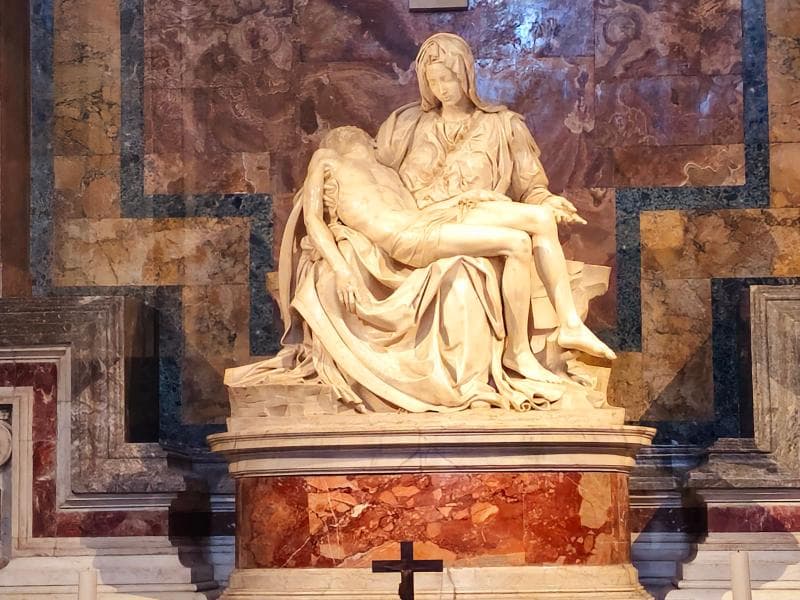
Among the countless artworks, Michelangelo's 'Pietà' is a poignant and powerful sculpture depicting Mary cradling the body of Christ. Carved when Michelangelo was just 24, it is the only work he ever signed. The basilica also houses the Cathedra Petri, or the Chair of Saint Peter, another stunning work by Bernini, encased within a glorious bronze monument.
Stories, Fun Facts & Local Details
One fascinating aspect is the Vatican Necropolis, located beneath the basilica. This ancient Roman burial ground contains early Christian tombs, including what is believed to be St. Peter's tomb. Visitors can explore this sacred site, tracing the path to the original basilica's foundations. The Vatican Grottoes, situated on a lower level of the basilica, house the tombs of numerous popes, cardinals, and monarchs.
St. Peter's Square, designed by Gian Lorenzo Bernini in the mid-17th century, serves as a monumental approach to the basilica. Its elliptical shape, embraced by colonnades topped with 140 statues of saints, is said to symbolize the arms of the church reaching out to welcome the faithful. The Pope often presides at liturgies here, drawing tens of thousands for events like the 'Urbi et Orbi' blessing on Easter Sunday and Christmas Eve.
Visitor Perspective
Visiting St. Peter's Basilica is an awe-inspiring experience. While entry to the main basilica itself is free, certain areas, such as climbing the dome for panoramic views or visiting the Vatican Necropolis, require a ticket or special arrangements. It is highly recommended to dress respectfully, with shoulders and knees covered, as a strict dress code is enforced.
The basilica is generally open from early morning until late afternoon, though hours can vary and it may close during papal masses or other special events. Given its popularity, arriving early or booking tours in advance is advisable to avoid long queues and fully appreciate the spiritual and artistic grandeur of this iconic landmark.
Coordinates: 12.4533, 41.9022
View on Google Maps💬 How Travelers Describe This Place
Based on community votes
Photogenic
996Must See
953Beautiful
658Interesting
585Unique
69
Traveler Stories
Discover memorable experiences shared by travelers who have visited this place.
No traveler stories yet.
Be the first traveler to share what made this place memorable.
Things to see at St. Peter's Basilica



Tour
By
Spot
Discover amazing places around the world. Your journey starts here.
Explore
© 2026 TourBySpot. All rights reserved.