St. Patrick's Cathedral
Dublin, Ireland
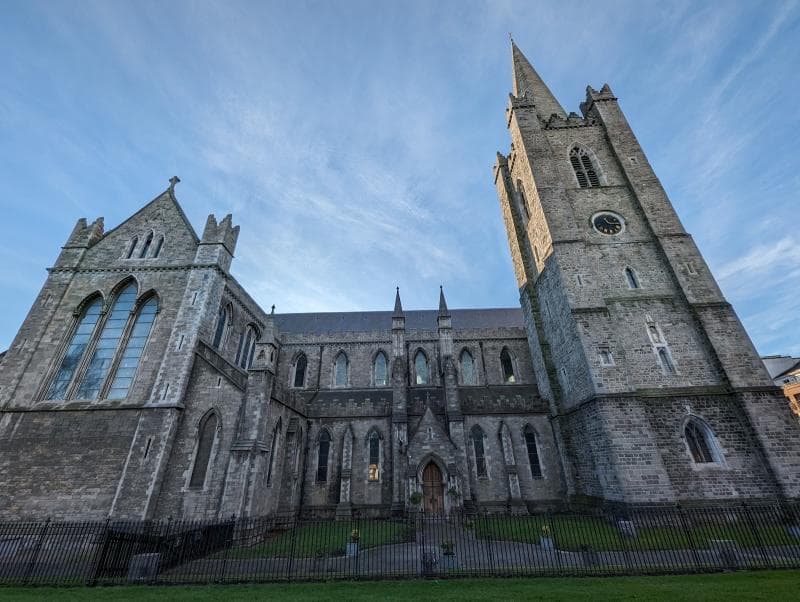
Explore St. Patrick's Cathedral in Dublin, Ireland. Discover its 800-year history, stunning Gothic architecture, and unique stories, including Jonathan Swift's tomb.
Overview
Nestled in the vibrant heart of Dublin, Ireland, St. Patrick's Cathedral stands as a magnificent testament to centuries of Irish history, spirituality, and architectural prowess. It is not only the largest church in Ireland but also the National Cathedral of the Church of Ireland, a distinction it has held since 1870. More than just a place of worship, this grand Gothic edifice serves as a pivotal cultural landmark, drawing visitors from across the globe to explore its rich heritage and stunning beauty.
Its very foundation is steeped in legend, believed to be the site where Ireland's patron saint, Saint Patrick, baptised early Christian converts over 1,500 years ago. Today, the cathedral offers a serene escape, inviting travellers to delve into its profound past and appreciate its enduring significance to the city of Dublin and the wider nation.
History & Cultural Background
The history of St. Patrick's Cathedral is a long and complex tapestry, woven through more than 800 years. While tradition places Saint Patrick himself here in the 5th century, the official founding of the collegiate church dates back to 1191 by John Comyn, the first Anglo-Norman Archbishop of Dublin. Construction of the present Gothic structure largely took place between 1220 and 1260, evolving from an earlier church. It became a cathedral in 1213.
Over the centuries, St. Patrick's has witnessed immense change, surviving wars, revolutions, and the Reformation, during which it transitioned to an Anglican (Church of Ireland) church. The building has undergone various modifications and restorations, most notably a significant restoration in the 19th century funded by Sir Benjamin Lee Guinness. This period of renewal helped preserve the cathedral's medieval charm while adding new elements, ensuring its survival as a spiritual and cultural beacon.
What Makes It Special
St. Patrick's Cathedral is a masterwork of Gothic architecture, immediately recognisable by its soaring vaulted ceilings, impressive pointed arches, and the longest nave in Ireland. The exterior is adorned with intricate stone carvings and flying buttresses, supporting a grand structure that spans 91 metres externally and features an imposing 43-metre-tall bell tower. Inside, visitors are greeted by a wealth of artistic and historical treasures.
Among its most cherished features are beautiful stained-glass windows, medieval tombs, and elaborately carved choir stalls. The Lady Chapel, dating from the 13th century, provides a peaceful space for reflection. The cathedral also houses the famous 'Door of Reconciliation,' a testament to a unique historical event. Furthermore, it is home to a world-famous choir, founded in 1432, which continues to perform daily during school terms, enriching the cathedral's spiritual atmosphere.
Stories, Fun Facts & Local Details
One of the most captivating tales associated with St. Patrick's Cathedral is the origin of the phrase 'to chance your arm.' In 1492, during a feud between the Butler and FitzGerald families, the Butlers took refuge in the Chapter House. To propose a truce, Gerald FitzGerald, the Earl of Kildare, cut a hole in the door and extended his arm through it, trusting the Butlers not to harm him. This courageous act led to reconciliation, giving rise to the well-known idiom. The original door, with the cut-out, is preserved within the cathedral.
Another famous figure deeply intertwined with the cathedral's history is Jonathan Swift, the celebrated author of 'Gulliver's Travels,' who served as Dean from 1713 to 1745. His tomb, along with that of his lifelong companion Esther Johnson (Stella), can be found within the cathedral walls. The cathedral also holds significant historical artifacts, including the tomb of Strongbow, a key Anglo-Norman figure in Irish history.
Visitor Perspective
A visit to St. Patrick's Cathedral is an immersive journey through Ireland's past. The cathedral offers a balance of history, architectural marvel, and cultural insight. Visitors can explore the interior through self-guided tours, often enhanced by audio guides available in multiple languages. For those seeking deeper understanding, free guided tours are typically available throughout the day, though it's always wise to confirm times upon arrival.
Beyond its historical exhibits, the cathedral remains an active place of worship, with services held regularly. It also features a Discovery Space that incorporates modern technology to bring its long history to life, including sounds from the choir. The cathedral is conveniently located at the junction of Patrick Street and Upper Kevin Street, easily accessible on foot from the city centre. Surrounding the cathedral, St. Patrick's Park provides a tranquil green space, offering picturesque views of the magnificent structure and a place for quiet contemplation in the heart of Dublin.
Coordinates: -6.2695, 53.337
View on Google Maps💬 How Travelers Describe This Place
Based on community votes
Beautiful
728Unique
481Must See
382Interesting
183Photogenic
28
Traveler Stories
Discover memorable experiences shared by travelers who have visited this place.
No traveler stories yet.
Be the first traveler to share what made this place memorable.
Things to see at St. Patrick's Cathedral



Tour
By
Spot
Discover amazing places around the world. Your journey starts here.
Explore
© 2026 TourBySpot. All rights reserved.