Baptistry
Dublin, Ireland
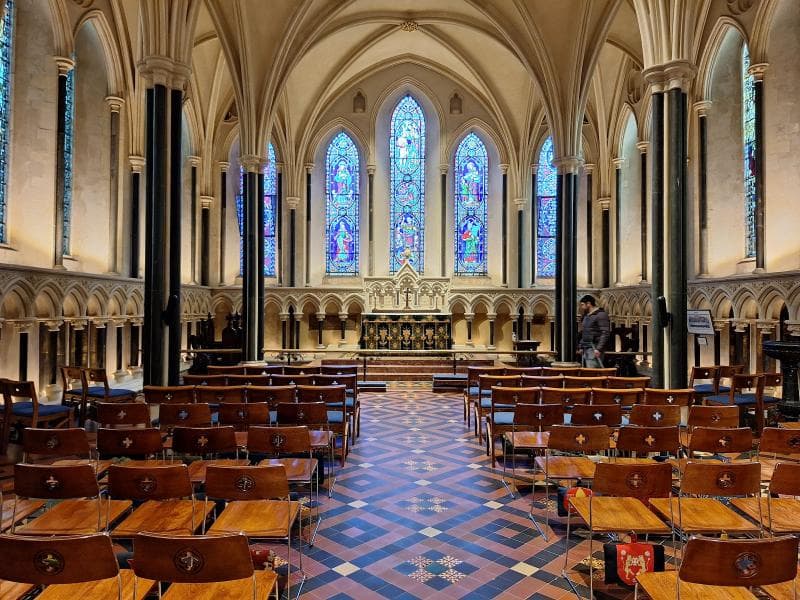
Discover the Baptistry at St. Patrick's Cathedral, Dublin, Ireland – the ancient site where St. Patrick himself reputedly baptized converts in the 5th century.
Overview
Deep within the venerable walls of St. Patrick's Cathedral in Dublin, Ireland, lies a sub-spot of profound historical and spiritual significance: the Baptistry. More than just a designated area for the sacrament of baptism, this location holds a direct, tangible link to the very origins of Christianity in Ireland. It is revered as the traditional site of a holy well where Saint Patrick himself is believed to have baptized converts to Christianity in the 5th century. This makes the Baptistry, or the site it occupies, the oldest Christian site in Dublin, pre-dating the cathedral structure by centuries.
For any curious traveler, visiting the Baptistry offers a unique opportunity to connect with Ireland's patron saint and witness a place where faith has been continuously practiced for over a millennium and a half. While the current magnificent Gothic cathedral largely dates from the 12th and 13th centuries, the essence of its spiritual foundation rests firmly in this ancient ground.
History & Cultural Background
The story of St. Patrick's Cathedral begins not with grand stone architecture, but with a simple well. Legend holds that in the 5th century, Saint Patrick, Ireland's patron saint, traveled throughout the island converting the pagan population to Christianity. During his time in Dublin, he is said to have used a holy well located on this very site to baptize new believers.
This ancient well, alongside a small wooden church, marked the genesis of Christian worship in this specific part of Dublin. Later, in 1191, John Comyn, the first Anglo-Norman Archbishop of Dublin, elevated the church dedicated to Saint Patrick to collegiate church status, paving the way for the construction of the present stone cathedral.
Archaeological findings further support the site's ancient roots. In 1901, during building works adjacent to the Cathedral, Celtic grave slabs dating to the 10th century were unearthed. One significant discovery was a large stone covering what appeared to be an ancient well, possibly the same one Saint Patrick used. This remarkable find reinforces the enduring legacy of the site as a place of early Christian conversion and burial.
What Makes It Special
The Baptistry at St. Patrick's Cathedral stands out not for elaborate architectural grandeur, but for its profound historical resonance. What makes it truly special is its unbroken, centuries-old connection to Saint Patrick himself and the formative period of Christianity in Ireland. Few places offer such a direct, tangible link to the life and work of a national patron saint.
It represents the bedrock upon which the entire cathedral—and indeed, much of Irish Christian identity—was built. While the cathedral has undergone numerous transformations, fires, and restorations over its 800-year history, the area of the Baptistry is cited as one of the few places where elements of the earliest work remain.
Visiting this spot is an encounter with the deep past, a reminder of the foundational acts that shaped a nation's spiritual landscape. It is a place where countless generations have begun their spiritual journeys through baptism, continuing a tradition reputedly started by Saint Patrick himself.
Stories, Fun Facts & Local Details
- The Ancient Well: The central story revolving around the Baptistry is that of the holy well. It's a powerful image: Saint Patrick, standing at this very spot, using the waters of Dublin to welcome new followers into the Christian faith. This tradition is deeply embedded in the cathedral's identity.
- Archaeological Confirmations: The discovery of the ancient well in 1901 was a thrilling moment, offering compelling evidence for the historical claims. Finding this well, possibly covered by 10th-century Celtic grave slabs, provides a physical link across the centuries to the earliest days of Christian Dublin.
- Enduring Significance: Even with the grandeur of the main cathedral, the spiritual weight of this humble site has never diminished. It reminds visitors that profound historical events often occur in unassuming places.
- Continuity of Faith: The act of baptism continues in the cathedral to this day, symbolically connecting contemporary congregants with the historical conversions of the 5th century, emphasizing the enduring nature of faith.
Visitor Perspective
As you stand within the Baptistry, a sense of awe is almost inevitable. You are not just observing an old structure, but occupying a space where the distant past feels remarkably close. It is a place for quiet contemplation, offering a profound moment to reflect on the immense sweep of history and the enduring power of faith.
Imagine the early converts, perhaps even Saint Patrick himself, at this very spot, participating in a rite that has spanned over fifteen centuries. The simplicity of the concept—a well, a baptism, the beginning of a spiritual journey—contrasts beautifully with the elaborate Gothic architecture surrounding it. It is a humble yet mighty testament to the enduring legacy of Ireland's patron saint and the continuous thread of Christianity in Dublin. This sacred corner of St. Patrick's Cathedral is a powerful reminder of how deeply history and spirituality are intertwined in the heart of Ireland.
Coordinates: -6.2695, 53.337
View on Google Maps💬 How Travelers Describe This Place
Based on community votes
Beautiful
747Must See
399Unique
302Photogenic
172Interesting
79
Traveler Stories
Discover memorable experiences shared by travelers who have visited this place.
No traveler stories yet.
Be the first traveler to share what made this place memorable.

Tour
By
Spot
Discover amazing places around the world. Your journey starts here.
Explore
© 2026 TourBySpot. All rights reserved.