Nave
Dublin, Ireland
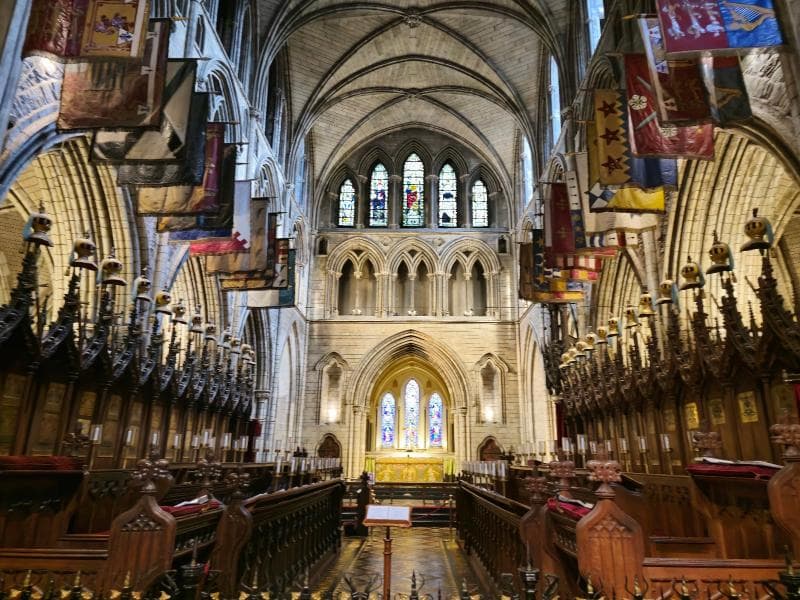
Explore the majestic Nave of St. Patrick's Cathedral in Dublin, Ireland. Discover its Gothic architecture, rich history, and cultural significance.
Overview
The Nave of St. Patrick's Cathedral in Dublin, Ireland, forms the majestic central body of this national cathedral, inviting visitors into centuries of Irish history and spiritual life. As the largest church in Ireland, St. Patrick's Cathedral, founded in 1191, stands as a prominent example of Gothic architecture. The Nave, stretching from the entrance to the choir, is the primary space where congregations gather, reflecting the cruciform layout typical of medieval cathedrals. Its imposing scale and architectural details immediately convey the cathedral's enduring significance as both a place of worship and a historical landmark.
This magnificent section of the cathedral has witnessed profound changes over more than 800 years, from its medieval origins to its role as the National Cathedral of the Church of Ireland today. It has been a silent observer of Dublin's evolution, embodying a rich tapestry of faith, conflict, and restoration. Visitors walking through the Nave are surrounded by the legacy of countless individuals who have passed through its doors, from ordinary parishioners to figures of immense historical importance.
History & Cultural Background
The current St. Patrick's Cathedral building, including its Nave, largely dates from a significant construction period between 1220 and 1259, built on the site of an earlier church and a holy well believed to have been used by Saint Patrick himself. Archbishop Luke oversaw the construction of this Gothic masterpiece, designed in a cruciform shape with the Nave forming the long arm of the cross. This medieval structure replaced what was likely a wooden church, utilizing local limestone and imported stone from Bristol.
The Nave's history is marked by periods of both grandeur and adversity. In 1544, during the Reformation, neglect contributed to the collapse of the Nave, a poignant reminder of the turbulent religious shifts occurring in Ireland. Following this, during Oliver Cromwell's stay in Dublin in the 17th century, his forces reportedly stabled horses in the Nave, a powerful symbol of disrespect towards the Anglican religion of the time. These events underscore the Nave's role as a silent witness to major historical and political upheavals. The west Nave was also rebuilt between 1362 and 1370 after a fire, under the supervision of Archbishop Thomas Minot.
A critical period of restoration occurred between 1860 and 1865, largely funded by Sir Benjamin Lee Guinness. This extensive work concentrated on the Nave and transepts, including the addition of a new ceiling and the raising of the Nave floor to align with the Choir. This massive undertaking ensured the preservation of the cathedral's architectural integrity for future generations.
What Makes It Special
The Nave's striking architecture and immense scale are immediately captivating. Its Gothic style, characterized by pointed arches, ribbed vaults, and tall, slender columns, creates an atmosphere of soaring grandeur. As you gaze upwards, the intricate stone carvings and the play of light from the stained-glass windows, particularly the expansive west window, draw your eye. While the current ceiling is a result of 19th-century renovations, it still contributes to the majestic feel of the space.
Beyond its architectural beauty, the Nave holds a unique national significance. Since 1870, St. Patrick's has been designated as the National Cathedral for the whole of Ireland by the Church of Ireland, distinguishing it from Christ Church Cathedral, which serves as the diocesan cathedral for Dublin and Glendalough. This status means the Nave has hosted countless national services and ceremonies, playing a central role in the spiritual life of the country.
Stories, Fun Facts & Local Details
One of the most intriguing aspects of the Nave is its connection to the celebrated satirist and author, Jonathan Swift, who served as Dean of St. Patrick's Cathedral from 1713 to 1745. His tomb, along with that of Esther Johnson (Stella), lies within the cathedral, making the Nave a place of pilgrimage for literary enthusiasts.
Another fascinating detail is the occasional use of the Nave for grand civic and cultural events. Its spaciousness and unique architecture make it an ideal setting for large gatherings, from banquets to cocktail receptions, offering a truly distinctive backdrop steeped in history. Imagine the echoes of Handel's 'Messiah,' which had its first public performance in Dublin in 1742, although not in the Cathedral itself, the long tradition of sacred music here adds to the resonant history of the space. The cathedral choir, with its rich history, still performs regularly, filling the Nave with beautiful melodies.
The restoration by Sir Benjamin Lee Guinness in the 19th century was a monumental undertaking, saving the cathedral from significant decay. His commitment to preserving this national treasure ensures that the Nave continues to stand as a testament to Irish heritage.
Visitor Perspective
Walking into the Nave of St. Patrick's Cathedral is an experience that transcends mere sightseeing; it's an immersion in history and spirituality. The sheer scale can feel overwhelming yet profoundly peaceful. Visitors can explore the Nave at their own pace, often with the aid of multi-lingual audio guides that enrich the experience by providing context to the architectural marvels and historical narratives.
The Nave is wheelchair accessible, and free guided tours are offered regularly throughout the day, providing deeper insights into its storied past. Observing the intricate details, from the memorials embedded in the floor to the lofty vaulted ceiling, allows for quiet contemplation and appreciation of the craftsmanship of past eras. Whether you are drawn by its architectural grandeur, its historical significance, or its spiritual ambiance, the Nave offers a compelling journey through the heart of one of Ireland's most cherished landmarks.
Coordinates: -6.2695, 53.337
View on Google Maps💬 How Travelers Describe This Place
Based on community votes
Interesting
585Beautiful
550Photogenic
546Unique
56Must See
28
Traveler Stories
Discover memorable experiences shared by travelers who have visited this place.
No traveler stories yet.
Be the first traveler to share what made this place memorable.

Tour
By
Spot
Discover amazing places around the world. Your journey starts here.
Explore
© 2026 TourBySpot. All rights reserved.