Piazza Navona
Rome, Italy
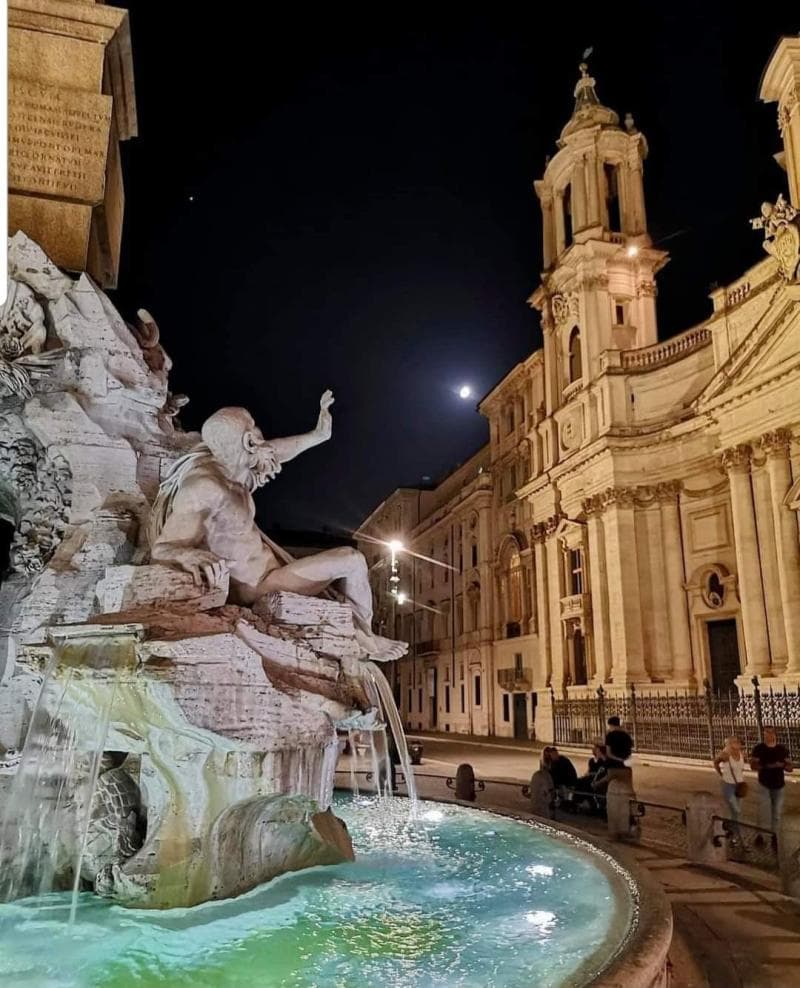
Discover Piazza Navona, Rome's stunning Baroque square built on Domitian's Stadium. Admire Bernini's fountains and Borromini's church in Italy's vibrant heart.
Overview
Piazza Navona, nestled in the heart of Rome, Italy, is a vibrant public square renowned for its stunning Baroque architecture and lively atmosphere. This iconic piazza is a masterpiece of urban design, an open-air museum where history, art, and daily Roman life converge. Its distinctive elongated oval shape immediately captures the eye, a direct nod to its ancient origins as a Roman stadium. Adorned with magnificent fountains, including Bernini's celebrated Fontana dei Quattro Fiumi, and surrounded by elegant palaces and a grand church, Piazza Navona offers an unforgettable experience for every traveler.
History & Cultural Background
The story of Piazza Navona stretches back nearly two millennia. It was originally the site of the Stadium of Domitian, commissioned by Emperor Titus Flavius Domitianus in 80 AD (or 86 CE) to host athletic competitions, known as 'agones.' This ancient arena, also called 'Circus Agonalis,' had a capacity of around 30,000 spectators and was Rome's first permanent Greek-style athletic venue, featuring foot races, wrestling, and other contests, but notably not gladiatorial combat or chariot races. The name 'Navona' itself is believed to be a linguistic evolution from the Latin 'in agone,' meaning 'in competition,' which eventually transformed into 'Navone' and then 'Navona.'
After the fall of the Western Roman Empire, the stadium fell into disuse and ruin, its materials sometimes quarried for other buildings. By the late 15th century, the area had transformed into a bustling market square. The piazza as we largely know it today took shape in the 17th century under the patronage of Pope Innocent X, who reigned from 1644 to 1655. His family palace, the Palazzo Pamphili, faced the square, and he sought to transform it into a grand showcase for his family's power and prestige. This ambitious renovation involved some of the greatest Baroque artists of the era, notably Gian Lorenzo Bernini and Francesco Borromini, whose artistic rivalry famously shaped much of Rome's Baroque landscape.
What Makes It Special
Piazza Navona stands out as a quintessential example of Baroque Roman architecture and art. Its grandeur is primarily defined by three magnificent fountains and the architectural splendor of the surrounding buildings. At its heart lies Bernini's spectacular 1651 Fontana dei Quattro Fiumi (Fountain of the Four Rivers), a dramatic sculptural group featuring allegorical representations of the four major rivers of the continents known at the time: the Nile, Danube, Ganges, and Rio de la Plata. An ancient Egyptian obelisk, originally brought to Rome for the Circus of Maxentius, rises majestically from its center.
At the southern end of the piazza is the Fontana del Moro (Fountain of the Moor), originally designed by Giacomo della Porta in 1575, with Bernini later adding the dynamic statue of a Moor wrestling a dolphin in 1673. The northern end features the Fontana del Nettuno (Fountain of Neptune), also by Giacomo della Porta, with the impressive statue of Neptune battling an octopus added in 1878 to complement its southern counterpart. Dominating the western side of the square is the Church of Sant'Agnese in Agone, a Baroque masterpiece primarily designed by Francesco Borromini, directly facing Bernini's Fountain of the Four Rivers.
Stories, Fun Facts & Local Details
Piazza Navona is steeped in captivating stories and local traditions. One of the most fascinating is the 'Lake of Piazza Navona' tradition. For nearly two centuries, up until the mid-19th century, the square was intentionally flooded on summer weekends, often in August. Drains were blocked, allowing water from the fountains to fill the square to a shallow depth, creating a vast temporary lake where Romans could cool off, enjoy boat rides, and witness elaborate celebrations of the Pamphili family.
The artistic rivalry between Bernini and Borromini is legendary, with many anecdotes surrounding their works in the piazza. While largely anecdotal, one popular tale suggests that Bernini's figure of the Nile in the Fountain of the Four Rivers covers its face in apparent disgust at Borromini's facade of Sant'Agnese in Agone across the square. Beyond the grand art, the piazza has always been a hub for public life. It hosts a vibrant Christmas market each year from early December to early January, continuing a tradition of festive gatherings.
Just a short walk from Piazza Navona, you can also find the 'talking statue' of Pasquino, one of Rome's oldest and most famous. Since the 16th century, anonymous satirical verses and political critiques, known as 'pasquinades,' have been posted on this ancient statue, offering a unique glimpse into Roman public opinion through the centuries.
Visitor Perspective
Piazza Navona is a public space, making it entirely free and accessible to visitors at all hours, allowing for a leisurely exploration of its beauty. To experience a more serene atmosphere, visiting early in the morning or late in the evening is recommended, when the crowds are thinner and the Baroque masterpieces are softly illuminated. During the day, the square buzzes with life, filled with street artists, musicians, portrait painters, and outdoor cafes, perfect for people-watching and soaking in the Roman ambiance.
For those eager to delve deeper into its ancient past, the underground remains of the Stadium of Domitian are open to visitors, offering a unique opportunity to walk through a 2,000-year-old Roman stadium beneath the modern piazza. While the cafes and restaurants directly on the square can be a bit pricier, they offer prime views of the majestic fountains and the surrounding architectural splendor. Piazza Navona's central location also makes it an ideal starting point or stop for exploring other major Roman landmarks, such as the Pantheon, which is just a 5-minute walk away.
Coordinates: 12.4733, 41.8993
View on Google Maps💬 How Travelers Describe This Place
Based on community votes
Beautiful
996Interesting
673Must See
585Unique
143Photogenic
80
Traveler Stories
Discover memorable experiences shared by travelers who have visited this place.
No traveler stories yet.
Be the first traveler to share what made this place memorable.
Things to see at Piazza Navona



Tour
By
Spot
Discover amazing places around the world. Your journey starts here.
Explore
© 2026 TourBySpot. All rights reserved.