Sant'Agnese in Agone
Rome, Italy
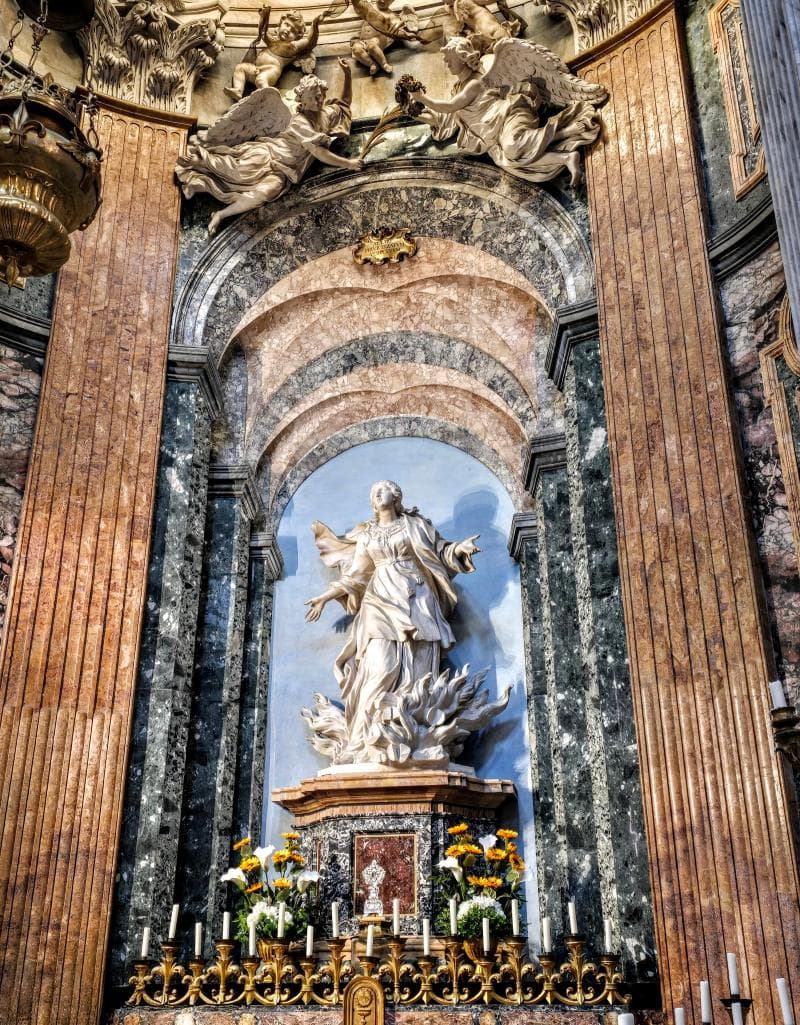
Discover Sant'Agnese in Agone, a stunning Baroque church in Rome, Italy. Explore its rich history, unique architecture, and the legends of Saint Agnes.
Overview
Nestled elegantly within the vibrant expanse of Piazza Navona in Rome, Italy, stands the magnificent Church of Sant'Agnese in Agone. This 17th-century Baroque masterpiece is more than just a church; it is a profound historical and architectural landmark, dedicated to the young Christian martyr Saint Agnes. Its prominent facade, a testament to Baroque artistry, directly faces Gian Lorenzo Bernini's iconic Fountain of the Four Rivers, creating one of Rome's most celebrated urban ensembles. The church's very name, 'in Agone', hints at its ancient roots, as it occupies the site of the former Stadium of Domitian, also known as the Circus Agonalis, where athletic contests—or 'agones'—once took place. Today, it draws visitors not only for its stunning beauty but also for the deep layers of history and spiritual significance it holds.
History & Cultural Background
The story of Sant'Agnese in Agone is deeply interwoven with Rome's rich papal history and the intense rivalries of its greatest Baroque architects. The church's construction began in 1652 under the impetus of Pope Innocent X Pamphili, whose family palace was adjacent to the site. The Pope envisioned it as a grand, almost private, chapel for his family, where he would eventually be entombed. Initial designs were laid out by Girolamo Rainaldi and his son Carlo Rainaldi. However, in 1653, the renowned architect Francesco Borromini took the reins, dramatically altering the plans to include his signature concave facade and a prominent dome, which became defining features of the church. Borromini's tenure was marked by creative brilliance but also by the complex politics and personality clashes of the era. Following Pope Innocent X's death in 1655 and Borromini's subsequent resignation amidst disputes, Carlo Rainaldi returned to complete the structure. The church was ultimately consecrated in 1672, a shining jewel of the Roman Baroque period, reflecting the power and artistic vision of its patrons and creators.
What Makes It Special
Sant'Agnese in Agone stands out for several compelling reasons, not least its exquisite Baroque architecture. Borromini's innovative design, particularly the undulating concave facade flanked by twin bell towers, masterfully draws the eye towards the central dome, creating a dynamic and visually engaging presence on Piazza Navona. Inside, the church reveals a lavish interior structured around a Greek cross plan, adorned with rich marble, gilding, and stucco work. The high dome features magnificent frescoes, notably 'The Apotheosis of Saint Agnes', begun by Ciro Ferri and completed by Sebastiano Corbellini, which creates an illusion of heavenly ascent. The church also houses important relics of Saint Agnes, including her skull, and a poignant marble relief by Alessandro Algardi depicting her miracle. The crypt, accessible via a staircase designed by Borromini himself, offers a glimpse into the ancient foundations of the church, including parts of the original Roman stadium.
Stories, Fun Facts & Local Details
The church is steeped in fascinating stories, beginning with its namesake, Saint Agnes. Legend holds that Agnes was a young noblewoman, barely twelve years old, who bravely upheld her Christian faith and chastity in the face of persecution around 304 AD. Refusing to marry the son of a Roman prefect, she was condemned to a brothel, where, according to lore, her hair miraculously grew to cover her nakedness. She was then subjected to fire, but the flames reputedly parted, leaving her unharmed, before she was ultimately martyred. Her name, 'Agnes,' signifying 'pure,' also remarkably echoes the Latin 'agnus' for lamb, a symbol often associated with her innocence and sacrifice.
Another famous tale revolves around the perceived rivalry between Borromini and Bernini, especially concerning Bernini's Fountain of the Four Rivers directly opposite the church. A popular, though apocryphal, story suggests that Bernini sculpted the River Nile figure with its head covered, as if recoiling in fear that Borromini's church facade might collapse. In reality, Bernini's fountain was completed before Borromini even began his work on the church's facade, making this a delightful but untrue anecdote that highlights the intense competition between the two Baroque masters. A unique architectural detail includes a private connection from the adjacent Palazzo Pamphili to the church's dome, allowing Pope Innocent X and his family to attend services discreetly. Beyond its religious functions, the Borromini Sacristy within the church frequently hosts classical concerts, adding a vibrant cultural dimension to its sacred space.
Visitor Perspective
Visiting Sant'Agnese in Agone offers a serene and enriching experience amidst the lively atmosphere of Piazza Navona. The church is typically open to visitors on weekdays (except Mondays) from 9:00 a.m. to 7:00 p.m., with a midday closure from 1:00 p.m. to 3:00 p.m. On Saturdays and Sundays, it generally extends its hours, opening from 9:00 a.m. to 8:00 p.m., also with a closure from 1:00 p.m. to 3:00 p.m. Entry is usually free, allowing everyone to step inside and appreciate its grandeur. While signs may restrict photography, many visitors choose to capture the stunning interior, often without intervention from custodians. For those keen to delve deeper, guided tours of the crypt are available, offering a direct connection to the ancient Roman history beneath the church. Whether you seek spiritual contemplation, architectural admiration, or a journey through Rome's layered past, Sant'Agnese in Agone provides a memorable encounter.
Coordinates: 12.4726, 41.89877
View on Google Maps💬 How Travelers Describe This Place
Based on community votes
Photogenic
953Unique
695Beautiful
396Must See
286Interesting
22
Traveler Stories
Discover memorable experiences shared by travelers who have visited this place.
No traveler stories yet.
Be the first traveler to share what made this place memorable.

Tour
By
Spot
Discover amazing places around the world. Your journey starts here.
Explore
© 2026 TourBySpot. All rights reserved.