Fontana del Moro
Rome, Italy
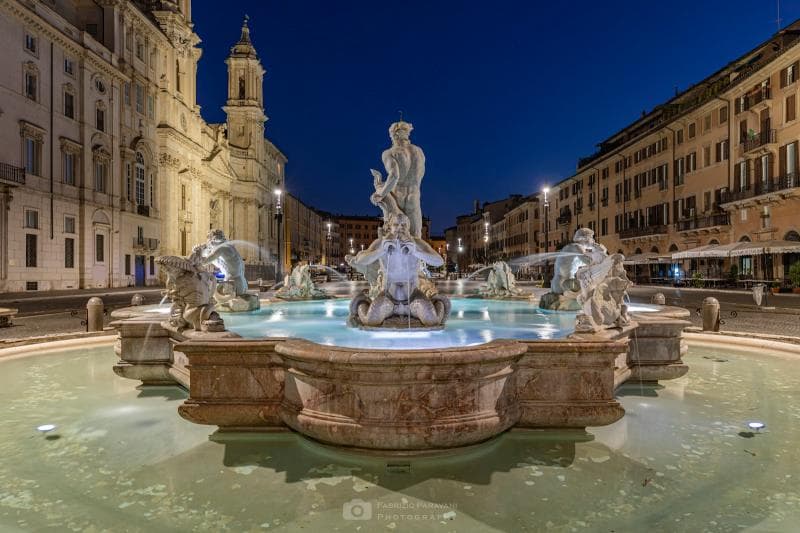
Discover the Fontana del Moro, a stunning Baroque fountain featuring a 'Moor' wrestling a dolphin, located at the southern end of Piazza Navona in Rome, Italy. Uncover its rich history and artistic evolution.
Overview
At the bustling southern end of Piazza Navona in Rome, Italy, visitors encounter the captivating Fontana del Moro, or 'Fountain of the Moor'. While its grander neighbor, the Fountain of the Four Rivers, often draws the immediate gaze, this fountain offers a more intimate and equally rich artistic experience. It is one of three significant fountains gracing the elongated square, a testament to Rome's enduring Baroque splendor. The Fontana del Moro features a dynamic central figure, often referred to as the 'Moor', engaged in a struggle with a dolphin, all surrounded by an ensemble of tritons and expressive masks. Its design represents a fascinating dialogue between Renaissance origins and Baroque transformation, making it a compelling stop for any curious traveler.
History & Cultural Background
The story of the Fontana del Moro begins in 1575, when Giacomo della Porta was commissioned by Pope Gregory XIII to design the original fountain. Della Porta's initial creation, fed by the ancient Aqua Virgo aqueduct, included a large rose-colored marble basin adorned with tritons, dragons, and masks, a common theme for public water features of the era. However, it lacked a central sculptural group.
For nearly eighty years, the fountain remained without a central figure. It was not until the mid-17th century, under Pope Innocent X Pamphili, that significant changes were initiated. Pope Innocent X, impressed by Gian Lorenzo Bernini's work on the Fountain of the Four Rivers, tasked him with renovating both end fountains in Piazza Navona. Between 1652 and 1655, Bernini contributed to the fountain's transformation, designing the powerful central figure that now dominates the composition. Although Bernini conceived the design, the marble statue was actually carved by his assistant, Giovanni Antonio Mari.
A notable historical detail is that the original tritons and masks crafted by della Porta's workshop were eventually removed during a restoration in 1874. Today, the figures one sees in the piazza are 19th-century copies sculpted by Luigi Amici, with the originals preserved in the Galleria Borghese. This blend of original and restored elements highlights the fountain's long and complex artistic journey.
What Makes It Special
The true essence of the Fontana del Moro lies in its dramatic central sculpture. The muscular figure, standing in a conch shell and wrestling a dolphin, exudes a powerful sense of movement and tension. This energetic portrayal is characteristic of Bernini's Baroque style, which sought to evoke emotion and dynamic engagement from the viewer. The interplay of water, which appears to stream from the dolphin's mouth and around the figures, further enhances this vitality, turning stone into a living spectacle.
The fountain's position at the southern end of the elliptical Piazza Navona provides a crucial counterpoint to Bernini's central Fountain of the Four Rivers and della Porta's Fountain of Neptune at the northern end. While the central fountain often garners the most attention, the Fontana del Moro offers a quieter, yet equally profound, experience of Roman Baroque art. Its rose-colored marble basin, a striking feature, adds to its distinctive character and elegance.
Stories, Fun Facts & Local Details
The central figure of the Fontana del Moro is commonly called the 'Moor' due to its distinct facial features. While some sources suggest it was initially intended to represent a triton or even Neptune, the term 'Moor' became popular, referring to a person of African descent—a descriptor that, in the Renaissance context, was not necessarily derogatory. Interestingly, there's an ongoing debate among art historians regarding whether Bernini explicitly intended to depict an African figure.
An intriguing anecdote surrounds Bernini's original proposal for the central statue. He initially designed a group known as 'della lumaca' (of the snail), featuring two dolphins supporting a seashell. However, this design failed to gain approval, reportedly at the insistence of Donna Olimpia Maidalchini, Pope Innocent X's influential sister-in-law, who held considerable sway over Vatican commissions. The rejected 'snail' sculpture was subsequently relocated to Villa Pamphili. Bernini's large terracotta model, or 'modello', for the approved central figure is now housed in the Kimbell Art Museum in Fort Worth, Texas, showcasing the master's preliminary vision.
In a more modern turn, the fountain suffered an act of vandalism in 2011 when a man attacked it with a rock, damaging some parts. Fortunately, diligent restoration efforts quickly repaired the masterpiece, allowing its beauty to endure. The fountain has also inspired local culture, with the Roman poet Giuseppe Gioacchino Belli dedicating one of his sonnets, 'Er Moro de Piazza Navona', to it, further cementing its place in the city's artistic soul.
Visitor Perspective
Visiting the Fontana del Moro is an essential part of experiencing the grandeur of Piazza Navona. Positioned at the square's southern tip, it's easily accessible and often provides a moment of relative tranquility compared to the bustling center. As you approach, take time to observe the intricate details of the sculptures and the lively play of water. The fountain's sculptural quality and historical depth make it a rewarding sight, best appreciated at a leisurely pace.
For photographers and art enthusiasts alike, the early morning or late afternoon hours are ideal. The softer light of dawn or dusk illuminates the rose-colored marble and the dynamic figures beautifully, and the crowds are typically thinner, allowing for a more reflective experience. While enjoying this splendid work of art, remember that bathing in the fountain, like all historical fountains in Rome, is strictly prohibited, ensuring its preservation for future generations to admire.
Coordinates: 12.473146, 41.898141
View on Google Maps💬 How Travelers Describe This Place
Based on community votes
Must See
836Beautiful
797Photogenic
695Interesting
396Unique
286
Traveler Stories
Discover memorable experiences shared by travelers who have visited this place.
No traveler stories yet.
Be the first traveler to share what made this place memorable.

Tour
By
Spot
Discover amazing places around the world. Your journey starts here.
Explore
© 2026 TourBySpot. All rights reserved.