Fountain of the Four Rivers
Rome, Italy
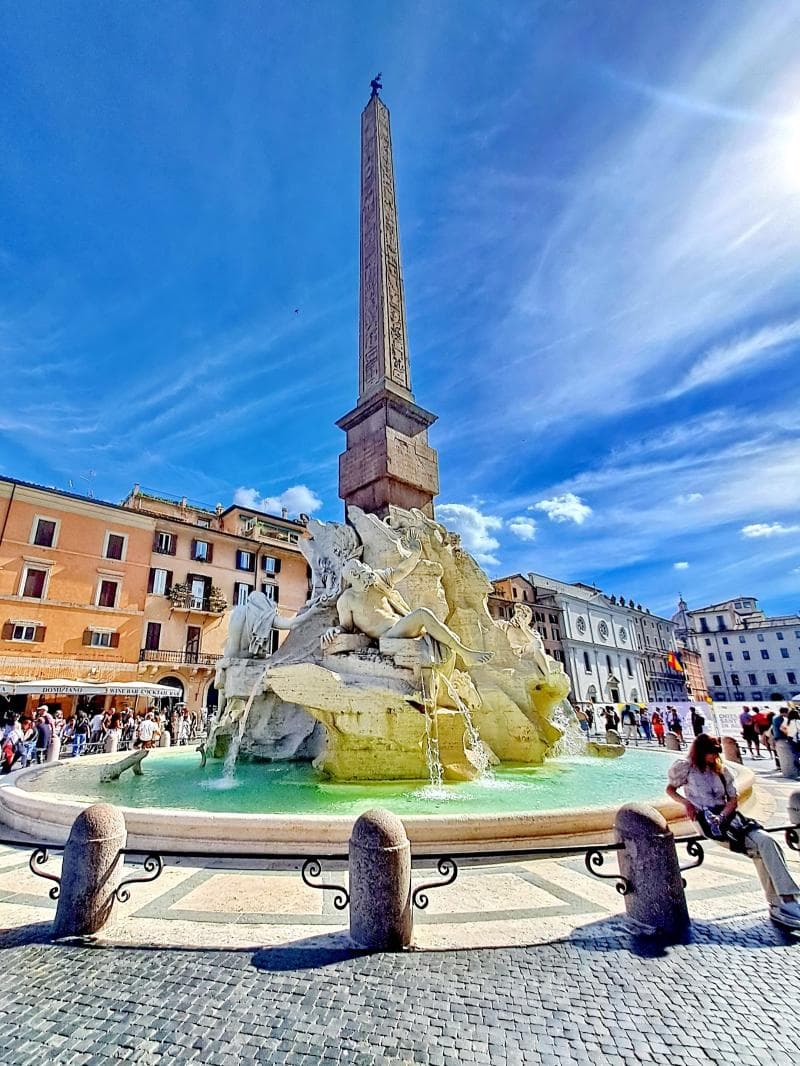
Discover Rome's iconic Fountain of the Four Rivers (Fontana dei Quattro Fiumi) in Piazza Navona. Explore its Baroque artistry, history, and symbolism.
Overview
At the heart of Rome's bustling Piazza Navona stands the magnificent Fountain of the Four Rivers, known in Italian as Fontana dei Quattro Fiumi. This iconic Baroque masterpiece, a creation of the celebrated artist Gian Lorenzo Bernini, commands attention with its dramatic sculptures and soaring obelisk. It serves as a breathtaking focal point in one of Rome's most vibrant public spaces, inviting visitors to pause and admire its intricate details and powerful symbolism. The fountain was unveiled in June 1651 and continues to amaze and entertain visitors to Rome.
The fountain is not merely an aesthetic marvel; it's a profound statement, representing four major rivers of the four continents known in the mid-17th century: the Nile (Africa), the Danube (Europe), the Ganges (Asia), and the Río de la Plata (the Americas). Each river god figure is surrounded by elements of flora and fauna characteristic of its continent, enriching the allegorical narrative. The entire composition is a dynamic blend of sculpture and architecture, embodying the exuberance of the Baroque era and offering a visual testament to the global reach of papal authority. The fountain's impressive scale and artistic brilliance make it an unmissable highlight for anyone exploring the Eternal City.
History & Cultural Background
The genesis of the Fountain of the Four Rivers is deeply intertwined with the ambitious urban redesign of Piazza Navona by Pope Innocent X Pamphilj. Elected in 1644, the Pope sought to transform the piazza into a grand monument reflecting the prestige and power of his family, whose palace, the Palazzo Pamphilj, faced the square.
Innocent X commissioned the fountain between 1648 and 1651. Initially, Bernini was out of favor with the Pamphilj papacy due to his close ties with the previous Barberini regime, the Pamphilj family's rivals. A competition was announced for designs, from which Bernini was implicitly excluded. However, Bernini, undeterred, ingeniously arranged for a silver model of his proposed fountain to be 'accidentally' seen by the Pope's influential sister-in-law, Olimpia Maidalchini, who then showed it to the Pope. Reportedly, upon seeing Bernini's model, Pope Innocent X declared that 'the only way to avoid employing Bernini was not to see his designs,' and immediately commissioned him to undertake the project. This turn of events cemented Bernini's legacy and resulted in one of Rome's greatest artistic achievements.
The fountain's base consists of a large elliptical basin at street level, from which travertine rocks rise, sculpted to mimic a natural grotto or rocky landscape. Perched atop this rugged terrain is an ancient Egyptian obelisk, known as the Agonal Obelisk, which had lain in pieces along the Appian Way since the 4th century. The obelisk is crowned with a bronze dove holding an olive branch, the heraldic emblem of the Pamphilj family, symbolizing peace and the Holy Spirit.
What Makes It Special
What truly sets the Fountain of the Four Rivers apart is its masterful fusion of sculpture, architecture, and engineering, creating a dynamic theatrical experience. Bernini's design created a sense of movement and vitality rarely seen before, making the water an integral part of the artwork, cascading over the carved rocks and figures. This innovative approach cemented its status as one of the highest expressions of Roman Baroque art.
Each of the four river gods, sculpted by Bernini's disciples under his direction, is a powerful personification. The Nile figure, sculpted by Giacomo Antonio Fancelli, has its head veiled, symbolizing the river's unknown source at the time. The Ganges, by Claude Poussin, carries a long oar, alluding to its navigability. The Danube, by Antonio Raggi, touches the papal coat of arms, signifying Europe's proximity to Rome and papal authority. Lastly, the Río de la Plata, by Francesco Baratta, sits on a pile of coins, representing the wealth of the Americas. These details, along with the accompanying animals like an armadillo, lion, and dragon, imbue the fountain with layered meaning. The massive Egyptian obelisk, rising dramatically from the center, further emphasizes the fountain's grandeur and its symbolic connection to ancient Rome and papal power.
Stories, Fun Facts & Local Details
The Fountain of the Four Rivers is steeped in anecdotes, particularly regarding the famous rivalry between its designer, Gian Lorenzo Bernini, and his contemporary, Francesco Borromini, who was responsible for the Church of Sant'Agnese in Agone, located directly opposite the fountain.
One popular, though historically inaccurate, legend claims that Bernini designed the Nile god with a veiled head to express disdain for Borromini's church, as if to shield its eyes from the 'eyesore'. Another tale suggests the Río de la Plata figure raises its hand to protect itself from the supposed instability of Borromini's facade, or from the church's potential collapse. In reality, the fountain was completed in 1651, a year before work on the church of Sant'Agnese in Agone even began in 1652, making these delightful stories pure Roman folklore, albeit enduring ones that add to the charm of the piazza. The veiled head of the Nile actually symbolizes its then-unknown source.
Until the 19th century, Piazza Navona would occasionally be flooded in August by closing the drains of the fountains. This transformed the square into a grand 'lake,' providing Romans with a unique summer spectacle and a way to cool down in the sweltering heat. The fountain's intricate details extend to various animals, such as a horse, sea monster, serpent, dolphin, crocodile, lion, and dragon, each adding to the exotic and symbolic narrative.
Visitor Perspective
Visiting the Fountain of the Four Rivers is an immersive experience. Situated centrally in the expansive Piazza Navona, the fountain is freely accessible and can be admired from all angles. The piazza itself is a vibrant hub, alive with street artists, musicians, and outdoor cafes, creating a lively backdrop for Bernini's masterpiece. Approaching the fountain, its colossal scale and dynamic composition immediately captivate the eye. The sound of water splashing and cascading contributes to the overall sensory experience, making the sculptures seem to come alive.
Whether you visit during the day, when the sunlight illuminates every detail of the travertine and marble, or in the evening, when the fountain is dramatically lit, its beauty is undeniable. Early mornings offer a more serene experience before the crowds gather, allowing for a more intimate appreciation of the artwork. Take your time to walk around the fountain, observing each river god and the symbolic creatures and plants that accompany them. Notice the intricate carvings, the powerful expressions of the figures, and the clever illusion of the heavy obelisk seemingly supported by the carved rocks. The Fountain of the Four Rivers is not just a monument; it is a theatrical display of Baroque artistry, offering endless details to discover for the curious traveler.
Coordinates: 12.4731, 41.8987
View on Google Maps💬 How Travelers Describe This Place
Based on community votes
Interesting
886Photogenic
564Beautiful
443Must See
310Unique
233
Traveler Stories
Discover memorable experiences shared by travelers who have visited this place.
No traveler stories yet.
Be the first traveler to share what made this place memorable.

Tour
By
Spot
Discover amazing places around the world. Your journey starts here.
Explore
© 2026 TourBySpot. All rights reserved.