Pantheon
Rome, Italy
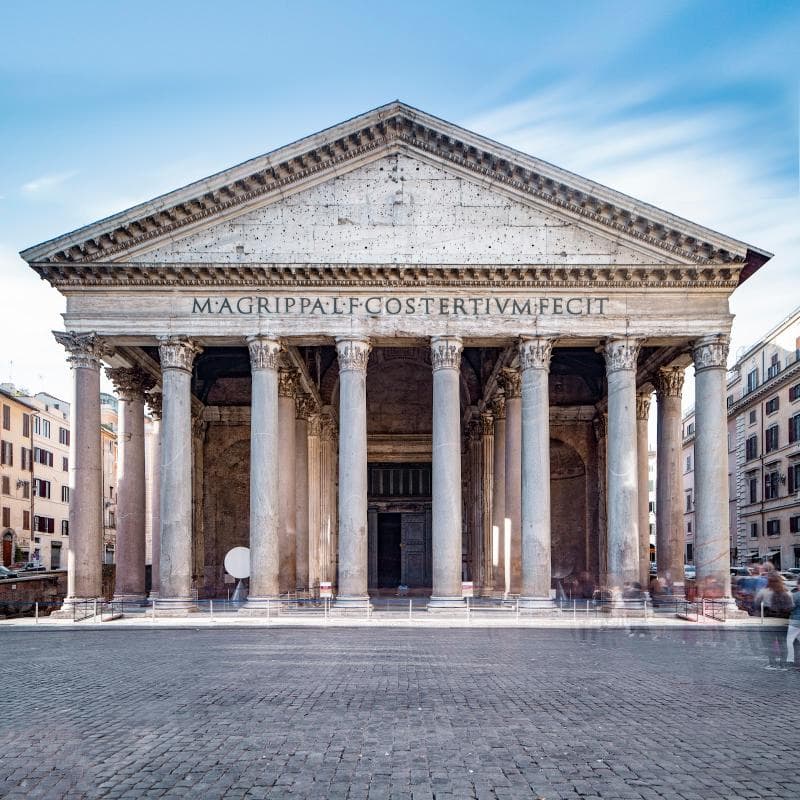
Discover the Pantheon in Rome, Italy – an ancient Roman temple transformed into a church. Marvel at its record-breaking unreinforced dome, open oculus, and rich history.
Overview
Stepping into the Pantheon in Rome, Italy, is like taking a journey back in time, a tangible connection to the ancient world. This architectural marvel, originally an ancient Roman temple, stands today as a consecrated Catholic church, the Basilica of St. Mary and the Martyrs. It is arguably the best-preserved ancient Roman building, renowned globally for its stunning dome and its iconic central opening, the oculus.
Located in the heart of Rome on Piazza della Rotonda, the Pantheon embodies nearly two millennia of history, continuously used and admired. Its immense scale and remarkable preservation offer a unique glimpse into the engineering prowess and spiritual beliefs of the Roman Empire.
History & Cultural Background
The Pantheon's story began with Marcus Agrippa, son of Lucius, who commissioned the first structure between 25 and 27 BC during the reign of Augustus, dedicating it as a temple to 'all the gods' (from the Greek 'Pantheion'). This original temple, however, was destroyed by fire.
The magnificent building we see today is a reconstruction, largely attributed to Emperor Hadrian, who rebuilt it between 118 and 128 AD. Interestingly, Hadrian chose to retain Agrippa's original inscription on the portico: 'M(arcus) Agrippa L(ucii) F(ilius) Co(n)s(ul) Tertium Fecit' ('Marcus Agrippa, son of Lucius, thrice Consul, built this'), honoring the original patron.
A pivotal moment in its history occurred in 609 AD when the Byzantine emperor Phocas gifted the building to Pope Boniface IV. The Pope then consecrated it as a Christian church, Santa Maria ad Martyres (St. Mary and the Martyrs), a conversion that played a crucial role in its exceptional preservation. Its continuous use, first as a pagan temple and then as a church, saved it from the fate of many other ancient Roman structures that fell into ruin or were dismantled for their materials.
What Makes It Special
The Pantheon's enduring allure stems from its extraordinary architectural features. Its most celebrated element is the colossal dome, which remains the world's largest unreinforced concrete dome almost two thousand years after its construction.
The dome has a diameter of 43.3 meters (142 ft), a dimension precisely matched by the height from the floor to the top of the oculus, creating a perfect sphere within the building's interior. This harmonious design symbolizes the heavens and reflects the Romans' deep understanding of geometry. The concrete used in its construction ingeniously incorporates lighter materials like pumice towards the top, reducing its overall weight and ensuring its stability without internal support.
At the apex of this architectural marvel is the oculus, a 9-meter (30-foot) circular opening that serves as the Pantheon's sole source of natural light. More than just a window to the sky, the oculus was a brilliant structural solution that reduced the dome's weight at its most critical point, preventing collapse. Symbolically, it connects the earthly realm with the divine, allowing sunlight to stream in and move across the interior walls like a celestial sundial throughout the day. Though open to the elements, the Pantheon's floor is subtly sloped with drains, so rainwater entering through the oculus rarely accumulates.
Another notable feature is the pair of massive bronze doors at the entrance to the cella, measuring 4.45 meters wide by 7.53 meters high, which are among the oldest surviving large bronze doors in Rome.
Stories, Fun Facts & Local Details
The name 'Pantheon' itself carries a hint of mystery; Roman senator Cassius Dio speculated it either came from the statues of many gods housed within, or from the dome's resemblance to the heavens.
The Pantheon is the final resting place for several notable figures, adding to its historical significance. Among them are the celebrated Renaissance painter Raphael, whose sarcophagus bears the poignant inscription, 'Here lies Raphael, by whom nature herself feared to be outdone while he lived, and when he dies, feared that she herself would die.' Also entombed here are Italy's first king, Vittorio Emanuele II, and his successor, Umberto I.
One enchanting annual event is the 'rain of petals' on Pentecost, fifty days after Easter, when thousands of red rose petals are dropped through the oculus, symbolizing the descent of the Holy Spirit.
Historically, the Pantheon wasn't always as aesthetically pure as it is today. During the Baroque period, two bell towers were added to its front, earning them the nickname 'donkey's ears' from unimpressed Romans. Fortunately, these were later removed.
Visitor Perspective
Visiting the Pantheon is an awe-inspiring experience that transcends time. As you step through its ancient doors, the sheer scale and architectural genius of the interior immediately impress. The unobstructed view upwards to the oculus creates a profound sense of connection to the sky, making you feel both small and part of something immense and eternal.
The shifting light entering through the oculus, painting different patterns on the marble floor throughout the day, adds a dynamic element to the visit, highlighting the building's role as a kind of cosmic calendar. It is a place of quiet contemplation, where the echoes of history and faith resonate profoundly. Recognizing that it is still a functioning church, visitors are encouraged to maintain respectful behavior, allowing others to appreciate its spiritual significance.
Coordinates: 12.4768, 41.8986
View on Google Maps💬 How Travelers Describe This Place
Based on community votes
Beautiful
872Must See
846Unique
684Interesting
363Photogenic
250
Traveler Stories
Discover memorable experiences shared by travelers who have visited this place.
No traveler stories yet.
Be the first traveler to share what made this place memorable.
Things to see at Pantheon



Tour
By
Spot
Discover amazing places around the world. Your journey starts here.
Explore
© 2026 TourBySpot. All rights reserved.