Portico Columns
Rome, Italy
Discover the colossal Portico Columns of the Pantheon in Rome, Italy. Explore their history, unique architecture, and the incredible journey of their Egyptian granite. An awe-inspiring entry to an ancient wonder.
Overview
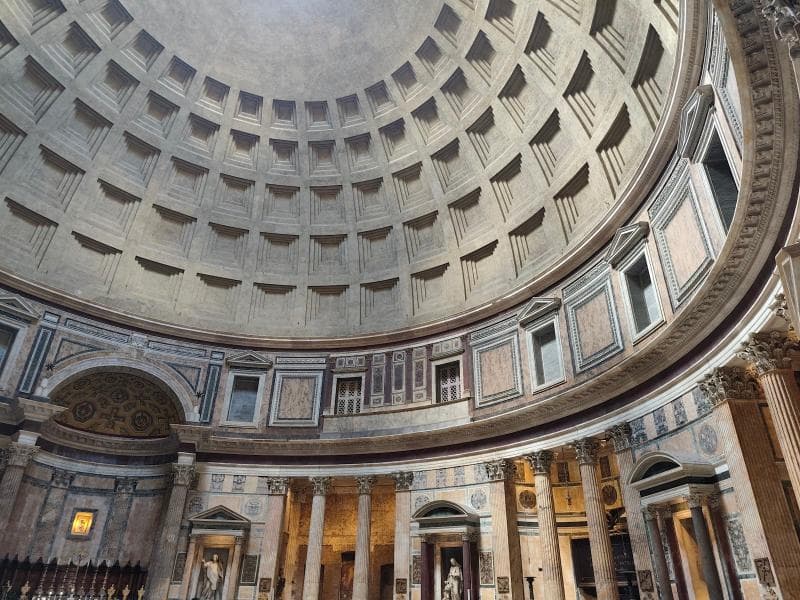
The Portico Columns of the Pantheon in Rome, Italy, serve as a majestic and iconic entrance to one of the ancient world's most remarkably preserved architectural marvels. This grand colonnaded porch, or pronaos, immediately sets a tone of immense scale and historical depth for any visitor approaching the structure. It features a striking array of 16 monolithic Corinthian columns, a design element that harks back to traditional Roman temple architecture, while subtly concealing the revolutionary circular interior that lies beyond.
Eight of these colossal columns stand proudly in the front row, with two groups of four forming the rows behind, supporting a massive triangular pediment. Each column is a single, unbroken piece of stone, a testament to ancient Roman engineering and logistical prowess. They are primarily crafted from grey granite, with some pink granite columns also present, all sourced from distant quarries in Egypt. Standing at an impressive height of approximately 11.8 to 12.2 meters (about 39 to 40 Roman feet) and measuring around 1.5 meters in diameter, each column weighs a staggering 60 tonnes. This incredible feat of ancient construction presents the initial, awe-inspiring glimpse into the genius of Roman builders.
History & Cultural Background
The Pantheon's history is layered, with the current structure being the third iteration on this site. The original temple was commissioned by Marcus Vipsanius Agrippa during the reign of Augustus (27 BC – 14 AD). After the initial building was destroyed by fire, the present Pantheon was completed by Emperor Hadrian around 126 AD. Remarkably, Hadrian chose to re-inscribe the new temple with Agrippa's original dedication, which proudly states: 'M.AGRIPPA.L.F.COS.TERTIVM.FECIT' – meaning 'Marcus Agrippa, son of Lucius, three times consul, built this.' This act honored the original commissioner despite Hadrian's extensive rebuilding, a nod to history and continuity.
The very design of the portico reflects a cultural interplay. Its rectangular shape and Corinthian columns were inspired by Greek temple architecture, a common aesthetic in Roman design. Yet, the use of such colossal monolithic columns, transported from Egypt, also highlights Rome's vast imperial reach and its ability to harness resources from across its empire. The grand scale of the portico also served an urban design purpose, influencing the space in front of the temple and creating a dramatic approach for worshippers and visitors alike.
What Makes It Special
What truly sets the Portico Columns apart is not just their sheer size, but the extraordinary narrative of their creation and transportation. Imagine the engineering challenge of extracting these massive granite shafts from quarries in Mons Claudianus and Aswan, hundreds of kilometers from the Nile, then dragging them over 100 km to the river. From there, they were loaded onto barges and shipped across the Mediterranean Sea to Rome, a journey that modern engineers still marvel at today.
The architectural contrast between the traditional, rectangular facade of the portico and the surprising, expansive circular rotunda it conceals is a masterstroke of design. Visitors often have no hint of the vast, spherical space that awaits them until they pass through the portico and the intermediate block. This deliberate design choice creates a powerful transition, emphasizing the monument's interior as a separate, sacred realm. Furthermore, historical evidence suggests the portico might have been intended for even larger columns, or is shorter than originally planned, adding an intriguing layer of 'what if' to its already captivating presence.
Stories, Fun Facts & Local Details
Beyond the architectural grandeur, the Portico Columns hold fascinating historical anecdotes. The bronze relief that once adorned the pediment is long lost, as is the bronze covering of the porch roof. These precious metals were famously stripped in the 17th century under Pope Urban VIII, with some of the bronze reportedly repurposed for Bernini's baldachin in St. Peter's Basilica and cannons for Castel Sant'Angelo.
Another interesting detail lies in the intermediate block between the portico and the rotunda. This section once housed niches that may have contained statues of Emperor Augustus and Agrippa, further solidifying the Pantheon's ties to its Augustan origins. The continuous use of the Pantheon throughout history, first as a Roman temple and then as a Christian church (Basilica of St. Mary and the Martyrs since 609 AD), has been crucial to its preservation, making these columns some of the best-preserved ancient artifacts in Rome.
Visitor Perspective
Approaching the Pantheon from the bustling Piazza della Rotonda, the Portico Columns are often the first feature to truly command attention. Their immense height and sheer number create an immediate sense of arrival and historical gravitas. Standing beneath them, one can't help but feel dwarfed by the scale of ancient ambition and engineering. The smooth, polished granite, despite millennia of exposure, retains a timeless quality, inviting a touch, a moment of reflection on the hands that quarried and transported these giants.
The columns frame the entrance, drawing the eye towards the inscription and the massive bronze doors, which are among the oldest in Rome. This experience of passing through the portico, from the bright Roman sunlight into the dim, cool vestibule, is an essential part of the Pantheon's magic. It's a journey from the outer world into an inner sanctuary, a moment where the modern traveler connects with the ancient past, appreciating the enduring power and beauty of these monumental pillars.
Coordinates: 12.4768, 41.8986
View on Google Maps💬 How Travelers Describe This Place
Based on community votes
Unique
996Interesting
726Photogenic
717Must See
494Beautiful
193
Traveler Stories
Discover memorable experiences shared by travelers who have visited this place.
No traveler stories yet.
Be the first traveler to share what made this place memorable.

Tour
By
Spot
Discover amazing places around the world. Your journey starts here.
Explore
© 2026 TourBySpot. All rights reserved.