Tomb of Raphael
Rome, Italy
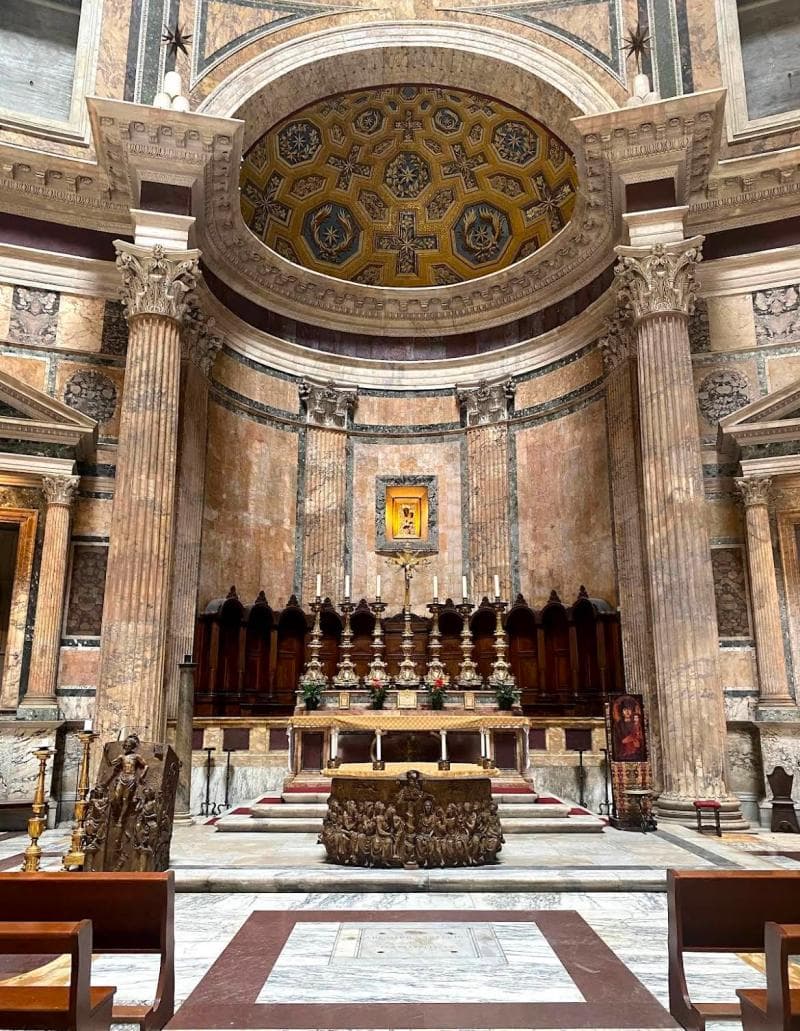
Discover the Tomb of Raphael inside Rome's majestic Pantheon, Italy. Learn about the Renaissance master, his epitaph, and the iconic resting place.
Overview
Deep within the ancient grandeur of the Pantheon in Rome, Italy, lies the resting place of one of the Italian Renaissance's most revered artists: Raphael. The Tomb of Raphael, officially known as Raffaello Sanzio da Urbino, draws visitors from across the globe, offering a poignant connection to a genius whose life was tragically cut short. Nestled within the larger structure that began its life as a Roman temple and was later consecrated as the Basilica of Santa Maria ad Martyres, Raphael's tomb is a significant cultural landmark. It is positioned prominently in front of the high altar, marked by the serene statue of the Madonna del Sasso.
Visiting the Pantheon to see Raphael's tomb offers a unique blend of ancient history, architectural marvel, and artistic homage. While entry to the Pantheon now requires a ticket for most tourists, its doors remain open for those seeking to reflect on the legacy of its famous interments.
History & Cultural Background
Raphael, born Raffaello Sanzio in Urbino in 1483, left an indelible mark on art and architecture before his untimely death in Rome in 1520, at the age of just 37. It was Raphael's own wish to be buried in the Pantheon, a testament to his profound appreciation for classical antiquity and his deep connection to Rome. Pope Leo X, recognizing Raphael's immense contributions to art and his efforts in preserving ancient monuments, granted this significant request.
Raphael's burial in the Pantheon was a pioneering act, making him the first prominent artist to be interred there and subsequently establishing a tradition that saw others, including Italian monarchs, choose it as their final resting place. The Pantheon itself boasts a rich history, originally commissioned by Marcus Agrippa in the 1st century BC and rebuilt by Emperor Hadrian around 126 AD. It transformed into a Christian church in 609 AD, preserving its magnificent structure through the centuries.
For centuries, the exact location of Raphael's remains was debated. However, in 1833, Pope Gregory XVI ordered the tomb's opening to verify its contents. The forensic examination confirmed the presence of Raphael's bones, which were then respectfully placed into an antique Roman sarcophagus, a gift from the Pope himself. The current, beautifully arranged tomb we see today is largely the result of a redesign completed by Antonio Muñoz in 1911.
What Makes It Special
The Tomb of Raphael is special not only because it houses the remains of a Renaissance master but also for the powerful sentiments it evokes. Its most famous feature is the epitaph inscribed on the sarcophagus, penned by his friend, the humanist and cardinal Pietro Bembo. The Latin inscription reads: 'Ille hic est Raphael timuit quo sospite vinci, rerum magna parens et moriente mori.' This translates to: 'Here lies Raphael: by him, when he lived, nature feared to be vanquished; now that he is dead, she fears to die.'
This moving tribute perfectly encapsulates Raphael's extraordinary talent and his profound impact on the art world. Overlooking the tomb is the graceful statue of the Madonna del Sasso (Madonna of the Rock), a piece commissioned by Raphael himself and executed by his student, Lorenzetto. This statue serves as a lasting artistic marker for the painter's final rest. The tomb symbolizes the enduring link between the artistic brilliance of the Renaissance and the awe-inspiring architectural legacy of ancient Rome.
Stories, Fun Facts & Local Details
Raphael's death on Good Friday, April 6, 1520, holds a fascinating, almost mythical, detail: it was believed to be his 37th birthday. While historical records suggest his actual birthdate was March 28, 1483 (also a Good Friday), the symmetry of dying on the same holy day as his birth, after a full life of artistic contribution, added to his legendary status. Legend has it that Pope Leo X was so moved by Raphael's passing that he knelt by his body before burial, shedding tears for the lost genius.
The opening of Raphael's tomb in 1833 was a grand affair, attended by 75 notable figures, including artists, church dignitaries, and medical experts, all eager to confirm the artist's final resting place. Adding a touch of personal history, a tombstone dedicated to Raphael's fiancée, Maria Bibbiena, can be found nearby within the Pantheon. When you visit, look closely at Lorenzetto's Madonna del Sasso: the Virgin Mary's left foot rests on a stone, a small but distinctive detail. The Pantheon itself, with its iconic oculus, allows natural light and even rain to enter, connecting the interior directly to the heavens, a fitting embrace for an artist whose work often touched the divine.
Visitor Perspective
Visiting the Tomb of Raphael is an experience that transcends a simple sightseeing stop; it's a journey into the heart of artistic and historical reverence. The Pantheon is centrally located in Rome, specifically in Piazza della Rotonda, making it easily accessible on foot from many of the city's key attractions. Alternatively, bus lines stop at Largo di Torre Argentina, and metro Line A has stops at Barberini and Spagna, all within a reasonable walking distance.
To best experience the tranquility and absorb the atmosphere around Raphael's tomb, consider visiting early in the morning, shortly after the Pantheon opens, to avoid the largest crowds. While a ticket is now required for tourist entry (with current prices at €5, increasing to €7 from July 2026), certain visitors, such as residents of Rome, those under 18, people with disabilities, and individuals attending mass, are granted free access. Audio guides are available to enhance your understanding of both the Pantheon's architectural wonders and the stories surrounding Raphael's life and burial. Remember that the Pantheon remains a consecrated church, so maintaining a respectful demeanor and quiet observation is appreciated by both visitors and worshippers alike.
Coordinates: 12.4768, 41.8986
View on Google Maps💬 How Travelers Describe This Place
Based on community votes
Must See
797Interesting
695Unique
396Beautiful
286Photogenic
22
Traveler Stories
Discover memorable experiences shared by travelers who have visited this place.
No traveler stories yet.
Be the first traveler to share what made this place memorable.

Tour
By
Spot
Discover amazing places around the world. Your journey starts here.
Explore
© 2026 TourBySpot. All rights reserved.