Palace Of Peace And Reconciliation
Astana, Kazakhstan
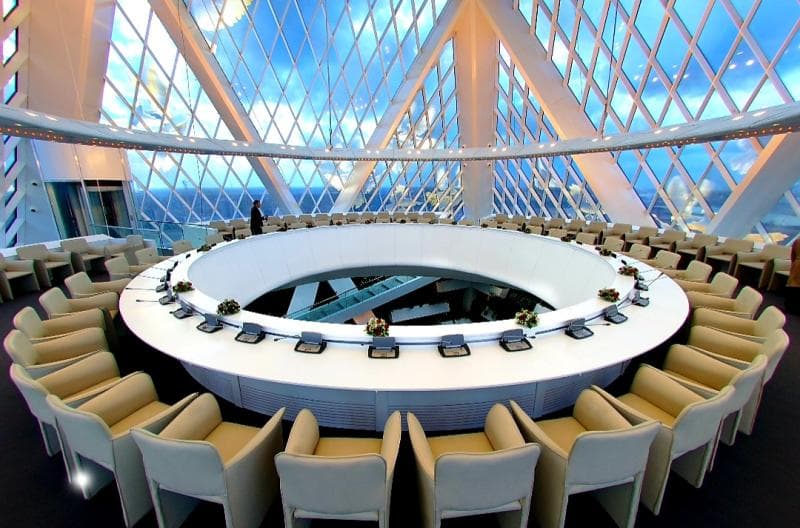
Discover the Palace of Peace and Reconciliation in Astana, Kazakhstan – a stunning pyramid symbolizing global unity and interfaith harmony.
Overview
Rising dramatically from the Kazakh steppe, the Palace of Peace and Reconciliation in Astana stands as a powerful symbol of unity and interfaith harmony. This architectural marvel, often referred to as the 'Pyramid of Peace and Accord,' is a giant glass and metal pyramid that seamlessly blends modern design with profound cultural significance. Conceived as a global center for religious understanding, the Palace hosts the triennial Congress of Leaders of World and Traditional Religions, providing a unique platform for dialogue and cooperation among diverse faiths. Its striking silhouette against the city's skyline makes it an unmissable landmark in Kazakhstan's capital.
Designed by the celebrated British architect Sir Norman Foster, the Palace is more than just an event venue; it is a cultural and spiritual hub that encapsulates Kazakhstan's commitment to multiculturalism and religious tolerance. Within its impressive structure, visitors can explore various facilities, including an opera house, exhibition areas, and a winter garden. The building's innovative design and its noble purpose draw curious travelers from around the world, seeking to witness this unique blend of architecture and diplomacy.
History & Cultural Background
The genesis of the Palace of Peace and Reconciliation traces back to 2003 when the First President of Kazakhstan, Nursultan Nazarbayev, proposed the idea at the inaugural Congress of Leaders of World and Traditional Religions in Astana. His vision was to create a permanent venue for this crucial interfaith dialogue, a physical embodiment of peace and understanding in a rapidly changing world. The initiative garnered significant support from religious leaders globally, leading to the rapid construction of the pyramid.
Completed in a remarkably short 13 months and officially opened in 2006, the Palace was ready to host the second Congress that same year. Its design deliberately avoids association with any single religion, instead serving as a secular center for interfaith dialogue. This approach reflects Kazakhstan's diverse population, comprising over 130 nationalities and numerous religious communities, all coexisting peacefully. The Palace, therefore, represents the nation's ethos of fostering harmony and mutual respect among its people and with the wider world.
What Makes It Special
The Palace of Peace and Reconciliation is an architectural marvel distinguished by its precise design and symbolic elements. Adhering to the principle of the Fibonacci Golden Section, the pyramid stands at an exact height of 62 meters, with a square base measuring 62 meters on each side. This mathematical precision contributes to its aesthetic balance and grandeur.
A notable feature is the stained-glass apex, a masterpiece created by British artist Brian Clarke. This striking dome depicts 130 white doves, symbolizing the more than 130 nationalities that call Kazakhstan home, soaring against a blue sky. Sunlight filtering through these doves casts vibrant patterns into the building's interior, creating a mesmerizing and uplifting atmosphere. Inside, the Palace houses a 1,300-seat Opera Hall that was famously inaugurated by Montserrat Caballé, a spacious Cheops Atrium, and a unique winter garden often dubbed 'The Hanging Gardens of Astana.' The structure was also engineered to withstand extreme temperature fluctuations, ranging from -40°C to over 40°C, a testament to innovative construction techniques.
Stories, Fun Facts & Local Details
Locals sometimes refer to the building simply as 'the Pyramid,' and its rapid construction and distinctive shape have even led some to jokingly call it the 'Eighth Wonder of the World.' The interior design incorporates Egyptian themes, particularly noticeable in the central Cheops Atrium. The Palace isn't just about serious religious discourse; it has also hosted cultural events, including the International Astana Action Film Festival, showcasing its versatility as a venue.
A particularly fascinating aspect for visitors are the special diagonal elevators that ascend through the pyramid's structure at a 60-degree angle, offering unique views of the interior and an experience akin to those found in iconic structures like the Eiffel Tower. The pyramid is symbolically divided into three levels: a dark lower section representing the 'underworld,' a white middle section signifying 'peace,' and the glass apex representing the 'sky,' further emphasizing its spiritual aspirations.
Visitor Perspective
Visiting the Palace of Peace and Reconciliation offers a journey through architectural brilliance and profound cultural symbolism. Upon entering, travelers are often struck by the central atrium's vastness, flooded with natural light, where the symbolic geometry becomes immediately apparent. Exploring the different levels reveals exhibition areas, art galleries, and the impressive Opera Hall. Many find themselves drawn to the top, where the vibrant stained-glass doves create a serene and inspiring setting, and panoramic views of Astana's modern cityscape unfold.
The Palace is accessible to the public, and guided tours are available in multiple languages, offering deeper insights into its history and significance. Visitors are advised to wear modest clothing, respecting the spiritual nature of the venue. The experience is not just about appreciating the architecture; it's about engaging with the building's core message of unity and understanding. A visit can range from a quick look around to a more immersive experience including a guided tour and a stroll through the adjacent park, making it a compelling stop on any Astana itinerary.
Coordinates: 71.46361, 51.12306
View on Google Maps💬 How Travelers Describe This Place
Based on community votes
Photogenic
996Must See
953Beautiful
658Interesting
585Unique
69
Traveler Stories
Discover memorable experiences shared by travelers who have visited this place.
No traveler stories yet.
Be the first traveler to share what made this place memorable.
Things to see at Palace Of Peace And Reconciliation



Tour
By
Spot
Discover amazing places around the world. Your journey starts here.
Explore
© 2026 TourBySpot. All rights reserved.