Museum Of European And Mediterranean Civilisations
Marseille, France
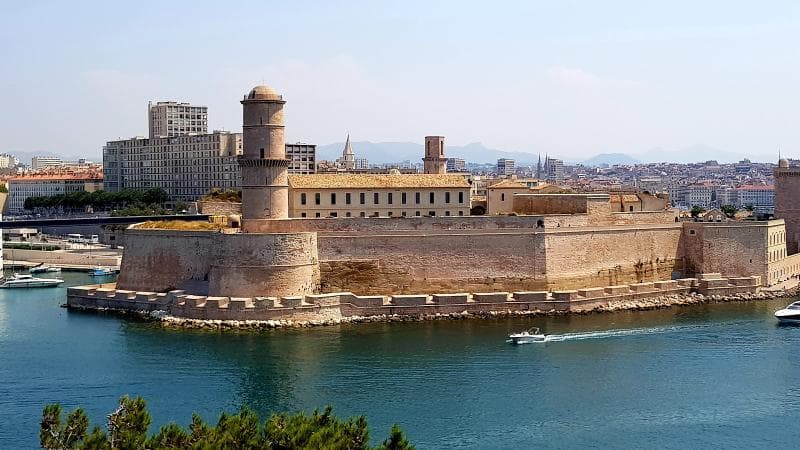
Explore the Museum of European and Mediterranean Civilisations (MuCEM) in Marseille, France. Discover its unique architecture, rich history, and diverse collections charting Mediterranean cultures.
Overview
The Museum of European and Mediterranean Civilisations, widely known as MuCEM, stands as a prominent cultural landmark in Marseille, France, gracefully positioned at the entrance of the city's historic Old Port. Inaugurated on June 7, 2013, during Marseille's tenure as the European Capital of Culture, MuCEM quickly established itself as the first major national museum dedicated exclusively to Mediterranean civilizations. Its mission is to explore and illuminate the rich tapestry of historical and cultural cross-fertilization within the Mediterranean basin, spanning from prehistoric times to contemporary issues. Attracting millions of visitors annually, it is recognized as one of the world's most visited museums.
MuCEM is not just a single building; it is a sprawling cultural complex comprising three distinct sites, offering approximately 40,000 square meters of dedicated space. The main J4 building, an architectural marvel, is connected by aerial footbridges to the historic Fort Saint-Jean and, further, to the Panier district. The third site, the Conservation and Resource Center (CCR), located in the Belle de Mai district, serves as the repository for its vast collections.
History & Cultural Background
MuCEM's roots trace back to the Musée des Arts et Traditions Populaires, established in Paris in 1937. Its transformation and relocation to Marseille in 2013 marked a significant shift from a national museum focused on French ethnography to one with a broad regional and international scope, dedicated to the diverse cultures of the Mediterranean. This relocation symbolized a bold new direction, highlighting Marseille's pivotal role as a historic port city and a melting pot of Mediterranean influences.
The museum's collections are comprehensive, encompassing over 350,000 objects, 200,000 posters, 350,000 photographs, and 150,000 artworks, totaling nearly a million items, documents, and objects. These collections are organized into nine major areas, covering aspects such as Performing Arts, Public life, Sport & health, Crafts, Commerce & Industry, Mobility, Home life, Body, Image & Sexuality, Agriculture & Food, and Religions & beliefs. This interdisciplinary approach, drawing from anthropology, history, archaeology, art history, and contemporary art, allows MuCEM to present a multifaceted view of the Mediterranean world and its ongoing dialogue with Europe.
What Makes It Special
What truly sets MuCEM apart is its striking architecture and unique integration with its historical surroundings. The main J4 building, designed by French architect Rudy Ricciotti in collaboration with Roland Carta, is a contemporary masterpiece. It features a 72-meter square cube enveloped in an intricate, lace-like concrete mesh, crafted from fiber-reinforced ultra-high-performance concrete. This delicate filigree skin not only provides a distinctive aesthetic but also modulates light, creating captivating shadow patterns and views of the sea, inviting the marine atmosphere indoors.
The museum's connection to the 12th-century Fort Saint-Jean is equally remarkable. Two slender concrete footbridges link the J4 building to the Fort Saint-Jean, and another connects the fort to the historic Panier district. This seamless integration allows visitors to move effortlessly between modern architecture and ancient heritage, transforming the museum experience into an urban journey. The Fort Saint-Jean itself, a historic monument, has been carefully restored and now offers freely accessible gardens, exhibition spaces, and breathtaking panoramic views of Marseille and the Mediterranean Sea.
Stories, Fun Facts & Local Details
The architect, Rudy Ricciotti, famously described the J4 building as a 'vertical casbah,' envisioning it as 'open to the sea, to draw a horizon where the two shores of the Mediterranean can meet.' This poetic vision is embodied in the building's design, which uses light and shadow to evoke the region's rich cultural heritage. The unique concrete mesh, resembling a woven veil, casts shifting patterns that Ricciotti himself likened to 'a projection of the bumpy and irregular sea bed.'
A fun aspect for visitors is the free accessibility of the Fort Saint-Jean and its gardens. Locals and tourists can stroll along its ancient walls, enjoy the Mediterranean gardens with their diverse plant species, relax in deckchairs, and savor unparalleled views of the Old Port, the sea, and the city. This public access has made the area around MuCEM a popular spot for fishing, evening strolls, and enjoying sunsets, fostering a sense of community ownership and transforming a historical site into a vibrant public space. In 2015, MuCEM received the prestigious Council of Europe Museum Prize, recognizing its innovative approach and mission to foster intercultural dialogue.
Visitor Perspective
Visiting MuCEM is an immersive experience that goes beyond traditional museum-going. Travelers are invited to embark on a journey through time and culture, starting with the striking contemporary architecture of the J4 building, where major permanent and temporary exhibitions are housed. The permanent 'Gallery of the Mediterranean' offers a chronological and thematic exploration of 3000 years of Mediterranean history, showcasing archaeological artifacts, artworks, and ethnographic testimonies.
The aerial walkways connecting the J4 to Fort Saint-Jean offer not just practical passage but also a spectacular, elevated perspective of the sea and the surrounding urban landscape. Once within Fort Saint-Jean, visitors can wander through beautifully landscaped gardens, explore ancient structures, and ascend the spiral staircase of the 15th-century King René's square tower for panoramic vistas. The museum's philosophy is to be a 'cultural city,' offering not only exhibitions but also auditoriums, bookstores, restaurants with panoramic terraces, and public spaces designed for reflection and exchange, making it a truly engaging destination for anyone curious about the Mediterranean world.
Coordinates: 5.36135, 43.297167
View on Google Maps💬 How Travelers Describe This Place
Based on community votes
Beautiful
886Unique
564Must See
233Interesting
201Photogenic
121
Traveler Stories
Discover memorable experiences shared by travelers who have visited this place.
No traveler stories yet.
Be the first traveler to share what made this place memorable.
Things to see at Museum Of European And Mediterranean Civilisations



Tour
By
Spot
Discover amazing places around the world. Your journey starts here.
Explore
© 2026 TourBySpot. All rights reserved.