J4 Building
Marseille, France
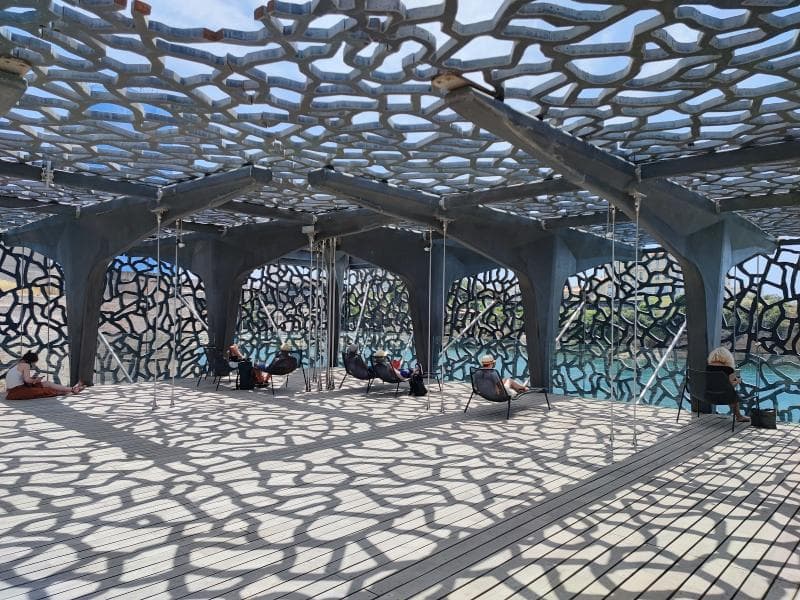
Explore the J4 Building at MuCEM in Marseille, France, an architectural marvel showcasing Mediterranean civilizations. Discover its unique concrete lace design and stunning sea views.
Overview
Perched gracefully at the entrance of Marseille's historic Vieux Port, the J4 Building is a captivating focal point of the Museum of European and Mediterranean Civilisations (MuCEM). More than just a museum wing, it stands as an architectural marvel, harmoniously blending contemporary design with the city's rich maritime heritage. Inaugurated on June 7, 2013, as part of Marseille-Provence's designation as European Capital of Culture, the J4 quickly became a symbol of the city's modern revival.
The J4 is one of three distinct sites that comprise the expansive MuCEM, working in concert with the venerable Fort Saint-Jean and the Conservation and Resource Center. This iconic structure houses the museum's major exhibition spaces, acting as a vibrant cultural crossroads where visitors embark on a journey through the diverse narratives of Mediterranean civilizations. Its unique design and prominent location offer an unparalleled dialogue between past and present, land and sea.
History & Cultural Background
The J4 Building is the visionary creation of renowned French architect Rudy Ricciotti, in collaboration with Roland Carta. Their design philosophy aimed to establish a profound connection between Marseille's historical roots and its contemporary aspirations. Ricciotti envisioned the building as a 'mineral cube,' a perfect square measuring 72 meters on each side, elegantly situated on the former J4 port pier. The name 'J4' itself is a historical nod, referring to one of four moles (J1-J4) in the Joliette basin, restructured from 1929 for maritime transit.
What truly sets the J4 apart is its ethereal concrete 'lace' facade, a delicate yet robust mesh (known as 'résille') that envelops the entire structure. This intricate skin is crafted from ultra-high-performance fiber-reinforced concrete (BFUHP), a pioneering French material that allowed for unprecedented architectural expression. The design, resembling the fishing nets that are intrinsic to Marseille's coastal identity, consciously contrasts with the heavy fortifications of the nearby Fort Saint-Jean, yet it forms a complementary and 'friendly' juxtaposition.
What Makes It Special
The J4 Building's allure lies in its masterful blend of innovative architecture and sensory experience. The most striking feature is undoubtedly its 'concrete lace' facade, which bathes the interiors in a mesmerizing interplay of light and shadow throughout the day. This partially transparent skin creates a 'gauzy mirage' from a distance, drawing the eye towards its distinctive form.
Beyond its visual appeal, the J4 is intricately linked to its maritime environment. Its seafront location provides breathtaking 360-degree panoramic views of Fort Saint-Jean, the sparkling Mediterranean Sea, and the city of Marseille from various vantage points, including its glassed exhibition rooms and rooftop terrace. A remarkable 115-meter (or 135-meter, depending on the source) aerial footbridge elegantly spans the water, connecting the J4 directly to the historic Fort Saint-Jean. This 'vertigo-inducing ribbon' allows visitors a unique elevated stroll, bridging centuries of history in a single, memorable journey.
Inside, the J4 hosts a significant 1,600 square meter permanent exhibition, the 'Mediterranean Gallery,' dedicated to the vast history of Mediterranean civilizations, alongside 2,000 square meters for dynamic temporary exhibitions. The building also features an auditorium, a well-stocked bookstore, dedicated children's areas, and a panoramic restaurant, Le Môle Passédat, offering exquisite dining with unparalleled sea views.
Stories, Fun Facts & Local Details
Rudy Ricciotti, the visionary architect, deliberately designed the J4's 'dematerialized' facade to be in stark yet harmonious contrast with the ancient, massive stone of Fort Saint-Jean. This thoughtful dialogue between the ultra-modern and the deeply historic embodies Marseille's spirit as a city constantly evolving while honoring its past.
The building's concrete mesh draws inspiration from the moucharabieh, a traditional architectural element found in Arab countries that allows for both ventilation and privacy – enabling one to see out without being fully seen. This subtle cultural reference reinforces the museum's dedication to Mediterranean civilisations and adds another layer of depth to its striking appearance.
A curious detail is how the J4 Building's color appears to shift depending on the weather and light conditions; it can seem almost white on a bright, sunny day, yet transform to nearly black under a cloudy sky. Since its opening, the J4, along with the entire MuCEM, has rapidly risen to international prominence, earning recognition as a 'world-object' and attracting millions of visitors annually, cementing its status as a global architectural and cultural landmark.
Visitor Perspective
A visit to the J4 Building is an immersive experience designed to engage and inspire. From the ground level, visitors are invited to embark on a captivating architectural promenade. Outdoor ramps gracefully wind their way upwards, leading to the expansive rooftop terrace. As you ascend, the concrete mesh offers ever-changing perspectives and panoramic views of Fort Saint-Jean and the vast Mediterranean horizon, making the journey itself an integral part of the discovery.
The aerial footbridge, a striking concrete ribbon suspended over the water, offers a unique opportunity to literally walk between two worlds: the contemporary museum and the ancient fort. This connection facilitates a seamless exploration of both sites, allowing visitors to appreciate the historical context of Marseille's port while engaging with modern cultural narratives. The J4 is designed to be highly accessible and welcoming, offering interactive exhibits and activities suitable for all ages, ensuring that every curious traveler finds a meaningful connection with the rich tapestry of European and Mediterranean civilizations.
Coordinates: 5.36097, 43.29671
View on Google Maps💬 How Travelers Describe This Place
Based on community votes
Interesting
836Photogenic
797Unique
255Must See
231Beautiful
86
Traveler Stories
Discover memorable experiences shared by travelers who have visited this place.
No traveler stories yet.
Be the first traveler to share what made this place memorable.

Tour
By
Spot
Discover amazing places around the world. Your journey starts here.
Explore
© 2026 TourBySpot. All rights reserved.