Panoramic Walkways
Marseille, France
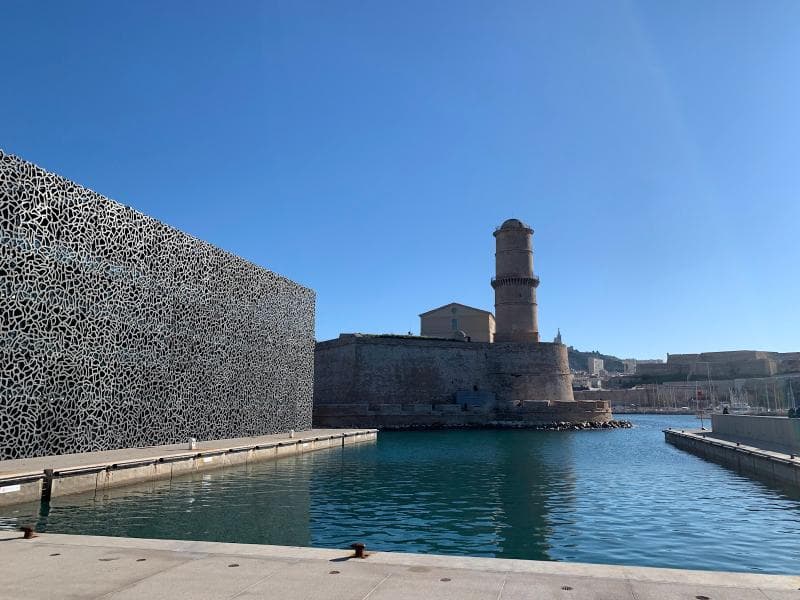
Discover the Panoramic Walkways at MuCEM in Marseille, France, connecting modern architecture with historic Fort Saint-Jean, offering stunning Mediterranean views.
Overview
Perched gracefully above the sparkling waters of the Mediterranean, the Panoramic Walkways at the Museum of European and Mediterranean Civilisations (MuCEM) in Marseille, France, are more than mere connecting paths. They are a defining feature of this iconic cultural institution, offering visitors an unforgettable journey. These aerial footbridges serve to seamlessly link the avant-garde J4 building of MuCEM with the historic Fort Saint-Jean, and further extend towards the charming, ancient neighborhood of Le Panier. As you traverse these elevated pathways, you are invited to embark on a unique promenade that unites Marseille's rich past with its vibrant present, all while providing breathtaking, unobstructed vistas of the sea and the city.
History & Cultural Background
The MuCEM itself is a beacon of modern architectural ambition, inaugurated in June 2013 as Marseille proudly embraced its role as the European Capital of Culture. It stands as the world's first museum entirely dedicated to the diverse civilizations of the Mediterranean, a basin renowned for its profound historical and cultural cross-pollination. The architectural vision for the J4 building and its connecting walkways was brought to life by the esteemed architect Rudy Ricciotti, in collaboration with Roland Carta.
Integral to this complex is Fort Saint-Jean, a formidable historical monument whose origins trace back to the 12th century, initially serving as a commandery for the Knights Hospitaller of Saint John. This ancient fortress has been a strategic sentinel guarding the entrance to Marseille's Old Port for centuries. Ricciotti's design ingeniously utilizes the Panoramic Walkways to create both a literal and symbolic bridge, drawing together the stoic, age-old ramparts of Fort Saint-Jean with the sleek, contemporary lines of the J4 building. This connection powerfully embodies the museum's mission: to highlight the continuous tapestry of Mediterranean history and culture.
What Makes It Special
The principal walkway, a slender marvel stretching approximately 115 meters, acts as an elevated umbilical cord, joining the roof terrace of the J4 building directly to Fort Saint-Jean. A secondary footbridge, measuring about 70 meters, further extends from the fort, gracefully arching towards the venerable Saint-Laurent church nestled within the historic Panier district. These structures are a testament to cutting-edge engineering and material science, fabricated from Ultra-High-Performance Fiber-Reinforced Concrete (UHPFRC or UHPC). This innovative material endows the walkways with their remarkable slenderness and a deceptive delicacy, forming part of the distinctive 'lace-like' concrete mesh that envelops the J4 building.
Suspended dramatically at heights of up to 19 meters above the ground, the walkways offer an exhilarating sense of elevation and freedom. The seamless integration of these modern elements with the ancient stone of the fort is a masterstroke, creating a harmonious dialogue between different eras and architectural styles.
Stories, Fun Facts & Local Details
Rudy Ricciotti, the architect, evocatively described the J4 building as a 'vertical casbah' and the connecting walkways as a 'taut thread,' emphasizing the structure's transparency and the rich sensory experience it offers. The intricate, openwork concrete mesh of the J4 building is not merely decorative; it orchestrates a captivating dance of light and shadow that shifts throughout the day, adding an ethereal quality to the architectural journey.
These pathways are an integral part of what Ricciotti termed a 'Mediterranean path,' conceptualized as a continuous promenade inviting discovery between land and sea, historical narratives and contemporary expressions. A notable aspect is that the outdoor areas of both the J4 and Fort Saint-Jean, including these magnificent footbridges, are freely accessible to the public. This open access has successfully fostered a profound sense of local ownership and integration, making the MuCEM complex a cherished part of Marseille's urban fabric and daily life.
Visitor Perspective
For the traveler, traversing the Panoramic Walkways is an inherently immersive and sensory experience. Imagine the gentle sea breeze on your skin, the warmth of the Provençal sun, and the ever-evolving vistas unfolding before your eyes. You'll be treated to spectacular 360-degree panoramas that sweep across the bustling Old Port, the boundless expanse of the deep blue Mediterranean Sea, the intricate cityscape of Marseille, and the venerable outlines of its historic landmarks.
The feeling of floating between the sky and the water creates a profound connection to Marseille's maritime identity. It's a photographer's paradise, offering endless opportunities to capture the striking interplay of modern architectural genius, ancient history, and breathtaking natural beauty. More than just a means to get from one point to another, these walkways are a destination in themselves – a tranquil yet exhilarating promenade where one can pause, reflect on the layers of Marseille's heritage, and appreciate its dynamic role as a vital cultural crossroads of Europe and the Mediterranean.
Coordinates: 5.36097, 43.29671
View on Google Maps💬 How Travelers Describe This Place
Based on community votes
Interesting
836Photogenic
797Unique
255Must See
231Beautiful
86
Traveler Stories
Discover memorable experiences shared by travelers who have visited this place.
No traveler stories yet.
Be the first traveler to share what made this place memorable.

Tour
By
Spot
Discover amazing places around the world. Your journey starts here.
Explore
© 2026 TourBySpot. All rights reserved.