Musegg Wall
Lucerne, Switzerland
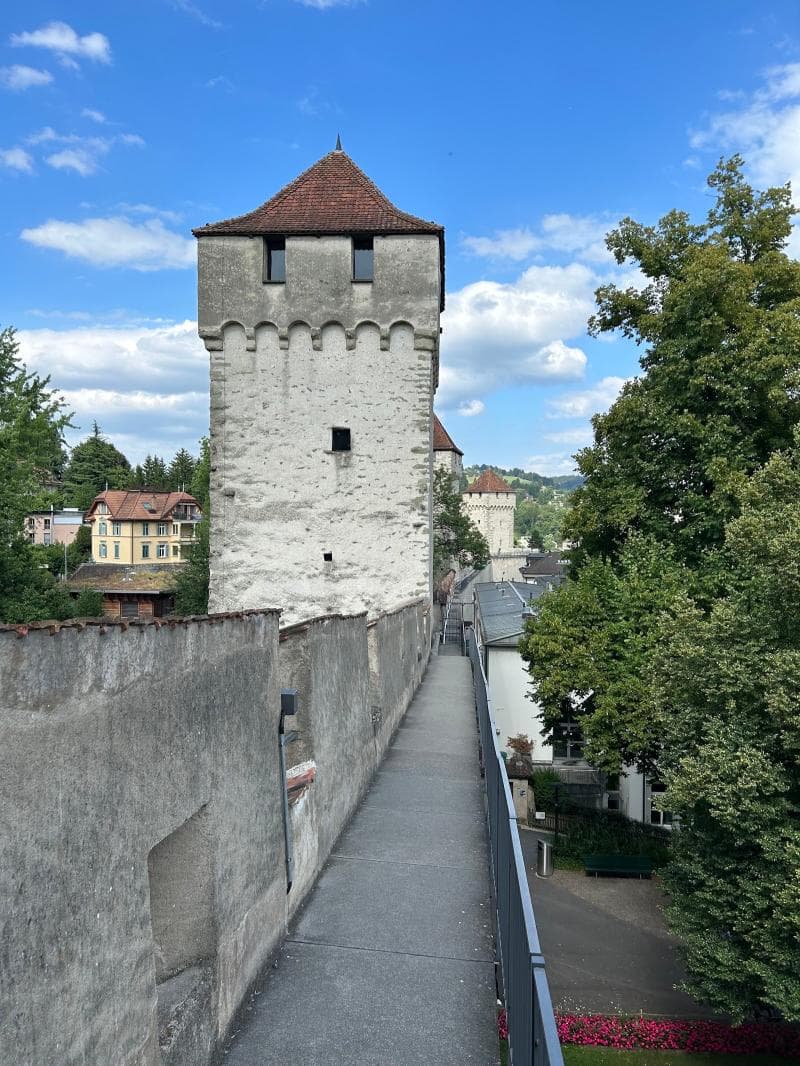
Explore Lucerne's medieval Musegg Wall and its nine towers, offering panoramic views of the city, Lake Lucerne, and the Alps in Switzerland.
Overview
Towering majestically above the charming city of Lucerne, Switzerland, stands the Musegg Wall, a remarkably preserved medieval fortification. Stretching approximately 870 meters, this iconic landmark, locally known as Museggmauer, offers a captivating glimpse into Switzerland's rich past. It is celebrated as one of the longest continuous city walls in the country, crowned by nine distinctive towers that dominate the skyline. Visitors can walk along sections of the wall, exploring several of its historic towers and enjoying breathtaking panoramic views of Lucerne's Old Town, the shimmering Lake Lucerne, and the majestic surrounding Alps.
Constructed primarily in the 14th century, the Musegg Wall served as a crucial defensive barrier for the growing city. Today, it remains a vital piece of Lucerne's cultural heritage and a cherished attraction for curious travelers seeking both history and scenic beauty. Four of the nine towers are accessible to the public, offering unique insights and unparalleled vistas.
History & Cultural Background
Lucerne's fortifications began as early as the 13th century, initially comprising two rings of ramparts. The inner ring included structures like the Chapel Bridge and Spreuer Bridge, while the outer ring, the Musegg Wall, was strategically built on an ascending sandstone ridge on the right bank of the River Reuss.
The main part of the Musegg Wall and its famous towers were constructed between the 14th and 15th centuries, a period when Lucerne needed robust protection as it expanded beyond its initial confines. The wall itself, measuring about 870 meters long, 9 meters high, and 1.5 meters wide, was largely completed around 1400, following significant historical events like the Battle of Sempach. While originally featuring around 30 towers as part of a more extensive defensive system, only nine of these imposing stone structures remain standing today, creating an impressive 'city crown'.
What Makes It Special
What truly sets the Musegg Wall apart is its exceptional state of preservation, making it one of Switzerland's best-maintained medieval defensive structures. It offers a rare opportunity to literally step back in time by walking on the ramparts, just as medieval guards once did. The experience of ascending ancient wooden stairs within the towers and emerging onto battlements provides a tangible connection to the past. Each of the nine towers boasts its own unique character and history, from the round Nölliturm to the tallest Luegislandturm.
The wall's strategic position provides extraordinary 360-degree views. From here, one can survey the entire panorama of Lucerne's picturesque Old Town, the expansive Lake Lucerne, and the dramatic backdrop of the Central Swiss Alps, including Mount Pilatus. This combination of historical immersion and stunning natural beauty makes the Musegg Wall a uniquely compelling destination.
Stories, Fun Facts & Local Details
The Musegg Wall is rich with tales and intriguing details. One of its most famous towers is the Zytturm, or Time Tower, which houses the city's oldest clock mechanism, dating back to 1535. This remarkable clock has a unique privilege: it strikes the hour one minute before all other clocks in Lucerne, a distinctive local tradition that harks back to medieval times when only the full hours truly counted.
Another tower with a dramatic story is the Heuturm, or Hay Tower, also known as the Wachturm (Watchtower). It once stored hay and gunpowder. In 1701, a lightning strike caused the gunpowder to explode, devastating the tower and causing widespread damage and fatalities in the city. The tower was later rebuilt and now stands 44 meters high. The Männli Tower is easily recognizable by its 'iron Männli' figure—a small knight holding a flag and sword atop its pinnacle, an iconic symbol of Lucerne's strength. Several towers, including the Nölli Tower, Pulver Tower, Allenwinden Tower, and Dächli Tower, were leased to various Lucerne guilds over the centuries, serving as guild halls and storage, connecting them deeply to the city's civic life.
Beyond its human history, the Musegg Wall is also an important ecological site. It provides a valuable habitat for specialized flora and fauna, including rare breeding birds like jackdaws, goosanders, and swifts, as well as bats, wall lizards, and a diverse range of insects. Adjacent to the wall, visitors can also find 'Hof Hinter Musegg,' an organic farm that offers a delightful experience with animals and a farm store, particularly popular with families.
Visitor Perspective
Visiting the Musegg Wall offers an immersive and rewarding experience. The wall and its accessible towers are typically open daily from April 1 to November 1, between 8:00 AM and 7:00 PM, with free admission. A leisurely stroll along the entire accessible section of the wall, including climbing a few towers, generally takes about 1.5 to 2 hours. It's important to note that the wall path can be narrow and involves climbing stone stairs, so comfortable shoes are recommended. The Männli, Wacht, Zyt, and Schirmer towers are among those open to the public, allowing visitors to ascend and capture stunning photographs. For a truly memorable moment, consider visiting the Zytturm just before the hour to witness its historic clock striking early. The Musegg Wall serves as more than just a historical monument; it's a living vantage point from which to appreciate Lucerne's enduring beauty and storied past.
Coordinates: 8.305611, 47.054686
View on Google Maps💬 How Travelers Describe This Place
Based on community votes
Must See
886Beautiful
564Unique
201Interesting
121Photogenic
87
Traveler Stories
Discover memorable experiences shared by travelers who have visited this place.
No traveler stories yet.
Be the first traveler to share what made this place memorable.
Things to see at Musegg Wall



Tour
By
Spot
Discover amazing places around the world. Your journey starts here.
Explore
© 2026 TourBySpot. All rights reserved.