Lion Monument
Lucerne, Switzerland
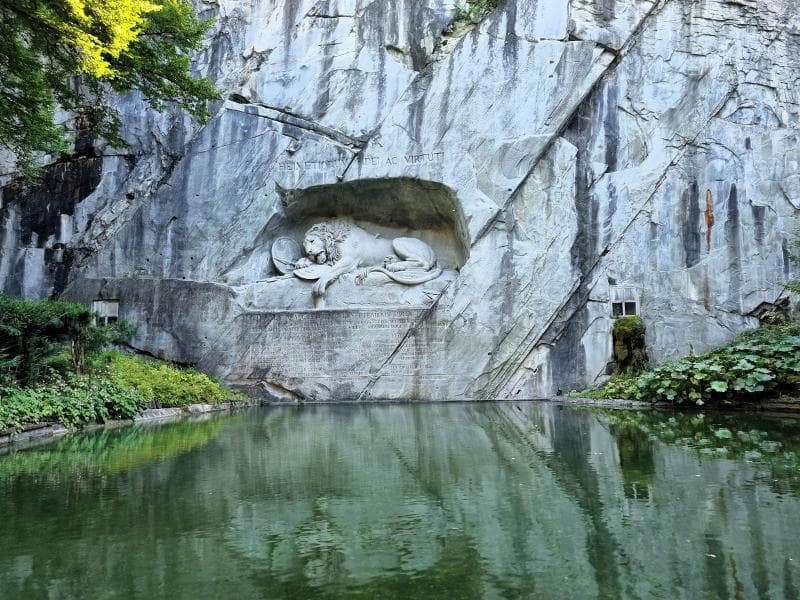
Discover the profound Lion Monument in Lucerne, Switzerland, a majestic rock relief commemorating the Swiss Guards' sacrifice in 1792.
Overview
Nestled within a tranquil rock grotto in Lucerne, Switzerland, the Lion Monument, also known as the Löwendenkmal, stands as a profoundly moving tribute carved directly into a sandstone cliff. This colossal sculpture depicts a dying lion, an enduring symbol designed by Bertel Thorvaldsen and meticulously hewn by Lukas Ahorn between 1820 and 1821. It serves as a poignant memorial to the Swiss Guards who valiantly lost their lives during the tumultuous French Revolution in 1792. Attracting approximately 1.4 million visitors annually, it is recognized as one of Switzerland's most celebrated monuments. American author Mark Twain famously described it as 'the most mournful and moving piece of stone in the world,' a testament to its profound emotional impact on all who witness it.
History & Cultural Background
The story of the Lion Monument begins with a long-standing tradition of Swiss mercenaries, revered throughout Europe for their unwavering loyalty and bravery. From the 17th century, a regiment of these highly respected Swiss Guards served as part of the Royal Household of France, protecting the French monarchy.
The monument specifically commemorates the tragic events of August 10, 1792, during the French Revolution. On this fateful day, revolutionary forces stormed the Tuileries Palace in Paris, where the Swiss Guards were tasked with defending King Louis XVI and his family. Despite being vastly outnumbered, the guards fought with exceptional courage and dedication. The ensuing battle led to a massacre, with over 600 to 1,000 Swiss Guards killed or dying from their wounds. Historical inscriptions on the monument indicate that 760 guards perished, while 350 survived.
The idea for this significant memorial originated from Karl Pfyffer von Altishofen, a Swiss Guard officer who was on leave in Lucerne during the massacre. Deeply affected by the loss of his comrades, Pfyffer dedicated years to establishing a fitting tribute. He successfully raised funds and proposed the site of a former sandstone quarry in Lucerne for the monument. The Latin inscription above the lion, 'HELVETIORUM FIDEI AC VIRTUTI,' translates to 'To the loyalty and bravery of the Swiss,' encapsulating the monument's core message. Beneath the lion, the names of the fallen officers are listed alongside Roman numerals detailing the numbers of those killed and those who survived.
What Makes It Special
The Lion Monument’s profound impact lies in its raw emotional intensity. The colossal sculpture portrays a mortally wounded lion, impaled by a spear, with a look of agony and resignation etched onto its face. One paw rests protectively on a shield bearing the fleur-de-lis of the French monarchy, while another shield, adorned with the Swiss cross, lies beside it, symbolizing their dual allegiance and sacrifice. This powerful imagery conveys not a triumphant victory, but the profound sorrow of loyal sacrifice.
Unlike many monuments celebrating victories, the Lucerne Lion commemorates a tragic defeat, focusing solely on the victims and their unwavering fidelity. This unique perspective contributes significantly to its reputation as 'the most mournful and moving piece of stone.' The setting itself, carved into the natural rock face of a former quarry, creates an immersive and solemn atmosphere. A serene pond at its base often reflects the sculpture, enhancing its dramatic effect and providing a moment of quiet contemplation for visitors. The monument was placed under Swiss monument protection in 2006, recognizing its immense cultural and historical value.
Stories, Fun Facts & Local Details
The personal dedication of Karl Pfyffer von Altishofen is a central narrative to the monument's creation. His tireless efforts ensured that the sacrifice of his fellow guardsmen would never be forgotten, transforming his personal grief into a national memorial. The monument's design by Bertel Thorvaldsen, a renowned Danish sculptor, brought artistic excellence to this commemorative project.
Interestingly, the Lion Monument has not been without its historical complexities. At its inauguration in 1821, some pro-democracy circles criticized it as a tribute to absolute monarchy. Later, during the 20th century, it became a rallying point for certain political movements. However, efforts have been made to emphasize its primary role as a memorial to courage and loyalty, transcending political interpretations.
Adjacent to the monument is the Glacier Garden, a fascinating natural and cultural museum showcasing glacial potholes and fossils from the Ice Age, as well as a mirror labyrinth. This nearby attraction provides an excellent complement to a visit, offering further insights into the region's natural history. Informational boards at the monument, available in multiple languages via QR code, offer deeper historical context, allowing visitors to fully grasp the intricate story behind this powerful stone lion.
Visitor Perspective
The Lion Monument is freely accessible to the public all year round, making it a convenient and essential stop for anyone visiting Lucerne. It is located approximately a 20-minute walk from Lucerne train station. While a visit to the monument itself typically takes about 15 to 30 minutes, allowing time for quiet reflection is highly recommended.
For a truly immersive and peaceful experience, many suggest visiting early in the morning when the crowds are smaller, enabling a deeper connection with the monument's solemnity. The surrounding park, especially vibrant in spring and summer or adorned with the colors of autumn, offers a serene environment perfect for contemplation. Beyond the monument, visitors can explore other nearby Lucerne treasures such as the historic Chapel Bridge, the charming Old Town, and the picturesque Lake Lucerne, making it a central point in a memorable Swiss itinerary.
Coordinates: 8.3108, 47.0583
View on Google Maps💬 How Travelers Describe This Place
Based on community votes
Interesting
951Beautiful
748Must See
499Photogenic
491Unique
427
Traveler Stories
Discover memorable experiences shared by travelers who have visited this place.
No traveler stories yet.
Be the first traveler to share what made this place memorable.
Things to see at Lion Monument



Tour
By
Spot
Discover amazing places around the world. Your journey starts here.
Explore
© 2026 TourBySpot. All rights reserved.