House Of The Black Heads
Riga, Latvia
Discover the House of the Black Heads in Riga, Latvia. Explore its rich history, stunning Dutch Renaissance architecture, and the legacy of its merchant guild.
Overview
The House of the Black Heads, known in Latvian as Melngalvju nams, is an iconic and grand building nestled in the heart of Riga’s Old Town, specifically in Town Hall Square. It stands as a powerful symbol of Riga's rich mercantile history and enduring resilience. Originally constructed in 1334, it served as a bustling hub for various public organizations and merchants, a place for meetings, banquets, and trade. Today, its meticulously reconstructed facade, with its intricate Dutch Renaissance details, immediately captures the eye, making it one of the most photographed landmarks in Latvia. Beyond its stunning exterior, the House of the Black Heads functions as a vibrant museum, concert venue, and ceremonial hall, offering visitors a deep dive into centuries of Riga's cultural and economic life.
History & Cultural Background
The story of the House of the Black Heads begins in 1334, when it was first erected as a 'New House' for Riga’s public life. By the mid-15th century, it became closely associated with the Brotherhood of Blackheads, a distinguished guild of unmarried foreign merchants and shipowners, predominantly German, who played a significant role in Riga's medieval trade. This brotherhood eventually became the building's sole owners in 1713. The guild chose Saint Maurice, often depicted as a Black African knight, as their patron saint, which is the origin of the 'Blackheads' name.
Over centuries, the building underwent several architectural transformations, evolving from its initial medieval form to embrace the opulent Dutch Renaissance style, complete with Mannerist ornamentation in the 17th century. Tragically, this architectural masterpiece faced immense destruction during World War II, bombed on June 29, 1941, and subsequently demolished by Soviet authorities in 1948, leaving the site as ruins. However, the spirit of the building was too integral to Riga's identity to be lost. Following Latvia's renewed independence, a monumental reconstruction effort took place from 1995 to 1999, meticulously rebuilding the house based on historical documents, photographs, and surviving fragments. It was officially reopened on December 9, 1999, embodying the nation's cultural resilience and pride.
What Makes It Special
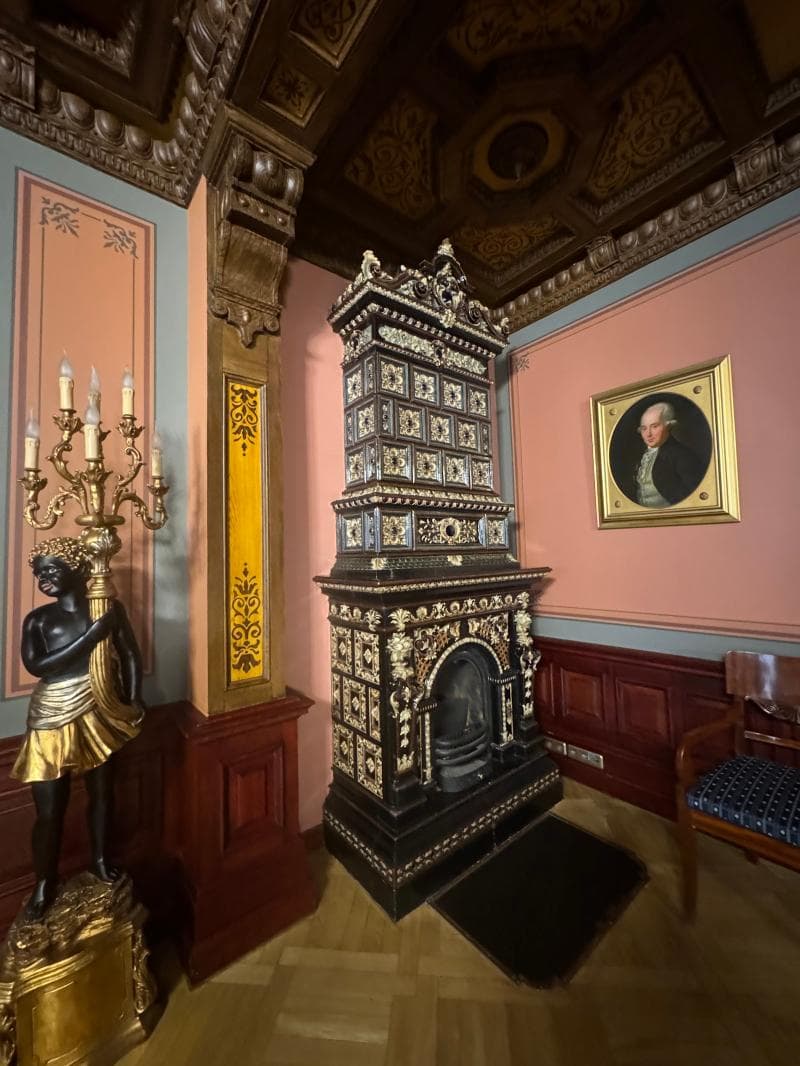
The House of the Black Heads is more than just a reconstructed building; it's a vibrant narrative in brick and stone. What truly makes it special is its remarkable ability to tell the story of Riga’s merchant class and its enduring cultural heritage. Its facade, adorned with intricate sculptures, coats of arms, and an astronomical clock, is a visual feast, reflecting the wealth and influence of its former occupants. Inside, visitors can explore grand ballrooms, where kings, queens, and presidents were once received, and view impressive collections, including antique furniture and ornate silverware. The building's most authentic surviving element, the medieval cellar, offers a tangible link to the original 14th-century structure, having remarkably withstood the wartime destruction.
Stories, Fun Facts & Local Details
- The First Christmas Tree: Legend has it that the Brotherhood of Blackheads is credited with erecting and decorating the first public Christmas tree in Riga in 1510, a tradition that has since spread worldwide. A stone marker outside the building commemorates this festive event.
- A Motto of Resilience: Engraved on the building’s entrance is a poignant motto that speaks volumes about its history: 'Should I ever crumble to dust, rebuild my walls you must'. This inscription foretold its tragic destruction and subsequent rebirth, symbolizing Riga’s unwavering spirit.
- Lively Gatherings: The Brotherhood was renowned for its lavish festivals, banquets, and 'wild parties,' making the house a vibrant center of social life and culture in medieval Riga. Their enthusiasm helped establish the House as a key cultural center.
- Presidential Residence: During the renovation of Riga Castle, the House of the Black Heads temporarily served as the official residence for the President of Latvia from 2012 to 2016, adding another layer to its prestigious history.
Visitor Perspective
Visiting the House of the Black Heads offers an immersive journey into Riga's past. Located conveniently in the central Town Hall Square, it's easily accessible for travelers exploring the Old Town. You can stroll through beautifully restored interiors that evoke the grandeur of bygone eras, imagining the elaborate events that once took place within its walls. The museum exhibitions provide detailed insights into the Brotherhood of Blackheads, Riga’s trade history, and the extensive reconstruction process. Audio guides are available in multiple languages to enrich the experience, allowing for a self-paced and informative tour. While the interiors are a faithful reconstruction, they offer an authentic impression of the building’s former splendor. The House of the Black Heads stands as a testament to history and architectural beauty, offering an enriching experience for anyone interested in Latvia's heritage.
Coordinates: 24.1068, 56.9472
View on Google Maps💬 How Travelers Describe This Place
Based on community votes
Beautiful
791Photogenic
613Unique
514Must See
457Interesting
207
Traveler Stories
Discover memorable experiences shared by travelers who have visited this place.
No traveler stories yet.
Be the first traveler to share what made this place memorable.
Things to see at House Of The Black Heads



Tour
By
Spot
Discover amazing places around the world. Your journey starts here.
Explore
© 2026 TourBySpot. All rights reserved.