Black Heads Museum
Riga, Latvia
Explore the Black Heads Museum in Riga, Latvia, a reconstructed masterpiece showcasing medieval merchant history and Latvian resilience.
Overview
The House of the Black Heads, standing majestically in Riga's Old Town, is far more than just a beautiful building; it is a captivating journey into Latvia's rich mercantile history and cultural resilience. While often referred to as a single entity, the ‘Black Heads Museum’ specifically highlights the historical exhibits and the preserved areas within this grand structure. It serves as a vivid reminder of Riga's past as a vital Hanseatic city and the influential Brotherhood of Blackheads.
Today, this iconic landmark functions as both an event venue and a museum, inviting visitors to explore its opulent halls, discover fascinating artifacts, and delve into the narratives that shaped Riga over centuries. Its striking Dutch Renaissance facade, a meticulous reconstruction, immediately draws the eye and beckons curious travelers inside.
History & Cultural Background
The original building, known initially as the 'New House,' was erected in 1334, serving as a prominent gathering place for Riga's various public organizations and merchants. By the mid-15th century, it became the exclusive domain of the Brotherhood of Blackheads, a formidable guild of unmarried foreign merchants and shipowners. These Blackheads, as they were known, played a crucial role in Riga's medieval trade, economy, and social life, organizing lavish celebrations and influencing the city's cultural landscape.
The Brotherhood took its distinctive name from its patron saint, Saint Maurice, often depicted as a Black African knight, whose image became their emblem – a black Moor's head. The House underwent significant architectural transformations over the centuries, notably adopting a Dutch Renaissance style in the 16th and 17th centuries. Tragically, the building was severely damaged during World War II bombings in 1941 and its ruins were later demolished by Soviet authorities in 1948. However, between 1995 and 1999, the House of the Black Heads was painstakingly rebuilt to its former glory, symbolizing Latvia's enduring spirit and commitment to its heritage.
What Makes It Special
What truly sets the Black Heads Museum apart is its dual identity: a testament to architectural splendor and a repository of living history. The meticulous reconstruction based on historical documents and photographs means that every ornate detail, from the vibrant brickwork to the intricate sculptures, authentically reflects its pre-war magnificence. Inside, visitors can explore various exhibits that bring the Brotherhood's world to life.
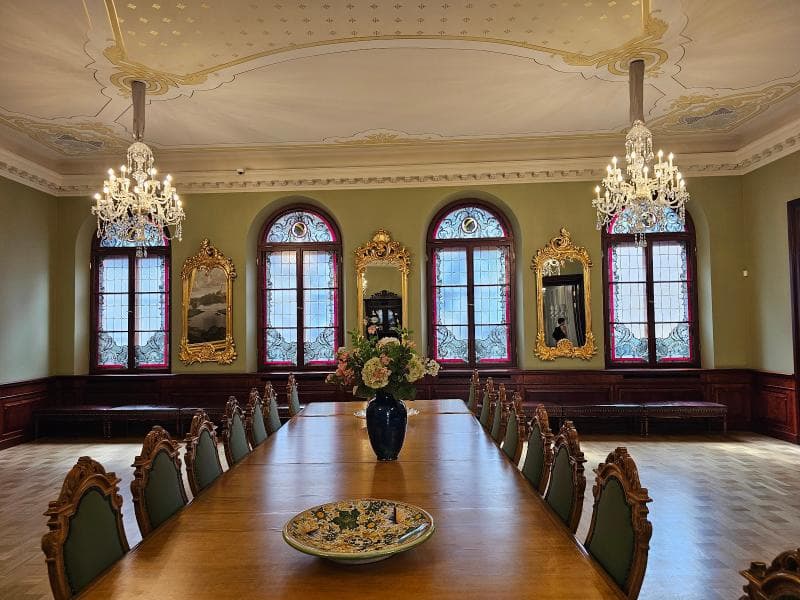
A major highlight is the preserved medieval cellar, the only original part of the building that survived the destruction. Here, one can walk amidst authentic 14th-century Gothic walls and foundations, offering a tangible connection to medieval Riga. The museum also showcases a collection of historical artifacts, including antique furniture, ornate silver, weaponry, and ceremonial items belonging to the Brotherhood, providing insights into their wealth and influence. The Grand Celebration Hall, with its soaring ceilings and rich decorations, frequently hosts concerts and events, allowing visitors to experience the building's historical function as a hub of social and cultural life.
Stories, Fun Facts & Local Details
The story of the House of the Black Heads is rich with intriguing details. The symbol of the black Moor's head, derived from Saint Maurice, is not just a guild emblem but a visual link to centuries of tradition and their role in the Hanseatic League. A delightful, though debated, local legend suggests that the House of the Black Heads, or at least the Brotherhood, might be associated with the tradition of the first decorated Christmas tree in 1510, a charming thought for any winter visitor.
During its reconstruction, a unique public initiative allowed individuals to donate money and have their names inscribed on a brick, contributing directly to the rebuilding of this cherished national symbol. This 'I build the House of the Black Heads' project garnered over 5,000 participants, embedding community spirit into its very foundations. Furthermore, the building temporarily served as the official residence for the President of Latvia between 2012 and 2016 while Riga Castle underwent renovations, adding another layer to its esteemed history.
Visitor Perspective
A visit to the Black Heads Museum offers a truly immersive historical experience. As you step inside, you are transported from Riga's bustling Town Hall Square into an era of powerful merchant guilds and grand celebrations. The blend of impressive architecture and well-curated exhibits creates a captivating atmosphere, making history accessible and engaging. You can wander through the various rooms, each telling a part of the building's storied past, from the meticulously recreated interiors to the ancient cellar where Riga's foundations lie.
The museum provides clear explanations and context, making it easy for any curious traveler to understand the significance of the Brotherhood and the building itself. Whether you are an architecture enthusiast, a history buff, or simply a traveler looking to connect with the heart of Riga, the House of the Black Heads offers a meaningful and memorable experience, embodying the city's rich heritage and its triumph over adversity.
Coordinates: 24.10878, 56.94793
View on Google Maps💬 How Travelers Describe This Place
Based on community votes
Interesting
953Beautiful
695Photogenic
658Must See
396Unique
22
Traveler Stories
Discover memorable experiences shared by travelers who have visited this place.
No traveler stories yet.
Be the first traveler to share what made this place memorable.

Tour
By
Spot
Discover amazing places around the world. Your journey starts here.
Explore
© 2026 TourBySpot. All rights reserved.