Hofkirche Innsbruck
Innsbruck, Austria
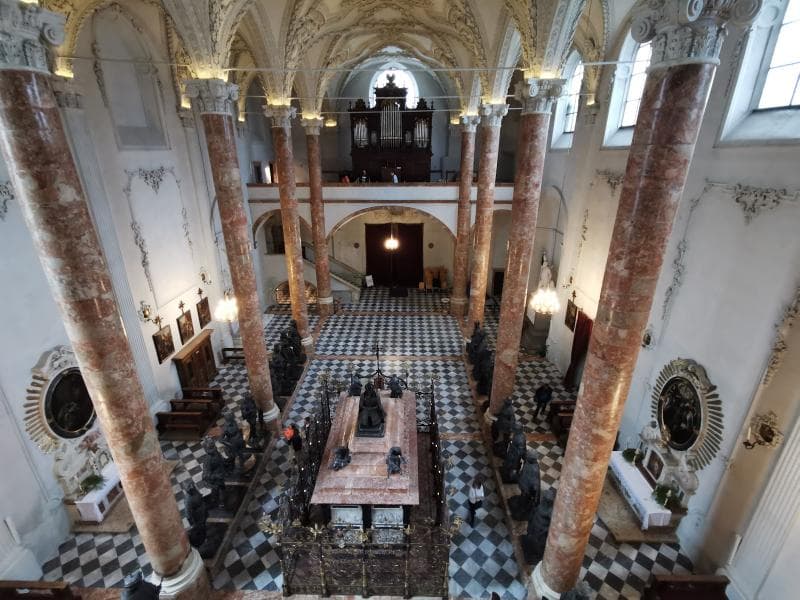
Explore Hofkirche Innsbruck, Austria's Imperial Court Church, home to Emperor Maximilian I's cenotaph and the legendary 'Black Men' bronze statues.
Overview
Hofkirche Innsbruck, also known as the Court Church or 'Schwarzmander Church' (Black Men's Church), stands as a significant historical and artistic monument in Innsbruck, Austria. Built in the 16th century, its primary purpose was to house a magnificent cenotaph for Emperor Maximilian I, though his actual remains lie elsewhere. This Gothic church, with strong Renaissance influences, is renowned for its unique collection of art and historical artifacts. It forms an integral part of the Tyrolean State Museums, sharing an entrance with the Tyrolean Folk Art Museum, inviting visitors into a rich tapestry of regional history and imperial legacy.
History & Cultural Background
The Hofkirche's story begins with Emperor Ferdinand I, who commissioned its construction between 1553 and 1563 as a memorial to his illustrious grandfather, Emperor Maximilian I. Maximilian, a pivotal figure in the Habsburg dynasty, had meticulously planned an elaborate tomb during his lifetime, even supervising the designs for a grand memorial. However, his dying wish was to be buried in Wiener Neustadt. Due to the immense weight of the bronze statues intended for his tomb, the ambitious project could not be realized there. Consequently, Ferdinand I proceeded with the church in Innsbruck, creating a grand cenotaph – a symbolic tomb – for his grandfather. The church also became the final resting place for other notable figures, including Archduke Ferdinand II and his wife Philippine Welser in the Silver Chapel, and the revered Tyrolean freedom fighter Andreas Hofer.
What Makes It Special
What truly sets the Hofkirche apart is its awe-inspiring centerpiece: the empty sarcophagus of Emperor Maximilian I, surrounded by twenty-eight larger-than-life bronze statues. These figures, known as the 'Schwarzmander' or 'Black Men,' depict Maximilian's ancestors and heroic role models, showcasing an extraordinary display of German Renaissance sculpture. The cenotaph itself is adorned with twenty-four intricately carved marble reliefs illustrating significant moments from Maximilian's life. Another highlight is the mid-16th-century Renaissance organ crafted by Jörg Ebert, considered one of the oldest and most important playable organs in the world, with its exquisite panels painted by Domenico Pozzo. The Silver Chapel, with its ornate silver altar and the tombs of Archduke Ferdinand II and Philippine Welser, adds another layer of artistic and historical richness.
Stories, Fun Facts & Local Details
The Hofkirche carries the popular nickname 'Schwarzmander Church' due to its impressive array of bronze statues, though it's interesting to note that among the 'Black Men' are also several women, including Maximilian's wives, Mary of Burgundy and Bianca Maria Sforza. Legend even has it that King Arthur of England is depicted among these figures, reflecting Maximilian's desire to connect his lineage to legendary heroes. Maximilian himself was deeply concerned with his legacy, even traveling with his own coffin at one point. The decision to build the cenotaph in Innsbruck, rather than Maximilian's preferred Wiener Neustadt, was purely practical: the bronze figures were too heavy for the original chapel. The reburial of Tyrolean national hero Andreas Hofer in the church in 1823, years after his execution, further intertwines the Hofkirche with local identity and history.
Visitor Perspective
Visiting the Hofkirche offers a journey back in time, beginning with entry through the Tyrolean Folk Art Museum. This integrated approach provides a broader cultural context for the church. It is recommended to allocate at least an hour to fully appreciate the intricate stucco work, paintings, and particularly the details of the 'Black Men' and Maximilian's cenotaph. Many visitors find the multimedia experience about Maximilian I's life, available at the beginning of the visit, to be a valuable introduction. The Innsbruck City Card can offer a cost-effective way to explore the Hofkirche and other local attractions. Photography is generally allowed, but visitors are encouraged to be respectful within the sacred space.
Coordinates: 11.3953, 47.2683
View on Google Maps💬 How Travelers Describe This Place
Based on community votes
Interesting
996Photogenic
726Beautiful
494Unique
193Must See
125
Traveler Stories
Discover memorable experiences shared by travelers who have visited this place.
No traveler stories yet.
Be the first traveler to share what made this place memorable.
Things to see at Hofkirche Innsbruck



Tour
By
Spot
Discover amazing places around the world. Your journey starts here.
Explore
© 2026 TourBySpot. All rights reserved.