Imperial Tomb
Innsbruck, Austria
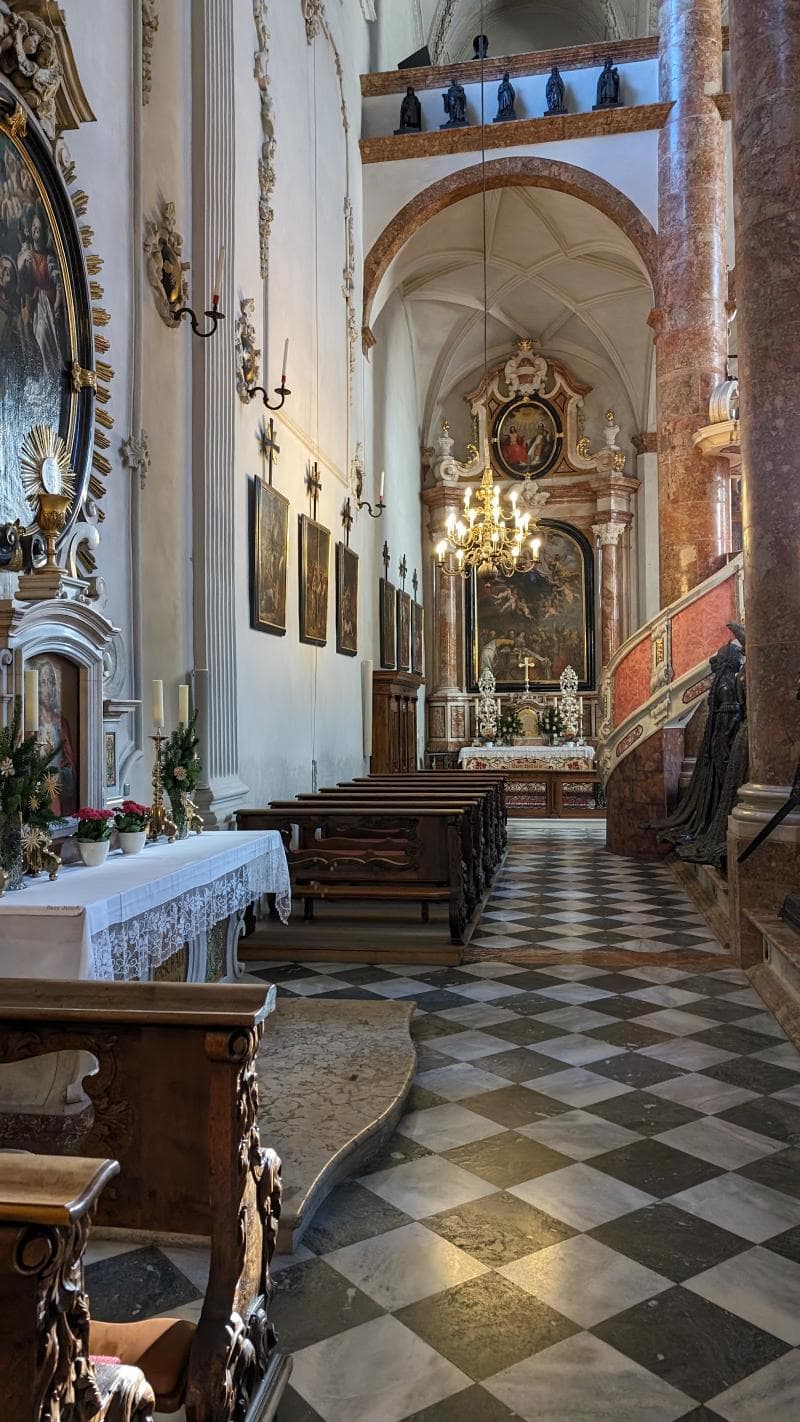
Discover the Imperial Tomb within Hofkirche Innsbruck, Austria. Explore Emperor Maximilian I's empty cenotaph and 28 bronze 'Schwarze Mander' statues.
Overview
Step into the Hofkirche in Innsbruck, Austria, and you'll immediately sense the profound historical significance of the 'Imperial Tomb' within. This isn't just a tomb; it's a grand cenotaph dedicated to Emperor Maximilian I, a pivotal figure in European history, whose legacy is immortalized here in a truly magnificent way. While Maximilian I's actual remains lie in Wiener Neustadt, this elaborate memorial was conceived as his lasting tribute, a powerful symbol of Habsburg ambition and artistry.
The centerpiece is a striking black marble sarcophagus, but what truly captivates visitors is the silent guard surrounding it: 28 larger-than-life bronze figures, known affectionately as the 'Schwarze Mander' or 'Black Men.' These monumental statues, representing ancestors, heroes, and role models, create an awe-inspiring processional display that transports you back to the Renaissance era.
History & Cultural Background
The genesis of this 'Imperial Tomb' traces back to Emperor Maximilian I himself, who, in 1502, began commissioning a grandiose funeral monument. He envisioned an impressive array of 40 bronze statues to accompany him into eternity, a project intended to glorify his lineage and uphold the splendor of the Habsburg dynasty. However, the project remained unfinished at his death in 1519, and his wish to be buried in Wiener Neustadt was fulfilled.
It was Maximilian's grandson, Emperor Ferdinand I, who took on the monumental task of completing this artistic vision. Recognizing the immense artistic and political importance of the memorial, Ferdinand I ordered the construction of the Hofkirche in Innsbruck between 1553 and 1563 specifically to house this magnificent, albeit empty, tomb and its bronze guardians. The entire ensemble was finally completed in 1584 under Archduke Ferdinand II. This enduring effort involved some of the most prominent artists of the time, including Albrecht Dürer, who provided designs, and master casters who brought the intricate figures to life.
What Makes It Special
The sheer scale and artistic ambition of Maximilian's cenotaph and the 'Schwarze Mander' set it apart as one of Europe's most impressive imperial tombs. Each of the 28 bronze statues is a masterpiece of Renaissance sculpture, meticulously detailed to capture clothing, armor, and individual facial features. Some figures weigh up to two tons, a testament to the advanced bronze-casting technology of the 16th century.
The central sarcophagus itself features a kneeling bronze figure of Emperor Maximilian I in prayer. Surrounding its base are 24 exquisite marble reliefs, each depicting a significant event from Maximilian's life, from military victories to his marriages. These reliefs serve as a visual narrative, a 'historical comic strip' that chronicles his reign and achievements. The deliberate contrast of dark bronze and white marble adds to the monument's dramatic impact.
Stories, Fun Facts & Local Details
- The 'Black Men' Misnomer: Despite their nickname 'Schwarze Mander' (Black Men), eight of the 28 statues are actually women, including Maximilian's two wives. The name stuck due to the dark patina the bronze developed over centuries. Locals sometimes even refer to the Hofkirche as the 'Schwarzmanderkirche.'
- King Arthur's Presence: Among the diverse group of historical and legendary figures guarding the tomb is King Arthur, whose iconic statue was designed by none other than Albrecht Dürer. This inclusion highlights Maximilian's desire to connect his lineage with revered heroes and legendary rulers.
- An Empty Tomb: One of the most fascinating aspects is that this grand monument is an empty tomb, a cenotaph. Maximilian I is actually buried in the castle chapel in Wiener Neustadt. The Innsbruck monument served as a symbolic resting place and a powerful statement of his enduring legacy.
- Beyond the Cenotaph: The Hofkirche also houses other treasures, including the beautiful Silver Chapel, the final resting place of Archduke Ferdinand II and his wife Philippine Welser, and the tomb of the Tyrolean freedom fighter Andreas Hofer. The church also boasts the Ebert Organ, a more than 450-year-old Renaissance instrument still in use today.
Visitor Perspective
Visiting the Hofkirche offers a truly immersive historical and artistic experience. As you walk among the silent bronze figures, you can't help but feel a profound connection to a bygone era. The sheer artistry and meticulous detail of the statues and reliefs invite close inspection, revealing stories of power, ambition, and artistic excellence. The cool, contemplative atmosphere of the church, enhanced by its Gothic architecture, provides a fitting backdrop for reflecting on the life and legacy of Emperor Maximilian I.
Access to the Hofkirche is typically through the adjacent Tyrolean Folk Art Museum, creating a seamless cultural journey. Allow ample time to fully appreciate the monument, delve into the stories of the 'Schwarze Mander,' and explore the other significant areas of the church, such as the Silver Chapel. It's a place where history truly comes alive, offering a unique glimpse into the heart of the Habsburg Empire.
Coordinates: 11.39525, 47.26839
View on Google Maps💬 How Travelers Describe This Place
Based on community votes
Photogenic
898Unique
618Beautiful
449Interesting
308Must See
22
Traveler Stories
Discover memorable experiences shared by travelers who have visited this place.
No traveler stories yet.
Be the first traveler to share what made this place memorable.

Tour
By
Spot
Discover amazing places around the world. Your journey starts here.
Explore
© 2026 TourBySpot. All rights reserved.