Helsinki Cathedral
Helsinki, Finland
Explore Helsinki Cathedral, a stunning Neoclassical landmark in Helsinki, Finland. Discover its history, iconic white facade, and vibrant Senate Square setting.
Overview
Helsinki Cathedral, known locally as Helsingin tuomiokirkko, stands as a majestic beacon overlooking Senate Square in the heart of Helsinki, Finland. This iconic white neoclassical landmark, with its striking green dome and four smaller cupolas, is arguably the most recognizable building in the city and a powerful symbol of the Finnish capital. As the Finnish Evangelical Lutheran Cathedral of the Diocese of Helsinki, it holds significant religious and cultural importance. Its grandeur and prominent position make it an unmissable sight for anyone visiting the city, offering a serene escape amidst the bustling urban environment.
History & Cultural Background
The history of Helsinki Cathedral is deeply intertwined with Finland's past as a Grand Duchy under Russian rule. Construction began in 1830 and concluded in 1852, a monumental undertaking that spanned over two decades. The church was originally designed by the renowned German architect Carl Ludvig Engel, who also masterminded the entire Senate Square complex. Engel's vision for Helsinki was to create a new imperial capital that echoed the Neoclassical grandeur of St. Petersburg. Following Engel's death in 1840, the work was continued by architect Ernst Bernhard Lohrmann, who added the four smaller domes and the statues of the Twelve Apostles that adorn the roofline.
Initially consecrated as the St. Nicholas Church, it served as a tribute to Tsar Nicholas I of Russia, who initiated the building project and was also the Grand Duke of Finland. After Finland gained its independence in 1917, the church's name was changed to Suurkirkko, or 'Great Church'. It was officially designated as Helsinki Cathedral in 1959 when the Diocese of Helsinki was formed. Before its construction, a smaller Ulrika Eleonora Church, completed in 1727, stood on the site. Today, a bell from that earlier church is preserved in Helsinki Cathedral's central tower, connecting its past to the present.
What Makes It Special
Helsinki Cathedral's architectural brilliance lies in its pure Neoclassical style, characterized by clean lines, symmetrical design, and impressive scale. The church is built in the shape of a Greek cross, meaning it has a central square and four arms of equal length, each featuring a colonnade and pediment. Its most distinguishing feature is the central dome, rising over 80 meters above sea level, surrounded by four smaller domes, all painted a vivid green that contrasts beautifully with the stark white facade.
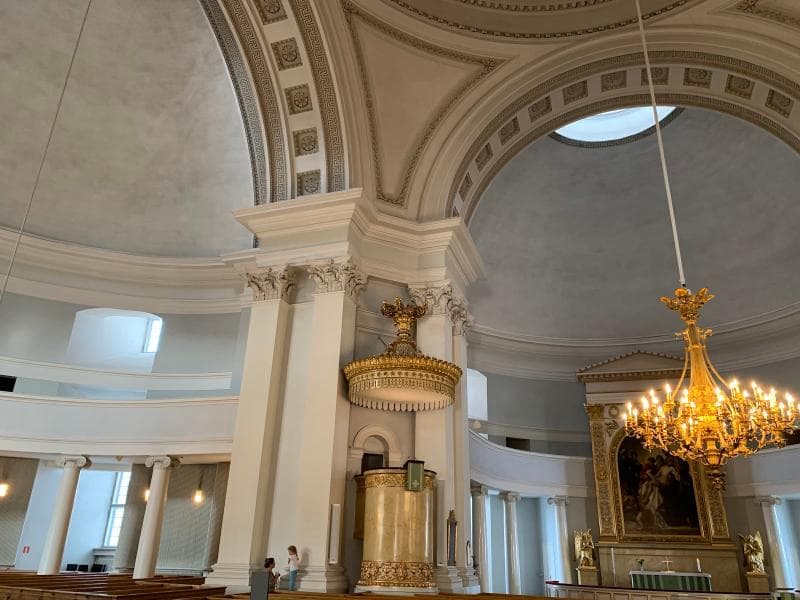
Perhaps one of its most unique elements is the collection of twelve zinc statues depicting the Apostles, which stand guard on the roof. These sculptures, cast in Berlin and installed in the late 1840s, comprise one of the world's largest uniform collections of zinc sculptures. Inside, the cathedral's interior is remarkably minimalist and austere, reflecting the Lutheran tradition. Natural light floods the whitewashed space through high windows, highlighting a modest altarpiece by Carl Timoleon von Neff, which was donated by Emperor Nicholas I.
Stories, Fun Facts & Local Details
The grandeur of Helsinki Cathedral extends beyond its architecture to the atmosphere it creates for both locals and visitors. The imposing flight of 60-meter-wide steps leading up to the main entrance from Senate Square was specifically ordered by Nicholas I to replace a guard post. These steps have become a popular spot for people to gather, relax, and soak in the city's ambiance, especially during sunny summer days. It's not uncommon to see students, tourists, and locals alike lounging on the steps, enjoying the panoramic views of Senate Square.
The Cathedral's Crypt, accessible from Kirkkokatu 18, once housed a basement with heating equipment and log cellars. Renovated in the 1970s and later improved, it now serves as a vibrant meeting place for the parish, hosting services, concerts, and art exhibitions. During the summer months, the Crypt even transforms into a charming cafe, offering a unique setting for refreshments. The cathedral is also known for its organs; while the first organ concert was held in 1847, the current main organ, with 57 stops, was manufactured in 1967.
Visitor Perspective
Visiting Helsinki Cathedral is an essential experience for any traveler to Finland's capital. It is generally open daily, though hours can vary depending on seasons and church events. While entry has typically been free, during certain periods (e.g., June to October), a modest admission fee may apply for tourists, with under-18s usually entering for free. The cathedral welcomes all, whether for quiet contemplation, to admire its architecture, or to attend services.
For those with mobility needs, accessible entrance is available through the Crypt. The cathedral's central location in Senate Square means it is surrounded by other significant landmarks, including the Government Palace and the main building of the University of Helsinki, making it easy to integrate into a broader walking tour of the city. Its striking presence and rich history offer a profound glimpse into Finland's cultural and architectural heritage, making it a truly memorable destination.
Coordinates: 24.95222, 60.17028
View on Google Maps💬 How Travelers Describe This Place
Based on community votes
Unique
953Must See
695Interesting
658Photogenic
69Beautiful
22
Traveler Stories
Discover memorable experiences shared by travelers who have visited this place.
No traveler stories yet.
Be the first traveler to share what made this place memorable.
Things to see at Helsinki Cathedral



Tour
By
Spot
Discover amazing places around the world. Your journey starts here.
Explore
© 2026 TourBySpot. All rights reserved.