Main Cathedral Hall
Helsinki, Finland
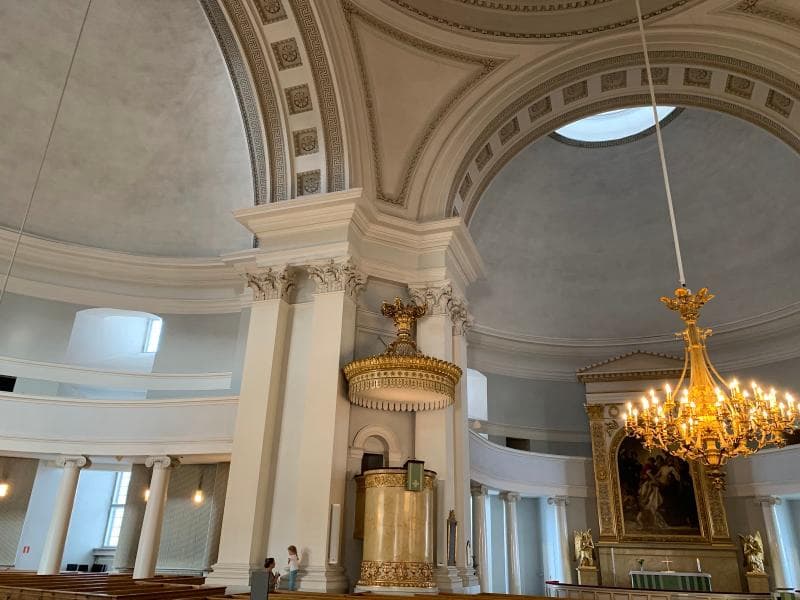
Explore the Main Cathedral Hall of Helsinki Cathedral in Finland, a stunning Neoclassical masterpiece of serene white walls and grand architecture.
Overview
Stepping into the Main Cathedral Hall of Helsinki Cathedral is an experience that immediately conveys both grandeur and serene simplicity. This majestic space, located within the iconic Neoclassical landmark of Helsinki, Finland, is characterized by its brilliant white walls, soaring ceilings, and a pervasive sense of openness. The hall follows a Greek cross plan, meaning its four arms are of equal length, creating a symmetrical and harmonious interior that feels both vast and welcoming. Natural light streams through high windows, illuminating the carefully chosen details and contributing to the hall's tranquil atmosphere. The primary function of this hall is as a place of worship and contemplation for the Evangelical Lutheran Church of Finland, accommodating services, concerts, and significant national events throughout the year.
As the central heart of the cathedral, the Main Cathedral Hall houses key elements of Lutheran worship, including the altar, an impressive altarpiece, and the pulpit. The overall design emphasizes clarity and light, reflecting the Lutheran tradition's focus on the word and music.
History & Cultural Background
The history of Helsinki Cathedral's Main Hall is deeply intertwined with Finland's past as a Grand Duchy under Russian rule. Construction of the cathedral, initially known as St. Nicholas's Church, began in 1830 and was consecrated in 1852. It was designed by the renowned German architect Carl Ludvig Engel, who envisioned it as the focal point of Helsinki's Empire-style city center.
Engel's work, which shaped much of Helsinki's core, was continued by Ernst Bernhard Lohrmann after Engel's death in 1840. Lohrmann made several additions, including the four smaller corner domes and the impressive zinc statues of the Twelve Apostles that adorn the roofline, which subtly influence the light entering the main hall. The cathedral's design, with its Greek cross plan, is believed to have been inspired by Russian cathedrals like Saint Isaac's Cathedral and Kazan Cathedral in St. Petersburg, demonstrating the era's Russian imperial influence.
After Finland gained independence in 1917, the church was renamed Suurkirkko ('Great Church') and later, in 1959, officially became Helsinki Cathedral. It transitioned from a tribute to a Russian Tsar to a powerful symbol of Finnish national identity and resilience. The Main Hall has since served as a significant venue for national celebrations, academic ceremonies, and regular church services, cementing its role as both an architectural masterpiece and a living cultural institution.
What Makes It Special
The Main Cathedral Hall distinguishes itself through its striking Neoclassical aesthetic, which combines monumental scale with an understated elegance. Its Greek cross floor plan ensures perfect symmetry from all four cardinal directions, contributing to a balanced and uplifting interior space. The soaring central dome, rising to over 80 meters above sea level, creates a powerful sense of verticality and light within the hall.
Within this expansive space, the eye is drawn to the main altar, situated at the eastern end, in keeping with traditional church orientation. Above the altar hangs a compelling altarpiece, a painting by Carl Timoleon von Neff depicting the Entombment of Jesus, which was a gift from Emperor Nicholas I. The wooden pulpit, crafted according to Engel's own drawings, also features prominently, covered in marble plaster and surmounted by a baldachin symbolizing God's kingship.
Another significant feature is the cathedral's main organ. The current instrument, built by Danish company Marcussen & Son in 1967, boasts 57 stops and fills the vast hall with rich sound during services and numerous concerts. Statues of key figures of the Lutheran Reformation—Martin Luther, Philipp Melanchthon, and Mikael Agricola—also stand within the hall, reinforcing its Lutheran identity.
Stories, Fun Facts & Local Details
The Main Cathedral Hall is not merely a static monument but a vibrant space steeped in stories. It's often called the 'white church' due to its pristine interior, a conscious design choice that reflects the Lutheran spirit of austerity and focus on spirituality rather than excessive ornamentation. Despite this simplicity, the golden chandeliers are a notable exception, a requirement for a Lutheran cathedral that adds a touch of warmth and glow to the white expanse.
The cathedral's steps, leading up to the main entrance and the hall, are a famous meeting point and a popular spot for large public gatherings, concerts, and even academic ceremonies, including the opening and closing of parliament. The imposing structure and its central location make it a natural stage for significant local and national events, becoming a true 'living heritage' site.
The current main organ, a later addition, replaced an earlier instrument from the mid-19th century. Music plays a central role here, with the hall regularly hosting organ recitals and concerts that take full advantage of its excellent acoustics. The interior's blend of grandeur and minimalism creates a unique sensory experience, offering visitors a quiet respite from the bustling city life outside.
Visitor Perspective
For visitors, entering the Main Cathedral Hall provides an immediate sense of calm and reverence. The expansive, light-filled space encourages quiet contemplation and an appreciation for the architectural skill involved in its creation. The sparse yet impactful decoration, focusing on significant religious symbols and figures, allows one to easily absorb the spiritual essence of the place without distraction. Many find themselves drawn to the altar and its altarpiece, reflecting on the artistry and meaning.
Walking through the hall, one can imagine the countless services, weddings, and baptisms that have taken place here, each contributing to the cathedral's rich tapestry of communal life. The clear sightlines and abundant natural light make it easy to appreciate the Greek cross layout and the impressive scale of the architecture. Whether attending a service, a concert, or simply seeking a moment of peace, the Main Cathedral Hall offers a deeply moving and memorable experience, connecting visitors to Helsinki's history, faith, and cultural heart. While the main entrance involves climbing significant steps, wheeled access is thoughtfully provided via the Crypt entrance at Kirkkokatu 18.
Coordinates: 24.95222, 60.17028
View on Google Maps💬 How Travelers Describe This Place
Based on community votes
Unique
910Beautiful
755Photogenic
658Interesting
374Must See
28
Traveler Stories
Discover memorable experiences shared by travelers who have visited this place.
No traveler stories yet.
Be the first traveler to share what made this place memorable.

Tour
By
Spot
Discover amazing places around the world. Your journey starts here.
Explore
© 2026 TourBySpot. All rights reserved.