Frankfurt Cathedral
Frankfurt, Germany
Explore Frankfurt Cathedral, the historic election and coronation church of Holy Roman Emperors in Frankfurt, Germany. Discover its Gothic beauty and imperial past.
Overview
Steeped in centuries of history, Frankfurt Cathedral, officially known as the Imperial Cathedral of Saint Bartholomew (Kaiserdom St. Bartholomäus), stands proudly in the heart of Frankfurt, Germany. This magnificent Roman Catholic Gothic church is the largest religious edifice in the city, instantly recognizable by its distinctive red sandstone and towering 95-meter spire. While commonly referred to as a cathedral, it was never actually the seat of a bishop. Instead, its 'Imperial Cathedral' title stems from its unparalleled historical role as the election and coronation site for Holy Roman Emperors for centuries, a distinction that firmly establishes its significance in German history.
Its imposing architecture and rich past make it a central landmark, drawing visitors to explore its depths and marvel at its enduring legacy. The interior offers a serene escape, characterized by soaring vaulted ceilings, intricate stonework, and beautiful stained-glass windows, some of which feature abstract designs due to post-war reconstruction.
History & Cultural Background
The site of Frankfurt Cathedral has been a place of worship since the 7th century, with archaeological findings suggesting a small Merovingian chapel was present even before 680 CE. The current Gothic structure, dedicated to Saint Bartholomew, began to take shape around the 13th century, with construction primarily spanning from 1250 to 1514. However, the iconic west tower was only completed much later in 1878, following a devastating fire in 1867.
Its most profound historical role began in 1356 with the Golden Bull of Emperor Charles IV, which designated it as the official site for the election of German kings. From 1562 to 1792, ten Holy Roman Emperors were crowned within its walls, solidifying its status as a symbol of national unity and a key political center of the Holy Roman Empire. The cathedral suffered significant damage during World War II bombings in 1944, particularly to its interior, but was painstakingly restored in the mid-20th century, preserving its historical essence.
What Makes It Special
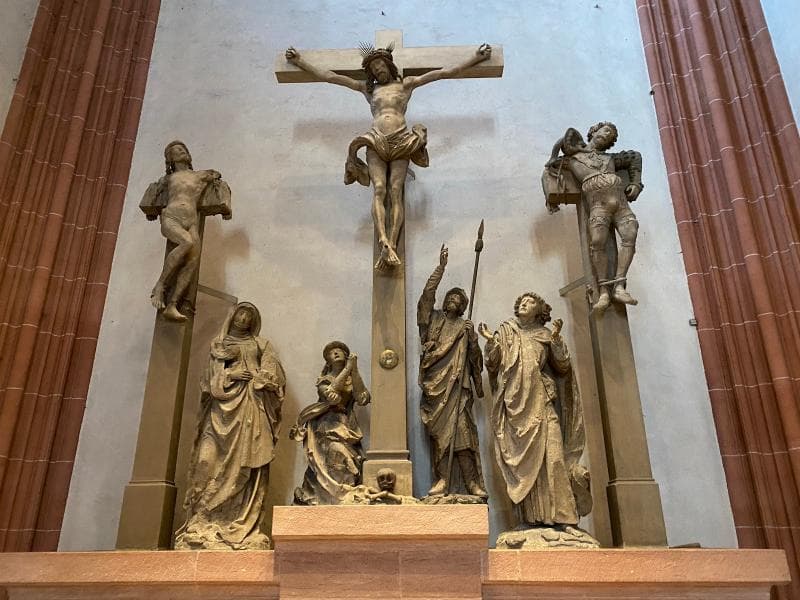
What truly sets Frankfurt Cathedral apart is its unique dual identity: a magnificent example of Gothic architecture and an irreplaceable monument to the Holy Roman Empire. The 'Wahlkapelle' or Election Chapel, an intimate vaulted room, was where imperial elections took place, with 16 out of 23 German emperors elected there. The main interior features significant artworks, including the 15th-century Gothic retable depicting the life of Jesus Christ, the 1434 Maria Schlaf Altar, and finely carved 14th-century choir stalls.
The cathedral also houses a valuable relic: a skullcap of Saint Bartholomew the Apostle, which has been preserved since the 13th century. Its red sandstone facade and its impressive height of 95 meters make it a striking visual landmark that has defined Frankfurt's skyline for centuries.
Stories, Fun Facts & Local Details
- Some locals affectionately refer to the cathedral's west tower as 'Frankfurt's first skyscraper,' given its impressive height that dominated the cityscape back in the 15th century.
- During excavations in the early 1990s, the grave of a rich noble girl from the 7th century was discovered beneath the cathedral, her burial marked by a sandstone slab near the west entrance.
- Despite its grand name, the term 'Dom' in German often refers to a main city church, not necessarily a bishop's seat, explaining why it's called a cathedral without ever having been one in the ecclesiastical sense.
- The majestic sound of its nine bells, cast in 1877, resonates through the city, adding to the cathedral's evocative atmosphere.
- The cathedral's resilience is remarkable; after being severely damaged by fire in 1867 and then by WWII bombings in 1944, it was rebuilt each time, showcasing the city's determination to preserve its heritage.
Visitor Perspective
Visiting Frankfurt Cathedral offers a journey through time and a chance for quiet contemplation. Entry to the main interior is free, allowing travelers to admire the architectural grandeur and historical artifacts at their own pace. For those seeking panoramic vistas, an ascent up the 328 steps of the Gothic tower is a must. From a viewing platform approximately 66 meters high, visitors are rewarded with breathtaking 360-degree views of Frankfurt's historic Old Town, the winding Main River, and the striking modern skyline. This climb offers a unique perspective on the city's blend of ancient and contemporary.
Adjacent to the main church, the Dommuseum Frankfurt houses a treasury with precious liturgical objects and significant finds from the cathedral's history, including artifacts from the Merovingian girl's grave. The cathedral is also a cultural hub, hosting religious ceremonies, organ recitals, and concerts throughout the year, enriching the visitor experience with spiritual and artistic depth. Conveniently located near the Römerberg square, it's easily accessible and often included in walking tours of Frankfurt's historic center.
Coordinates: 8.685, 50.11056
View on Google Maps💬 How Travelers Describe This Place
Based on community votes
Must See
934Beautiful
276Photogenic
152Unique
30Interesting
16
Traveler Stories
Discover memorable experiences shared by travelers who have visited this place.
No traveler stories yet.
Be the first traveler to share what made this place memorable.
Things to see at Frankfurt Cathedral



Tour
By
Spot
Discover amazing places around the world. Your journey starts here.
Explore
© 2026 TourBySpot. All rights reserved.