Nave
Frankfurt, Germany
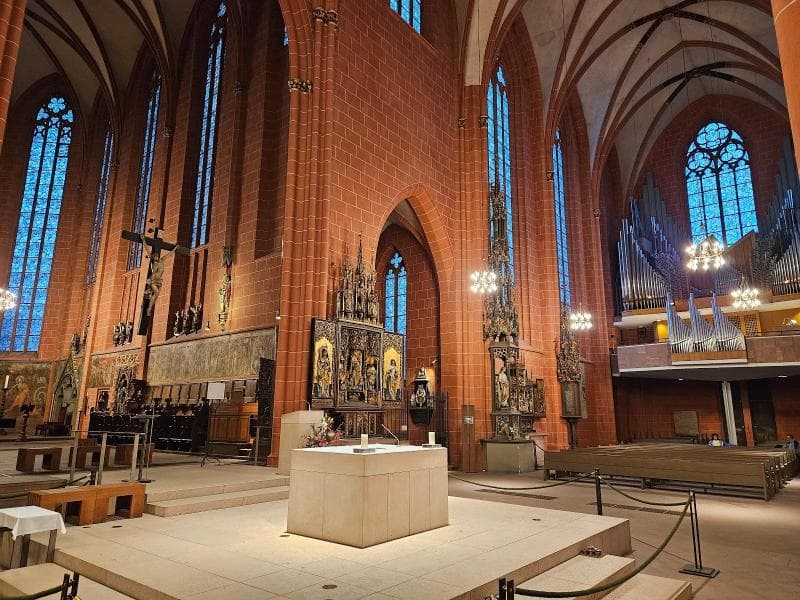
Explore the historic Nave of Frankfurt Cathedral (Kaiserdom St. Bartholomäus) in Frankfurt, Germany. Discover centuries of imperial history and stunning Gothic architecture.
Overview
Stepping into the Nave of Frankfurt Cathedral, officially known as the Imperial Cathedral of Saint Bartholomew (Kaiserdom St. Bartholomäus), is like walking through centuries of European history. Located in the heart of Frankfurt, Germany, this magnificent Gothic church stands as the city's largest religious building. Constructed primarily between the 14th and 15th centuries, its distinctive red sandstone facade and soaring 95-meter spire dominate the cityscape.
Despite its common English name, the Frankfurt Cathedral has never officially been a bishop's seat, hence it is technically a collegiate church rather than a true cathedral. However, its immense historical and cultural significance, particularly its role in imperial elections and coronations, earned it the honorary title of 'Kaiserdom' or 'Imperial Cathedral'. The interior features a grand hall church layout with three naves, with the central nave flanked by two aisles, creating an awe-inspiring sense of space and verticality.
History & Cultural Background
The site where Frankfurt Cathedral now stands has been a place of worship since the 7th century, with archaeological findings suggesting a Merovingian chapel existed here around 680 AD. Over time, successive churches were built, including the Savior's Church consecrated in 852, which was later rededicated to Saint Bartholomew in 1239.
The cathedral's profound importance in European history began in 1356, when Emperor Charles IV decreed it the official election church of the Holy Roman Empire, a role it maintained until 1792. Furthermore, from 1562 to 1792, ten Holy Roman Emperors were crowned within its sacred walls, solidifying its status as a symbol of imperial power and German national unity. The current Gothic structure you see today took shape largely between 1250 and 1514.
The cathedral has endured its share of trials, suffering a devastating fire in 1867, after which it was rebuilt by Franz Josef Denzinger. More recently, it sustained severe damage during Allied air raids in March 1944 in World War II, leading to extensive reconstruction efforts between 1948 and 1953. Each rebuilding phase carefully preserved its Gothic essence while adapting to the needs of the time.
What Makes It Special
The Nave of Frankfurt Cathedral is a masterwork of Gothic architecture, distinguished by its soaring verticality and the striking use of local red sandstone. As you look up, the fasciculate pilasters, pointed arches, and intricate cross vaults draw your gaze upwards, creating a powerful spiritual experience. The columns themselves seem to dissolve into the ribs of the cross vaults, forming a rhythmic grid across the ceiling that profoundly emphasizes the height of the space.
Within the nave and its adjoining areas, you will discover remarkable features that speak volumes of its past. Along the walls of the aisles, you'll find a collection of impressive altarpieces and tombs dating from the 16th to the 18th centuries. A significant relic housed here is the skullcap of Saint Bartholomew, the cathedral's patron saint, which is a focal point of veneration.
Connected to the nave is the renowned Electors' Chapel, or Wahlkapelle, where German kings were elected before their coronations in the main body of the church. This intertwining of religious and political history makes the cathedral's nave a unique space, offering a tangible connection to the powerful figures and pivotal decisions that shaped the Holy Roman Empire.
Stories, Fun Facts & Local Details
One fascinating aspect of the Frankfurt Cathedral is its unofficial title of 'Kaiserdom'. Despite never being the seat of a bishop, its role as the election and coronation church for emperors bestowed upon it a status far beyond that of a typical collegiate church, symbolizing national unity and historical grandeur.
Architecturally, the cathedral features an unusually long transept designed to compensate for a comparatively shorter nave, a clever design choice from its medieval builders that gives the interior a unique spatial dynamic. The nave itself is approximately 95 meters long, 40 meters wide, and reaches a height of about 30 meters, creating a truly expansive environment. The central nave is notably flanked by two aisles, with six great Gothic pillars separating them on each side, providing a strong structural and visual rhythm to the interior.
Beyond its walls, an archaeological garden displays excavations of a Roman settlement, revealing that the cathedral was built in one of Frankfurt's oldest continuously inhabited areas. This detail grounds the majestic Gothic structure in a much deeper historical timeline, illustrating centuries of human presence and faith on this very spot.
Visitor Perspective
For any curious traveler, walking through the Nave of Frankfurt Cathedral offers a truly immersive experience, a direct connection to centuries of rich history and cultural heritage. The stunning Gothic architecture, with its intricate details and soaring dimensions, provides ample opportunity for quiet reflection and appreciation.
As you explore the nave, you'll be enveloped by a peaceful atmosphere, allowing you to admire the beautiful stained-glass windows and the various ancient altars and sculptures. While the entire cathedral complex, including the crypt and chapels, merits exploration, the nave itself serves as the grand central artery, guiding your journey through this sacred space.
A typical visit to the cathedral, allowing time to explore the nave and other key areas, usually takes between one to two hours. It's important to remember that this remains an active place of worship, so visitors are encouraged to be mindful and respectful of the serene environment.
Coordinates: 8.685, 50.11056
View on Google Maps💬 How Travelers Describe This Place
Based on community votes
Beautiful
995Interesting
839Must See
603Unique
388Photogenic
289
Traveler Stories
Discover memorable experiences shared by travelers who have visited this place.
No traveler stories yet.
Be the first traveler to share what made this place memorable.

Tour
By
Spot
Discover amazing places around the world. Your journey starts here.
Explore
© 2026 TourBySpot. All rights reserved.