Forbidden City
Beijing, China
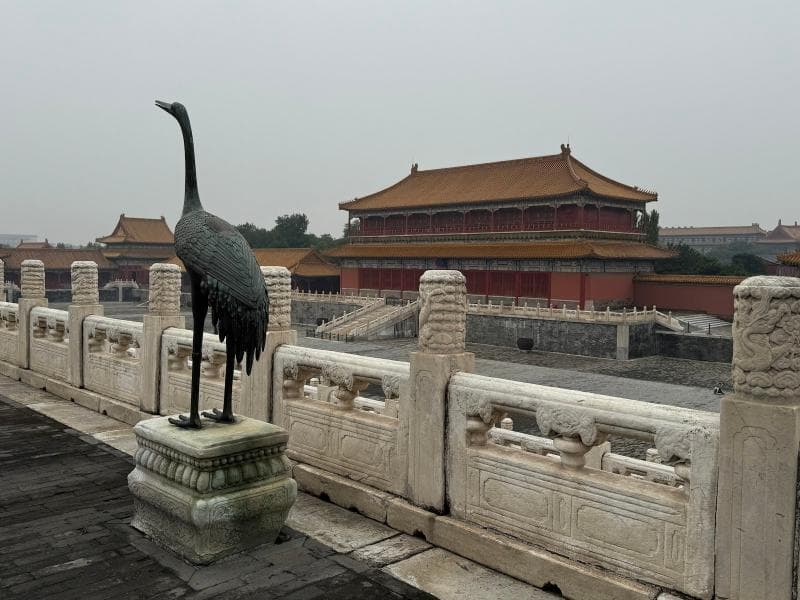
Explore Beijing's Forbidden City, an imperial palace and UNESCO site. Discover its rich history, unique architecture, and cultural significance.
Overview
Nestled in the heart of Beijing, China, the Forbidden City is an architectural marvel and a profound symbol of imperial Chinese history. This vast imperial palace complex served as the exclusive residence for 24 emperors across the Ming and Qing dynasties for over 500 years, from 1420 to 1912. Today, it is known as the Palace Museum and stands as a UNESCO World Heritage Site, welcoming millions of visitors annually. It is widely recognized as the largest collection of preserved ancient wooden structures in the world.
The sprawling compound covers approximately 72 hectares (180 acres) and features nearly a thousand buildings with almost ten thousand rooms. Surrounded by towering walls over 10 meters high and a wide moat measuring 52 meters, its design reflects traditional Chinese cosmology and aesthetics. The Forbidden City's strategic location and meticulous layout made it the ceremonial and political center of China for centuries, influencing architectural developments across East Asia.
History & Cultural Background
The construction of the Forbidden City began in 1406 and was completed in 1420, initiated by Emperor Zhu Di (the Yongle Emperor) of the Ming dynasty as part of a grand project to move the capital from Nanjing to Beijing. Its creation was a monumental undertaking, employing approximately one million workers to transport materials and construct the palace. The purpose was not only to house the emperor and his household but also to serve as the seat of government, ensuring imperial stability and better guarding the northern border.
For centuries, access to this imperial city was strictly controlled, hence its name 'Forbidden City' – it was off-limits to the general public without permission. Only the emperor could enter any section at will, emphasizing his divine authority. Following the fall of the Qing dynasty and the abdication of China's last emperor, Puyi, the complex was transformed into the Palace Museum in 1925, opening its doors to the public and preserving its vast collections of imperial treasures.
What Makes It Special
The Forbidden City's unique grandeur lies in its exceptional scale and preservation, making it the largest imperial palace in the world. Its architectural style is a remarkable example of traditional Chinese palatial design, characterized by yellow roofs, red walls, and intricate ornamentation. The layout adheres rigidly to the principles of Feng Shui, with all important buildings facing south to honor the Sun, embodying order and imperial power. The complex is meticulously organized along a prominent north-south axis, which remains a central feature of Beijing itself.
Beyond its physical structure, the Forbidden City is special for its profound cultural and historical significance. It served as the heart of Chinese power for five centuries and is a living history textbook, recording the political, economic, and cultural changes of ancient Chinese society. It houses an extensive collection of nearly 1.9 million pieces of art and artifacts, including ancient calligraphy, paintings, ceramics, and imperial objects, making it one of the world's most renowned museums of ancient art.
Stories, Fun Facts & Local Details
One fascinating aspect is the sheer number of rooms – often cited as 9,999 rooms, though experts suggest the actual count is closer to 8,886. The number nine is highly auspicious in Chinese culture, symbolizing good luck, eternity, and wholeness. The Hall of Supreme Harmony, the largest and most significant hall, features an intricate caisson ceiling with a coiled dragon and the Xuanyuan Mirror, used for major ceremonial events.
The Forbidden City's defensive measures were formidable, including its high walls and wide moat. In 1644, when rebel forces under Li Zicheng captured the city, parts were set ablaze. During the Cultural Revolution, Premier Zhou Enlai dispatched an army battalion to guard the city, preventing further destruction. Its enduring legacy and influence on East Asian architecture are undeniable, with its symmetrical layout and symbolic colors serving as a blueprint for other royal complexes.
Visitor Perspective
To fully experience the Forbidden City, visitors typically enter through the Meridian Gate (Wumen) in the south and exit from the Gate of Divine Prowess (Shenwumen) in the north. Planning your route in advance is highly recommended, as the site is massive, and comfortable shoes are essential for exploring the vast courtyards. Popular routes often include the Hall of Supreme Harmony, the Inner Court, and the Imperial Garden. The Palace Museum also offers audio guides in multiple languages to enhance the visitor's understanding of its rich history.
Tickets must be booked online in advance, as same-day tickets are not available and the daily visitor limit is 80,000. Avoiding weekends and Chinese holidays is advisable to experience fewer crowds. A visit can take anywhere from two to four hours for major palaces, or a full day to explore the east and west wings and additional galleries. After your visit, consider climbing Coal Hill in nearby Jingshan Park for a panoramic view of the entire Forbidden City.
Coordinates: 116.3906921, 39.9159942
View on Google Maps💬 How Travelers Describe This Place
Based on community votes
Must See
951Beautiful
491Unique
414Photogenic
310Interesting
277
Traveler Stories
Discover memorable experiences shared by travelers who have visited this place.
No traveler stories yet.
Be the first traveler to share what made this place memorable.
Things to see at Forbidden City



Tour
By
Spot
Discover amazing places around the world. Your journey starts here.
Explore
© 2026 TourBySpot. All rights reserved.