Dragon Bridge
Ljubljana, Slovenia
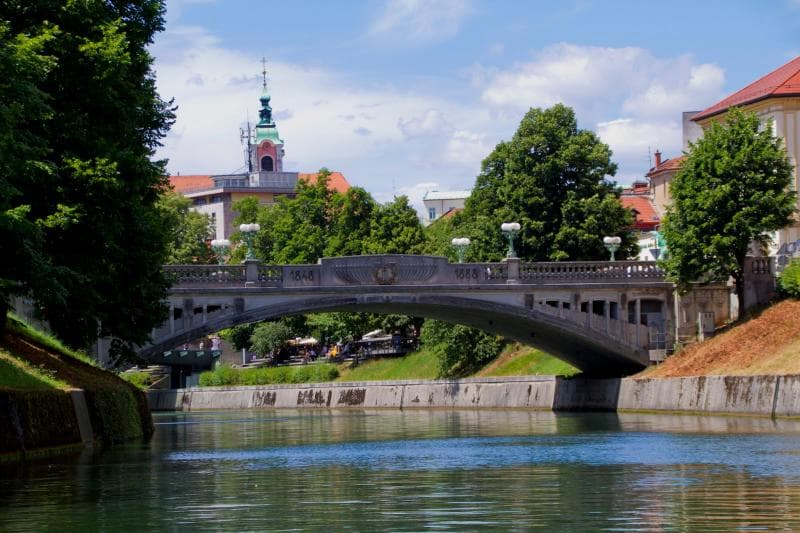
Discover Ljubljana's iconic Dragon Bridge, a stunning Art Nouveau landmark guarded by mythical dragons. Explore its history and legends.
Overview
Standing proudly over the Ljubljanica River in the heart of Ljubljana, Slovenia, the Dragon Bridge, known locally as Zmajski most, is far more than just a crossing. This iconic landmark, a stunning example of Art Nouveau architecture, was constructed between 1900 and 1901, with its official opening on October 4, 1901. It replaced an older wooden crossing and quickly became a symbol of the city's modernization after the devastating earthquake of 1895. The bridge is distinguished by its four imposing sheet-copper dragon statues, which fiercely guard its corners, and its status as one of Europe's earliest reinforced concrete bridges. Today, it is recognized and protected as a technical monument, embodying a blend of engineering innovation and rich cultural symbolism.
History & Cultural Background
The genesis of the Dragon Bridge lies in Ljubljana's need for urban renewal following the severe earthquake of 1895, which badly damaged the former Butchers' Bridge. The construction of the new bridge was a significant part of Mayor Ivan Hribar's vision for a modern Ljubljana. It was originally named the Jubilee Bridge of Emperor Franz Josef I, commemorating the 40th anniversary of his reign from 1848 to 1888, a detail still sometimes visible on the bridge itself.
A marvel of early 20th-century engineering, the Dragon Bridge was one of the first bridges in Europe, and the very first in Ljubljana, to be built using reinforced concrete. This pioneering use of the 'Melan System' patent, developed by Josef Melan, allowed for a structure that was both durable and cost-efficient. The aesthetic design, including the concrete covering, balustrades, and the celebrated dragon statues, was envisioned by Jurij Zaninović, a student of the renowned architect Otto Wagner. Its advanced construction meant that, upon completion, its single arch span of 33.34 meters ranked among the largest in Europe. In 1919, the bridge was officially renamed the Dragon Bridge, cementing the mythical creatures' indelible link to the city's identity.
What Makes It Special
The Dragon Bridge's distinctive Art Nouveau style, characterized by its elegant lines and decorative elements, sets it apart. However, its most striking feature is undoubtedly the four large, fearsome-looking green dragons cast from sheet copper, positioned at each corner. These magnificent creatures, with their raised wings and prominent tongues, are more than mere ornamentation; they are deeply ingrained in Ljubljana's symbolism. They represent strength, protection, and the city's enduring resilience. In addition to these main guardians, the bridge is further adorned with sixteen smaller dragon statues, sometimes referred to as griffins, adding to its mystical charm.
Beyond its aesthetic appeal, the bridge is a testament to early 20th-century technical ingenuity. Its protected status as a technical monument highlights its historical importance in the development of reinforced concrete construction. The bridge's pioneering features, such as being the first in Slovenia to be paved with asphalt, further underscore its significance. It stands as a vibrant example of how cutting-edge engineering can beautifully merge with artistic expression and profound cultural narrative.
Stories, Fun Facts & Local Details
The dragons of the Zmajski most are intrinsically linked to one of Ljubljana's most enduring legends: the tale of Jason and the Argonauts. According to local lore, Jason, along with his crew, founded Ljubljana after slaying a fierce dragon in the marshes of the area while returning from their quest for the Golden Fleece. This mythical beast is believed to be the ancestor of the dragons that now famously guard the bridge and the city. In fact, a dragon is a prominent feature on Ljubljana's coat of arms and can be seen atop the castle tower, reinforcing its status as a city guardian.
A popular local anecdote adds a playful touch to the bridge's mystique: it is said that the dragons will wag their tails when a virgin crosses the bridge. Some locals affectionately, or perhaps humorously, even refer to the bridge as 'mother-in-law' due to its perceived fiery nature. Interestingly, the idea for the bridge's statues initially included winged lions, but ultimately, the dragons prevailed, cementing their place as the city's iconic symbol. These dragons, crafted in Vienna, were shipped to Ljubljana, ready to take up their eternal watch.
Visitor Perspective
For any traveler exploring Ljubljana, encountering the Dragon Bridge is an unforgettable experience. It's not just a pedestrian crossing or a traffic route; it's an immersive dive into the city's soul. Its central location, just a short walk from Prešeren Square and the central market, makes it easily accessible and a natural focal point for sightseeing. Many visitors find themselves pausing to admire the intricate Art Nouveau details and, of course, to capture photographs with the impressive dragon statues.
The bridge offers splendid views of the Ljubljanica River and the historic city center, providing a picturesque backdrop for photos and moments of contemplation. To fully appreciate its grandeur and capture its essence without the bustle of crowds, an early morning or late evening visit is often recommended. The Dragon Bridge serves as a captivating gateway, welcoming visitors into a city where ancient legends seamlessly intertwine with modern urban life.
Coordinates: 14.5103, 46.0519
View on Google Maps💬 How Travelers Describe This Place
Based on community votes
Interesting
847Unique
685Photogenic
513Beautiful
433Must See
211
Traveler Stories
Discover memorable experiences shared by travelers who have visited this place.
No traveler stories yet.
Be the first traveler to share what made this place memorable.
Things to see at Dragon Bridge



Tour
By
Spot
Discover amazing places around the world. Your journey starts here.
Explore
© 2026 TourBySpot. All rights reserved.