Dajbabe Monastery
Podgorica, Montenegro
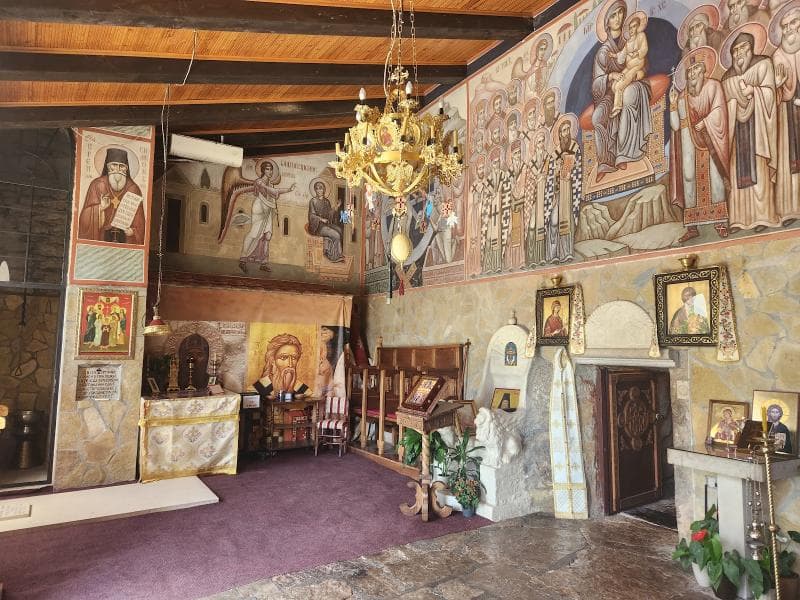
Discover Dajbabe Monastery, a unique Serbian Orthodox cave monastery near Podgorica, Montenegro. Explore its history, cave frescoes, and relics of St. Simeon.
Overview
Tucked away near Montenegro's capital city, Podgorica, lies the Dajbabe Monastery, a unique spiritual sanctuary that offers a fascinating blend of natural wonder and human devotion. This Serbian Orthodox monastery, dedicated to the Assumption of Mary (Uspenje Bogorodice), stands out due to its unusual construction; a significant portion of its church is carved directly into a natural cave on Dajbabe Hill, overlooking the scenic Zeta Valley. Visitors are often captivated by the mystical atmosphere created by its subterranean setting, where the church's interior adapts to the organic contours of the rock. The monastery provides a tranquil escape and a profound glimpse into Montenegro's rich religious and cultural heritage.
History & Cultural Background
The Dajbabe Monastery was founded in 1897 by Hieromonk Simeon Popović. Initially, the natural cave itself served as the primary sanctuary, with plans for later expansion to include additional chapels. Father Simeon, a highly educated monk who studied in Cetinje and Kiev, played a pivotal role not only in the monastery's establishment but also in its artistic embellishment. He meticulously painted the interior frescoes directly onto the irregular rock surfaces, skillfully adapting his artistry to the cave's natural shapes until his passing in 1941.
This spiritual site holds deep significance within the Serbian Orthodox tradition, acting as a testament to faith and artistic ingenuity. Its dedication to the Assumption of the Theotokos (Virgin Mary) highlights its importance within Orthodox veneration. The monastery's location on Dajbabe Hill, near the village from which it takes its name, positions it as a historical and spiritual landmark in the Zeta Valley.
What Makes It Special
The most compelling feature of the Dajbabe Monastery is undoubtedly its cave-church. Unlike many traditional monasteries, Dajbabe is largely subterranean, with its main church integrated into a natural cavern. The only visible part from the outside is a spacious entrance porch adorned with two bell towers. Inside, the church takes on a cross-shaped design, masterfully expanded from the original cave. The interior artwork, created by the founder Father Simeon, is uniquely adjusted to the natural rock formations, making each fresco an organic part of the cave's structure.
Furthermore, the monastery houses a reliquary containing the sacred relics of Saint Simeon Dajbabe. These relics contribute significantly to the monastery's spiritual importance, attracting pilgrims seeking blessings and healing. The seamless blend of nature and human craftsmanship, where the rough, natural cave walls become canvases for sacred art, creates an 'almost mystical' and 'unforgettable experience' for many who visit.
Stories, Fun Facts & Local Details
Legend has it that the monastery was founded after a local shepherd, Petko Ivezic, had visions instructing him to create a monastery on that very spot. This divine providence led to the discovery and development of the cave as a sacred place. Father Simeon, who later became a monk and was instrumental in founding Dajbabe, recorded these events, emphasizing the miraculous nature of the site.
A notable aspect of the Dajbabe Monastery is how its founder, Simeon Popović, also known as Saint Simeon Dajbabe, personally undertook the monumental task of painting the entire interior. He transformed the irregular surfaces of the cave into vibrant religious scenes, a truly remarkable artistic feat given the challenging environment. This dedication makes the monastery a personal testament to his faith and vision. The peaceful silence and mystical ambiance within the cave have been noted by visitors, often contrasting with the external world and offering a profound sense of tranquility.
Visitor Perspective
Visiting Dajbabe Monastery offers a peaceful and introspective experience for travelers. Many describe it as a 'hidden gem' and praise its serene, spiritual atmosphere. The unique cave interior is consistently highlighted as a fascinating attraction, providing a quiet space for contemplation and an escape from the hustle and bustle.
While the monastery is not large, visitors often linger, taking in the intricate frescoes and the distinct feeling of the ancient stone. The monks are known for their kindness and willingness to share the history and significance of the site. Although it's slightly off the main tourist path, it is easily accessible from Podgorica by car or taxi, being approximately five kilometers from the city center. It is recommended to wear appropriate, respectful clothing when visiting this active place of worship. The experience is often described as worthwhile for anyone interested in history, art, and spirituality.
Coordinates: 19.232456, 42.403852
View on Google Maps💬 How Travelers Describe This Place
Based on community votes
Beautiful
915Interesting
873Photogenic
422Must See
123Unique
53
Traveler Stories
Discover memorable experiences shared by travelers who have visited this place.
No traveler stories yet.
Be the first traveler to share what made this place memorable.
Things to see at Dajbabe Monastery



Tour
By
Spot
Discover amazing places around the world. Your journey starts here.
Explore
© 2026 TourBySpot. All rights reserved.