Calton Hill
Edinburgh, United Kingdom
Discover Calton Hill in Edinburgh, United Kingdom, a UNESCO World Heritage site offering panoramic views, iconic monuments, and rich history. Explore the 'Athens of the North' and its unique cultural landscape.
Overview
Perched majestically at the eastern end of Princes Street, Calton Hill is an iconic landmark in Edinburgh, United Kingdom. As a prominent part of the city's UNESCO World Heritage Site, this volcanic hill offers much more than just breathtaking panoramic views; it is a repository of history and a testament to Edinburgh's grand architectural ambitions. The ascent, though brief, leads to a summit adorned with a unique collection of neoclassical monuments that define Edinburgh's distinctive skyline.
Its elevated position, approximately 100 meters above sea level, provides unparalleled vistas encompassing famous landmarks such as Edinburgh Castle, Arthur's Seat, the historic Old Town, the elegant New Town, and stretching out to the Firth of Forth.
History & Cultural Background
Calton Hill's history is deeply intertwined with Edinburgh's 19th-century vision to become the 'Athens of the North'. This aspiration led to the construction of several classical revival structures, transforming the hill into Edinburgh's own version of the Athenian Acropolis.
One of its most famous, and perhaps poignant, monuments is the National Monument of Scotland, conceived as a replica of the Parthenon in Athens. Construction began in 1822 with the intent to commemorate Scottish servicemen who died in the Napoleonic Wars. However, due to a lack of funds, the project was left unfinished in 1829, with only twelve columns standing today. This incomplete structure, for many years, earned it the nickname 'Edinburgh's Disgrace' or 'Scotland's Disgrace'. Another significant landmark is the Nelson Monument, completed in 1816, commemorating Admiral Lord Nelson's victory and death at the Battle of Trafalgar in 1805.
The City of Edinburgh acquired 22 acres of land on the hill in 1725, making it one of Scotland's first public parks, a space where locals once even dried their washing. Historically, Calton Hill has served various purposes, including a quarry, a jousting ground, and even a leper colony. It also played a significant role in the 19th-century Chartist movement, campaigning for political reform.
What Makes It Special
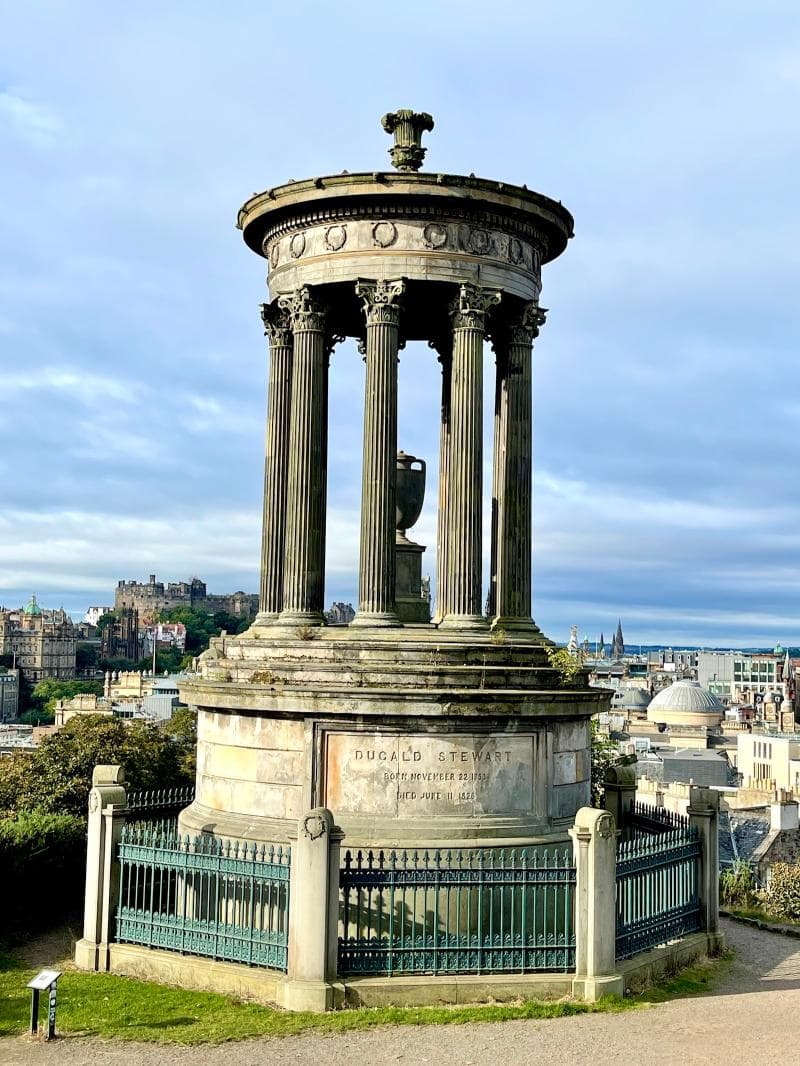
What truly sets Calton Hill apart is its extraordinary blend of natural beauty and monumental architecture. It acts as a natural gallery for some of Edinburgh's most important neoclassical structures, including the National Monument, the Nelson Monument, and the Dugald Stewart Monument.
The hill's elevated position offers one of the most comprehensive and iconic viewpoints of Edinburgh. From here, visitors can appreciate the city's unique topography, seeing how the historic Old Town, with its medieval charm, contrasts with the Georgian elegance of the New Town. The visual impact of these monuments against the backdrop of the city, especially during sunrise or sunset, creates truly unforgettable scenes often captured in photographs and paintings.
Beyond its historical monuments, the former City Observatory, designed by William Playfair, has been thoughtfully repurposed into Collective, a contemporary art space, adding a modern cultural layer to the ancient site.
Stories, Fun Facts & Local Details
The unfinished National Monument, affectionately dubbed 'Edinburgh's Disgrace' for its incomplete state, has become a quirky and beloved feature of the city's skyline, rather than a mark of shame. Climbing the 143 spiral stairs of the Nelson Monument offers an even more elevated and intimate perspective of the city.
Calton Hill is also a focal point for various cultural events, most notably the Beltane Fire Festival in April, a traditional Gaelic celebration that brings vibrant community spirit and ancient rituals to the hill. At the base of the hill lies the Old Calton Burial Ground, a historic cemetery that is the final resting place of several notable Scots, including the philosopher David Hume, and features monuments like the Political Martyrs' Monument and the American Civil War Memorial.
Interestingly, the site now occupied by St Andrew's House, the headquarters of the Scottish Government, was once the infamous Calton Jail, a prison complex that was demolished in 1930. Parts of the old prison walls and the Governor's House still stand, a quiet reminder of a bygone era.
Visitor Perspective
Calton Hill is easily accessible, situated just a short walk from the eastern end of Princes Street and Edinburgh Waverley Station. While the climb to the summit requires a bit of effort, the well-maintained paths ensure a relatively easy ascent, making it suitable for most visitors.
The hill is open to the public at all times and entry is free, offering flexibility for visitors to explore at their leisure. Many recommend visiting during sunrise or sunset for the most spectacular photographic opportunities, as the changing light casts a magical glow over the city and its monuments. However, for those seeking a quieter experience, early mornings tend to be less crowded. Calton Hill is consistently listed as a 'must-see' attraction, embodying the contrast of urban and natural landscapes that makes Edinburgh so special.
Coordinates: -3.18222, 55.95528
View on Google Maps💬 How Travelers Describe This Place
Based on community votes
Beautiful
804Unique
733Must See
563Interesting
404Photogenic
336
Traveler Stories
Discover memorable experiences shared by travelers who have visited this place.
No traveler stories yet.
Be the first traveler to share what made this place memorable.
Things to see at Calton Hill



Tour
By
Spot
Discover amazing places around the world. Your journey starts here.
Explore
© 2026 TourBySpot. All rights reserved.