Arcul De Triumf
Bucharest, Romania
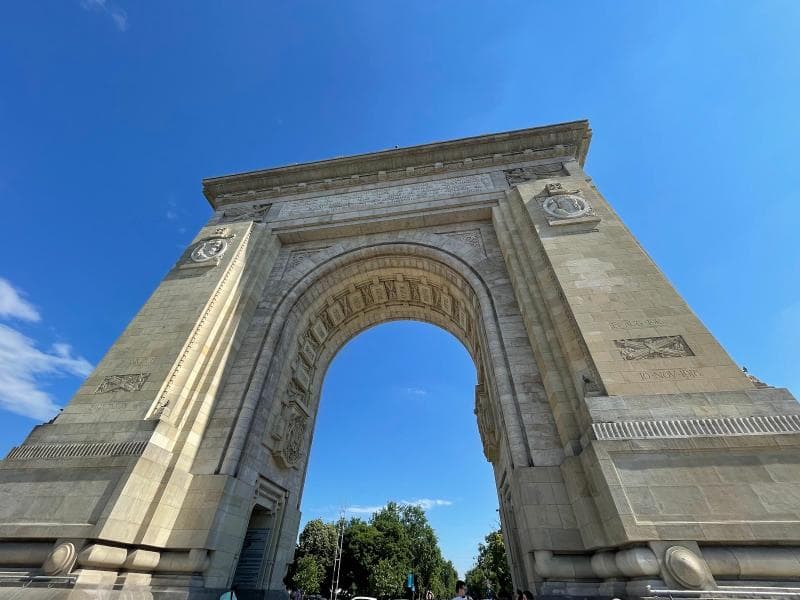
Discover Arcul de Triumf in Bucharest, Romania – a magnificent arch symbolizing national unity and WWI victory. Explore its history and iconic design.
Overview
Standing majestically in the northern part of Bucharest, Romania, Arcul de Triumf is far more than just a monumental arch; it is a profound symbol of national pride, unity, and resilience. Often drawing comparisons to its more famous Parisian counterpart, Bucharest's arch stands as a testament to Romania's hard-won independence and its significant victories, particularly in World War I. Constructed primarily from resilient Deva granite, this impressive structure reaches a height of 27 meters (89 feet), commanding attention in its prominent location at the intersection of several grand boulevards. It serves as a focal point for national celebrations and offers a deep dive into the country's rich historical narrative.
History & Cultural Background
The story of Arcul de Triumf is one of evolution, mirroring Romania's journey as a nation. The first iteration was a temporary wooden arch hastily erected in 1878 to celebrate Romania's newly gained independence from Ottoman rule. This modest structure allowed victorious troops to march beneath it, symbolizing sovereignty. Following World War I, in 1922, a more elaborate, though still temporary, wooden arch was built to commemorate the unification of all Romanian-inhabited territories into 'Greater Romania' and to honor the sacrifices of Romanian soldiers. It also served for the coronation of King Ferdinand I and Queen Marie. However, due to its temporary nature, this structure began to deteriorate. The decision was made in the late 1920s to construct a permanent, stone monument, as part of a larger effort to monumentalize Bucharest and assert Romanian national identity. The renowned Romanian architect Petre Antonescu designed the current neoclassical arch, which was inaugurated on December 1, 1936.
What Makes It Special
Arcul de Triumf is particularly special due to its synthesis of classical Roman imperial architectural principles with distinct Romanian artistic traditions. Unlike a mere copy, Antonescu's design imbued the arch with a uniquely national character. Its warm, slightly pinkish hue, derived from the Deva granite, distinguishes it from other triumphal arches worldwide. The arch's facades are adorned with intricate sculptures created by prominent Romanian artists, including Ion Jalea and Dimitrie Paciurea, who depicted allegories of victory, faith, and courage, as well as scenes from significant historical moments. These artistic elements transform the arch into a monumental narrative, honoring the countless Romanian soldiers who fought in World War I and celebrating the territorial unification that followed, which nearly doubled the country's size.
Stories, Fun Facts & Local Details
'Little Paris of the East': Bucharest earned this charming nickname during the interwar period, partly due to its elegant architecture and grand boulevards, with Arcul de Triumf being a prime example of its Parisian-resembling monuments.
National Day Celebrations: Every year on December 1st, Romania's National Day, Arcul de Triumf becomes the centerpiece for the country's most significant military parade. Thousands of troops, military vehicles, and aircraft pass beneath the arch, creating a spectacular display of national pride and remembrance.
Panoramic Views: While not always open, the arch's interior houses a steep spiral staircase that, when accessible, leads to a top platform. From here, visitors are rewarded with breathtaking panoramic views over Herăstrău Park (officially King Michael I Park) and the elegant residential areas of northern Bucharest.
Royal Inscriptions: The arch features significant inscriptions, including bronze medallions portraying King Ferdinand I and Queen Marie, key figures in Romania's modernization and unification.
Visitor Perspective
Arcul de Triumf is easily accessible in northern Bucharest, situated at Piața Arcul de Triumf. Visitors can reach it conveniently via the Aviatorilor metro station (M2), which is about a 10-minute walk away, or by numerous bus routes. While the exterior of the arch is visible and can be admired 24/7, offering excellent photographic opportunities, especially at sunrise, sunset, or when illuminated at night, interior access to the observation deck is typically limited. Historically, the arch has been open to the public on weekends, usually from June to October, and especially on National Day (December 1st). A small museum with historical exhibitions is also located inside. The monument's proximity to King Michael I Park, Bucharest's largest park, makes it an ideal stop to combine with a leisurely stroll through green spaces, enjoying the city's calmer side. While walking around the base is free, access to the interior and terrace may require a nominal ticket fee when available.
Coordinates: 26.0781, 44.4672
View on Google Maps💬 How Travelers Describe This Place
Based on community votes
Must See
673Photogenic
336Interesting
219Unique
186Beautiful
80
Traveler Stories
Discover memorable experiences shared by travelers who have visited this place.
No traveler stories yet.
Be the first traveler to share what made this place memorable.
Things to see at Arcul De Triumf



Tour
By
Spot
Discover amazing places around the world. Your journey starts here.
Explore
© 2026 TourBySpot. All rights reserved.