Surrounding Plaza
Bucharest, Romania
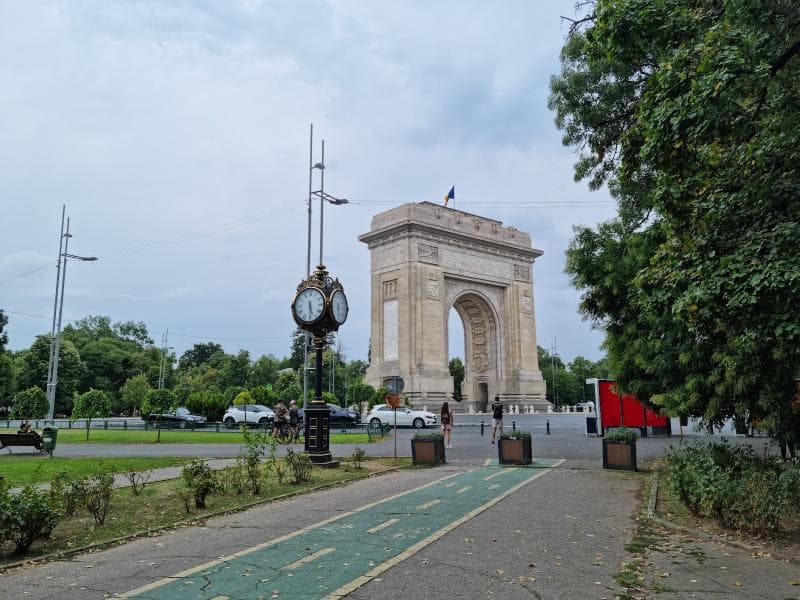
Explore Piața Arcul de Triumf, Bucharest, Romania – the majestic plaza surrounding the Triumphal Arch, a symbol of national unity and victory.
Overview
The Surrounding Plaza of Arcul de Triumf, officially known as Piața Arcul de Triumf, serves as a grand setting for Bucharest's iconic Triumphal Arch. Located in the northern part of the city, this significant roundabout stands at the intersection of major thoroughfares like Șoseaua Kiseleff and Bulevardul Mareșal Constantin Prezan. Far more than just a traffic hub, the plaza acts as a monumental gateway to Bucharest's elegant northern districts and provides direct access to the expansive King Michael I Park, formerly known as Herăstrău Park. It is a place where urban dynamism meets historical solemnity, inviting travelers to pause and reflect on Romania's rich past.
History & Cultural Background
The story of the Arcul de Triumf, and by extension its surrounding plaza, is deeply intertwined with Romania's journey to nationhood and its commemoration of pivotal historical moments. The site has hosted triumphal arches since 1878, when a temporary wooden structure was hastily erected to celebrate Romania's newly gained independence from Ottoman rule, allowing victorious troops to march beneath it. A more elaborate, yet still temporary, wooden arch followed in 1922, marking the unification of Transylvania with the Romanian Kingdom and honoring Romanian soldiers who fought in World War I. It was the celebrated Romanian musician George Enescu who, with a touch of humor, once questioned when Bucharest would finally receive a 'real' triumphal arch.
The permanent stone structure we see today, designed by architect Petre Antonescu, was inaugurated on December 1, 1936. It commemorates Romania's victory in the First World War and the Great Union of 1918, a defining moment that significantly expanded the country's territory. The arch's design, while inspired by Paris's Arc de Triomphe, uniquely synthesizes Roman imperial architecture with distinct Romanian sculptural traditions, creating a monument that is profoundly national in character.
What Makes It Special
The plaza's distinction lies in its role as a magnificent frame for the Arcul de Triumf itself. The Arch, standing 27 meters tall with a rectangular base measuring 25 by 11.5 meters, is adorned with intricate sculptures by renowned Romanian artists, including Ion Jalea and Dimitrie Paciurea. These sculptures vividly depict scenes of bravery, victory, faith, and courage, telling a compelling narrative of national struggle and triumph.
The surrounding area is meticulously planned, with tree-lined avenues radiating outward from the central roundabout, drawing the eye towards the monument and underscoring its significance as a focal point. This careful urban planning highlights the Arch's symbolism as a powerful representation of Romanian national identity, unity, and resilience. When accessible, visitors can ascend an internal staircase to an observation platform atop the Arch, offering unparalleled panoramic views of the plaza, the city's northern expanse, and the lush greenery of King Michael I Park.
Stories, Fun Facts & Local Details
Bucharest's historical nickname, 'Little Paris,' finds a tangible connection in its own Triumphal Arch, a cousin to its famous French counterpart. The repeated construction of temporary wooden arches before the grand stone monument reveals a persistent national desire to properly honor its heroes and achievements, culminating in Antonescu's enduring design.
One of the most vibrant traditions associated with Piața Arcul de Triumf occurs annually on December 1st, Romania's National Day. This plaza becomes the epicenter for grand military parades, with thousands of troops, vehicles, and aircraft passing under the Arch. The air fills with patriotic fervor, Romanian flags, traditional food vendors, and cultural performances, offering a deep insight into the country's national consciousness. A lesser-known local custom involves newly married couples, who sometimes drive under the Arch after their wedding ceremony, while friends honk horns and toss confetti, believing it brings good fortune. The Arch also features bronze medallions on its southern facade portraying King Ferdinand I and Queen Marie, who were central figures in Romania's unification.
Visitor Perspective
Approaching Piața Arcul de Triumf, a traveler immediately senses the blend of historical gravitas and contemporary city life. The constant whirl of traffic around the monumental arch presents a lively contrast to the serene beauty of the Arch itself. It offers excellent photographic opportunities, especially during the 'golden hour' of sunrise or sunset, or when the monument is illuminated at night. To truly appreciate its intricate details and the stories etched into its facade, an unhurried visit is recommended.
The plaza's proximity to King Michael I Park makes it an ideal starting point for a leisurely stroll through one of Bucharest's largest and most beautiful green spaces, or a visit to the nearby Dimitrie Gusti National Village Museum. While the Arch is visible 24/7, consider checking its official opening hours if you wish to climb to the top for those stunning panoramic city views. The area is easily accessible by public transportation, including the metro (Aviatorilor station) and various bus routes, making it a convenient and rewarding stop on any Bucharest itinerary.
Coordinates: 26.0781, 44.4672
View on Google Maps💬 How Travelers Describe This Place
Based on community votes
Interesting
996Must See
658Unique
585Photogenic
143Beautiful
69
Traveler Stories
Discover memorable experiences shared by travelers who have visited this place.
No traveler stories yet.
Be the first traveler to share what made this place memorable.

Tour
By
Spot
Discover amazing places around the world. Your journey starts here.
Explore
© 2026 TourBySpot. All rights reserved.