Accademia Gallery
Florence, Italy
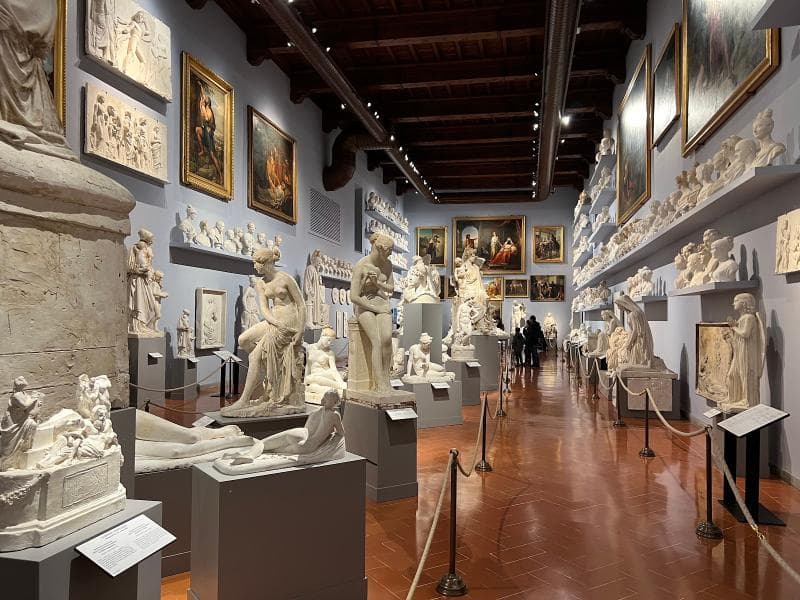
Discover the Accademia Gallery in Florence, Italy, home to Michelangelo's 'David,' 'Prisoners,' and exquisite Florentine art and musical instruments.
Overview
The Accademia Gallery (Galleria dell'Accademia) in Florence, Italy, stands as a beacon of Renaissance art, drawing visitors from across the globe. While often synonymous with Michelangelo's iconic 'David,' the museum offers a rich and diverse collection that delves deep into Florentine artistic heritage. It is a more specialized institution compared to the larger Uffizi Gallery, focusing on sculpture by Michelangelo, Florentine painting from the 13th to 16th centuries, and an exceptional array of musical instruments. Located centrally on Via Ricasoli, it remains a must-visit for anyone wishing to immerse themselves in the artistic spirit of Florence.
History & Cultural Background
The Accademia Gallery was founded in 1784 by Pietro Leopoldo, Grand Duke of Tuscany, initially as a teaching facility for the adjacent Academy of Fine Arts. Its primary purpose was to provide art students with a collection of exemplary artworks for study and inspiration. The museum was established within the former spaces of the Hospital of Saint Matthew and the Convent of Saint Niccolò di Cafaggio. Over time, its collection expanded significantly, largely due to the acquisition of paintings from convents and monasteries suppressed by Grand Duke Pietro Leopoldo and later by Napoleon.
A pivotal moment in the gallery's history occurred in 1873 when Michelangelo's colossal 'David' was transferred from its original outdoor location in Piazza della Signoria to the Accademia. This relocation was primarily driven by the need to protect the masterpiece from weathering and deterioration. A special tribune with a large skylight, designed by architect Emilio de Fabris, was constructed specifically to house the 'David,' creating a dramatic and fitting setting for the sculpture, which was completed in 1882.
What Makes It Special
The undisputed star of the Accademia Gallery is Michelangelo's 'David.' Carved from a single block of Carrara marble between 1501 and 1504, this monumental statue stands over 5 meters tall and weighs more than five tons. It captures David in the moment before his confrontation with Goliath, a depiction that conveys intense psychological tension and anatomical perfection. The 'David' is not just a masterpiece of sculpture; it became a powerful symbol of the Florentine Republic's strength and independence.
Beyond 'David,' the gallery houses other significant works by Michelangelo, including his four unfinished 'Prisoners' (or 'Slaves') and the 'Saint Matthew.' These unfinished sculptures are particularly compelling as they offer a unique insight into Michelangelo's artistic process, appearing to struggle to emerge from their marble blocks, illustrating his belief that the figure was already present within the stone.
The Accademia also boasts a substantial collection of Florentine paintings from the 14th to the 16th century, featuring artists such as Sandro Botticelli, Perugino, Filippino Lippi, and Andrea del Sarto. Additionally, a fascinating section is dedicated to the Museum of Musical Instruments, inaugurated in 2001. This collection, predominantly from the Medici and Lorraine families, includes rare instruments like violins and cellos by Antonio Stradivari and Niccolò Amati, as well as instruments by Bartolomeo Cristofori, the inventor of the piano.
Stories, Fun Facts & Local Details
Michelangelo was only 26 years old when he began sculpting 'David' in 1501, using a block of marble that two previous sculptors had abandoned, deeming it flawed. He worked on it for over two years, often behind wooden panels to keep his process private. Originally, the 'David' was intended for the roofline of Florence Cathedral, meant to be seen from afar. However, its extraordinary beauty led to its placement in front of the Palazzo Vecchio in Piazza della Signoria, where it served as a civic and political statement for over 350 years.
The 'Prisoners' sculptures were originally commissioned for the tomb of Pope Julius II in Rome, a grand project that was never fully realized. These powerful figures, trapped in stone, eloquently convey the artist's struggle and genius. The Musical Instruments Museum reflects the Medici family's deep passion for music and the performing arts, showcasing how integral music was to their court. Multimedia displays within this section allow visitors to hear the sounds of these historic instruments, including early pianos.
While many visitors flock primarily for 'David,' exploring the surrounding halls reveals a comprehensive narrative of Florentine art. The gallery also features a significant collection of plaster casts by Lorenzo Bartolini and Luigi Pampaloni, providing a glimpse into 19th-century sculptural practice.
Visitor Perspective
To make the most of your visit to the Accademia Gallery, planning ahead is highly recommended. The museum is one of Florence's most popular attractions, and lines can be substantial, especially during peak seasons. Booking timed-entry tickets in advance online is strongly advised to avoid long waits. A typical visit usually lasts between 1 and 2 hours, allowing ample time to appreciate 'David,' the 'Prisoners,' and the various painting galleries and musical instrument collection.
The best times to visit are generally early mornings right after opening or late afternoons before closing, as these periods tend to be less crowded. The Accademia Gallery is closed on Mondays, January 1st, May 1st, and December 25th. Conveniently located in the heart of Florence, it's easily accessible on foot from major landmarks like the Duomo and Piazza San Marco. The entire museum is wheelchair accessible, with an accessible bathroom available on the ground floor.
Coordinates: 11.2589, 43.7769
View on Google Maps💬 How Travelers Describe This Place
Based on community votes
Unique
950Beautiful
858Interesting
287Must See
275Photogenic
231
Traveler Stories
Discover memorable experiences shared by travelers who have visited this place.
No traveler stories yet.
Be the first traveler to share what made this place memorable.
Things to see at Accademia Gallery



Tour
By
Spot
Discover amazing places around the world. Your journey starts here.
Explore
© 2026 TourBySpot. All rights reserved.