Wilanów Palace
Warsaw, Poland
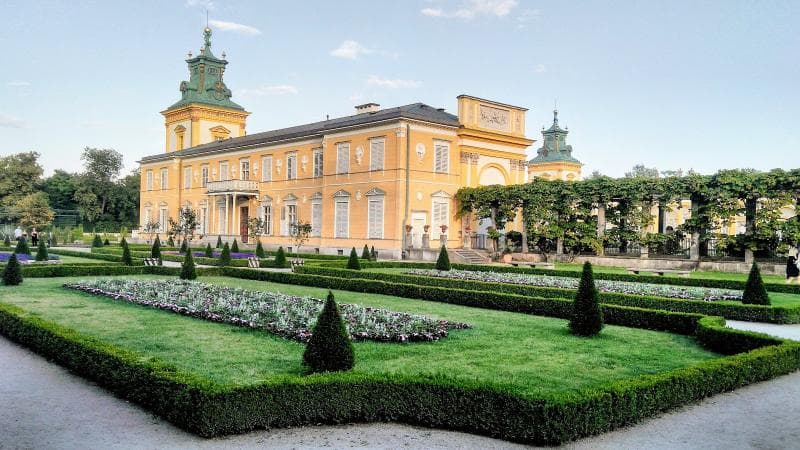
Explore Wilanów Palace in Warsaw, Poland – a stunning Baroque royal residence, museum, and one of Poland's most significant monuments.
Overview
Wilanów Palace, nestled in the historic Wilanów district of Warsaw, Poland, stands as a magnificent testament to Baroque architecture and a preserved piece of Polish heritage. Constructed between 1677 and 1696 for King John III Sobieski and his wife, Queen Marie Casimire d'Arquien, it is considered one of Poland's most important national monuments. The palace uniquely blends European Baroque styles with traditional Polish architectural elements, creating a distinctive aesthetic that has captivated visitors for centuries. Remarkably, Wilanów Palace survived both World Wars largely intact, preserving its original architectural form and invaluable artistic collections. Today, it serves as the King Jan III Palace Museum, a vibrant cultural institution that annually welcomes millions of visitors to explore its lavish interiors, impressive art collections, and expansive historical gardens.
History & Cultural Background
The origins of Wilanów Palace trace back to 1677 when King John III Sobieski acquired the village of Milanów (later renamed Wilanów, an adaptation of 'Villa Nova' meaning 'new villa') and commissioned architect Augustyn Wincenty Locci to design his summer residence. What began as a modest villa quickly expanded under the king's vision, reflecting his military successes and growing royal stature. The palace's design incorporates influences from Polish aristocratic mansions, Italian suburban villas, and French palaces, showcasing a sophisticated architectural fusion. Following King John III's death in 1696, the palace passed through the hands of his sons and several influential magnate families, including the Sieniawskis, Czartoryskis, Lubomirskis, and Potockis. A notable period of expansion and embellishment occurred under Elżbieta Sieniawska in the early 18th century, who was known as a powerful stateswoman and patron of the arts. A pivotal moment in the palace's history came in 1805 when Stanisław Kostka Potocki, an owner at the time, opened parts of it to the public, establishing one of Poland's first public museums. Despite suffering damage during World War II, the palace was meticulously restored, and after undergoing extensive conservation efforts, it reopened as a state-owned museum in 1962, continuing its legacy as a repository of Polish royal and artistic heritage.
What Makes It Special
Wilanów Palace is distinguished by its harmonious blend of European Baroque grandeur and indigenous Polish architectural elements, adorned with rich decorations that narrate the triumphs and family history of King John III Sobieski. The palace's façades and interiors are replete with symbolic paintings and sculptures glorifying the king's military victories, particularly his decisive role in the 1683 Battle of Vienna. Inside, visitors encounter impeccably preserved royal apartments, including King John III's chambers, Queen Maria Kazimiera's suites, and unique rooms like the Chinese Room with its imported lacquered panels. The museum houses a remarkable collection of European and Oriental art, featuring works by masters such as Rembrandt and Van Dyck, alongside an iconic equestrian portrait of Stanisław Kostka Potocki by Jacques-Louis David. Beyond the palace, the sprawling gardens are a highlight, featuring diverse styles including formal French parterres, an English-Chinese landscape garden, and a charming rose garden, all contributing to the palace's enduring allure.
Stories, Fun Facts & Local Details
King John III Sobieski, often called the 'Lion of Lechistan,' envisioned Wilanów not just as a residence but as a monument to his intellectual pursuits and military prowess. The palace's symbolism is deeply personal; for instance, an ornate sundial on the south wall, with astronomical aspects designed by Johannes Hevelius, underscores the king's interest in science. Legend has it that the palace also contains secret passages and underground tunnels, reportedly used by residents during times of unrest. In winter, the palace grounds transform into the enchanting 'Royal Garden of Light,' a popular annual illumination exhibition featuring thousands of diodes and classical music, offering a magical experience for visitors. Over the years, Wilanów Palace has also served as an distinguished venue for hosting VIP guests on official state visits, highlighting its continued importance on the international stage.
Visitor Perspective
A visit to Wilanów Palace offers a captivating journey into Poland's royal past, inviting travelers to explore the lavish Baroque interiors and stroll through the meticulously maintained gardens. The King Jan III Palace Museum provides rich historical context through its diverse collections. To enhance the experience, audio guides and mobile applications are available, offering detailed insights into the palace's history, art, and former inhabitants. It is recommended to allocate at least 3-4 hours to fully appreciate both the palace and its extensive grounds. Tickets can be conveniently purchased online or directly at the ticket office. For those planning a visit, note that admission to the palace, gardens, and park is free on Thursdays, though tickets still need to be collected.
Coordinates: 21.090277777778, 52.165277777778
View on Google Maps💬 How Travelers Describe This Place
Based on community votes
Must See
1.0kPhotogenic
804Interesting
563Beautiful
100Unique
63
Traveler Stories
Discover memorable experiences shared by travelers who have visited this place.
No traveler stories yet.
Be the first traveler to share what made this place memorable.
Things to see at Wilanów Palace



Tour
By
Spot
Discover amazing places around the world. Your journey starts here.
Explore
© 2026 TourBySpot. All rights reserved.