The Royal Palace
Oslo, Norway
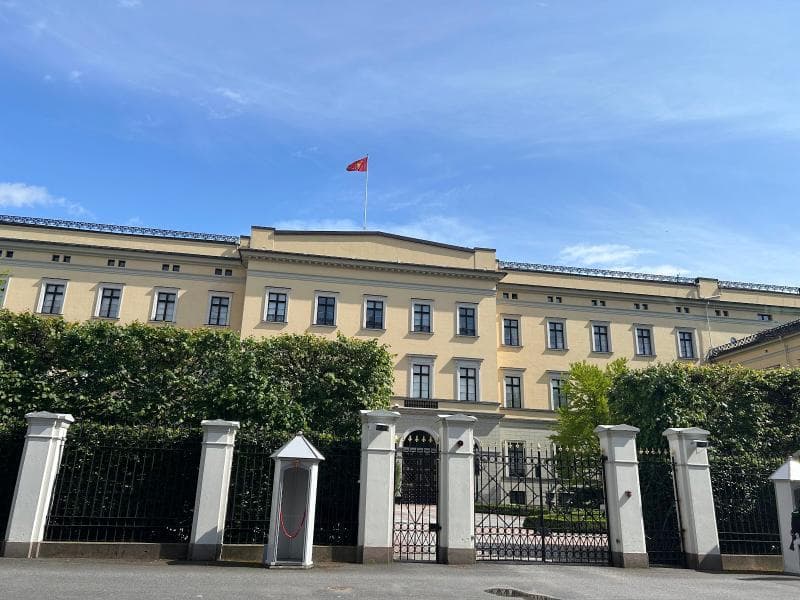
Explore The Royal Palace in Oslo, Norway, the official residence of the Norwegian monarch. Discover its rich history, neoclassical architecture, and public accessibility.
Overview
The Royal Palace in Oslo, Norway, stands as the official residence and principal workplace of the current Norwegian monarch, King Harald V and Queen Sonja. Located majestically at the western end of Karl Johans gate, Oslo's main thoroughfare, the palace crowns a gentle hill, offering commanding views over the city and its surrounding parklands. It is a central symbol of Norway's royal history and the heart of the Norwegian monarchy, owned by the state and placed at the disposal of the head of state.
Completed in 1849, this neoclassical architectural masterpiece is not merely a historical monument but a vibrant center for the Royal Family's official duties, including state visits, audiences, and various ceremonial events. Surrounding the palace is the expansive Palace Park (Slottsparken), a cherished public green space that invites both locals and visitors to explore its lawns, majestic trees, and serene pathways throughout the year.
History & Cultural Background
The vision for a royal residence in Oslo emerged in the early 19th century following Norway's separation from Denmark in 1814 and its subsequent union with Sweden. King Charles III John (also Charles XIV John of Sweden) commissioned the palace in 1821, envisioning a structure that would embody the grandeur of the monarchy and symbolize Norway's newfound independence and status as a kingdom.
Construction began in 1824, with Danish-born architect Hans Linstow tasked with its design. The project, however, faced significant challenges, including budget overruns and construction halts, leading to a simplified 'U' shape plan instead of the original 'H'. Despite these obstacles, the exterior was completed by 1836, and the interiors were finalized in the 1840s. The Royal Palace was formally inaugurated on July 26, 1849, under the reign of King Oscar I, Charles John's son.
Culturally, the palace represents Norway's enduring monarchy, a constitutional institution whose duties are largely representative and ceremonial. It has witnessed pivotal moments in Norwegian history, reflecting the nation's journey and evolving identity. The palace's neoclassical style, with its symmetrical facade, columned portico, and temple-like front, references classical antiquity, signifying order, civilization, and statehood, while maintaining a distinctly Nordic scale.
What Makes It Special
What truly sets The Royal Palace apart is its dual role as both a working royal residence and an accessible public space. Unlike many other European palaces, its surrounding park, Slottsparken, is open year-round, inviting people to stroll, relax, and connect with their monarch's home.
The palace's neoclassical architecture, designed by Hans Linstow, is notable for its stately yet understated elegance, reflecting Norway's cultural values rather than extravagant opulence. It blends classical forms with a uniquely Nordic sensibility, creating a dignified presence that feels integrated with the city rather than distant. This sense of openness is further underscored by the fact that the palace is owned by the state, symbolizing the monarchy's connection to the people.
Another unique feature is the Queen Sonja Art Stable (Dronning Sonja KunstStall), which opened in 2017. Located in the former palace stables, it now serves as a multipurpose art venue, hosting exhibitions of items from the Royal Collections and other cultural events, providing yet another point of public engagement with the royal estate.
Stories, Fun Facts & Local Details
One fascinating detail is that King Charles John, who initiated the palace's construction, never actually had the opportunity to live in it, as it was completed after his death in 1844. It was his son, King Oscar I, and Queen Josephine who became its first royal residents.
The palace truly became a permanent royal residence in 1905 when King Haakon VII, Queen Maud, and Crown Prince Olav moved in, following Norway's full independence from Sweden. This marked a new chapter, and King Haakon VII established the beloved tradition of greeting the children's parade from the palace balcony during Norway's Constitution Day celebrations on May 17th – a joyous national event where the Royal Family greets thousands of parading schoolchildren.
The daily Changing of the Guard ceremony, a popular spectacle, takes place at 1:30 PM, offering a glimpse into royal traditions. While not as grand as some other European palaces, Oslo's Royal Palace's more modest scale is often seen as a reflection of the Norwegian monarchy itself: present, functional, and close to its people, rather than distant and ostentatious.
Visitor Perspective
For visitors, The Royal Palace offers a unique opportunity to engage with Norwegian royal life and history. The palace interior is open to the public for guided tours during the summer season, typically from late June to mid-August. These tours lead guests through some of the most important and finest state rooms, such as the Council Chamber, the White Drawing Room, the Bernadotte Salon, the Grand Ballroom, and the Grand Dining Room. Tickets are highly sought after and it is recommended to purchase them in advance through Ticketmaster or other official channels.
Accessibility is considered, with an elevator available for mobility-impaired visitors, although the palace's historic nature means not all areas meet modern accessibility standards. The extensive Palace Park is open year-round for visitors to enjoy, featuring diverse flora and scenic paths, offering a tranquil escape in the heart of the city. Don't miss the daily Changing of the Guard ceremony at 1:30 PM, a traditional highlight that can be watched for free from the palace gates.
Coordinates: 10.7275667, 59.9169111
View on Google Maps💬 How Travelers Describe This Place
Based on community votes
Unique
791Interesting
514Beautiful
457Must See
252Photogenic
207
Traveler Stories
Discover memorable experiences shared by travelers who have visited this place.
No traveler stories yet.
Be the first traveler to share what made this place memorable.
Things to see at The Royal Palace



Tour
By
Spot
Discover amazing places around the world. Your journey starts here.
Explore
© 2026 TourBySpot. All rights reserved.