Palace Square
Oslo, Norway
Discover Palace Square in Oslo, Norway, the grand ceremonial forecourt of the Royal Palace. Learn its history, witness the Changing of the Guard, and experience its national significance.
Overview
Palace Square, known locally as Slottsplassen, serves as the majestic forecourt to Norway's Royal Palace in Oslo. This expansive open space is not merely a grand entrance but stands as Norway's largest ceremonial square, deeply embedded in the nation's public life and history [5, 6]. Situated at the top of Karl Johans gate, Oslo's main thoroughfare, the square forms a natural and impressive focal point, culminating the journey from the city center to the monarch's official residence [23]. It seamlessly integrates the Royal Palace with the surrounding Palace Park, creating an inviting and open urban landscape that is accessible to all [23].
This significant public space plays a crucial role in Norwegian national identity, hosting pivotal events and offering a unique insight into the country's constitutional monarchy. Visitors to Oslo inevitably find themselves drawn to Palace Square, where the blend of historical gravitas and everyday public life creates a distinctly Norwegian atmosphere.
History & Cultural Background
The history of Palace Square is intrinsically linked with the construction of the Royal Palace itself. The vision for a permanent royal residence in Oslo emerged in the early 19th century following Norway's union with Sweden and the establishment of its own monarchy [26]. King Charles XIV John of Norway and Sweden commissioned the Danish-born architect Hans Linstow to design the palace and its surrounding areas, including the square and park [2, 12, 19]. Construction of the palace began in 1825, with the foundation stone laid by the King himself, and the palace was officially inaugurated in 1849 by King Oscar I [20, 26].
Linstow's design for Palace Square, developed in conjunction with the palace and the Palace Park, aimed to create a harmonious and stately setting [12]. The square became a vital component of the overall royal precinct, designed to accommodate both ceremonial functions and serve as an integral part of the city's public domain. The neoclassical architectural style of the palace, mirrored in the square's dignified expanse, reflected the era's ideals of order and grandeur without being overly ostentatious [21, 24]. This careful planning ensured that the square became a symbolic stage for national events, a tradition that continues to this day.
What Makes It Special
Palace Square's true distinction lies in its dual role as a symbol of monarchy and a vibrant public gathering place. It is where the Norwegian people connect directly with their Royal Family during significant national celebrations [14]. The square is most famously known as the central stage for Norway's Constitution Day, 'Syttende Mai', on May 17th. On this joyous occasion, the Royal Family appears on the palace balcony to wave to the annual Children's Parade as it processes across the square, a truly moving spectacle of national pride [5, 7, 14].
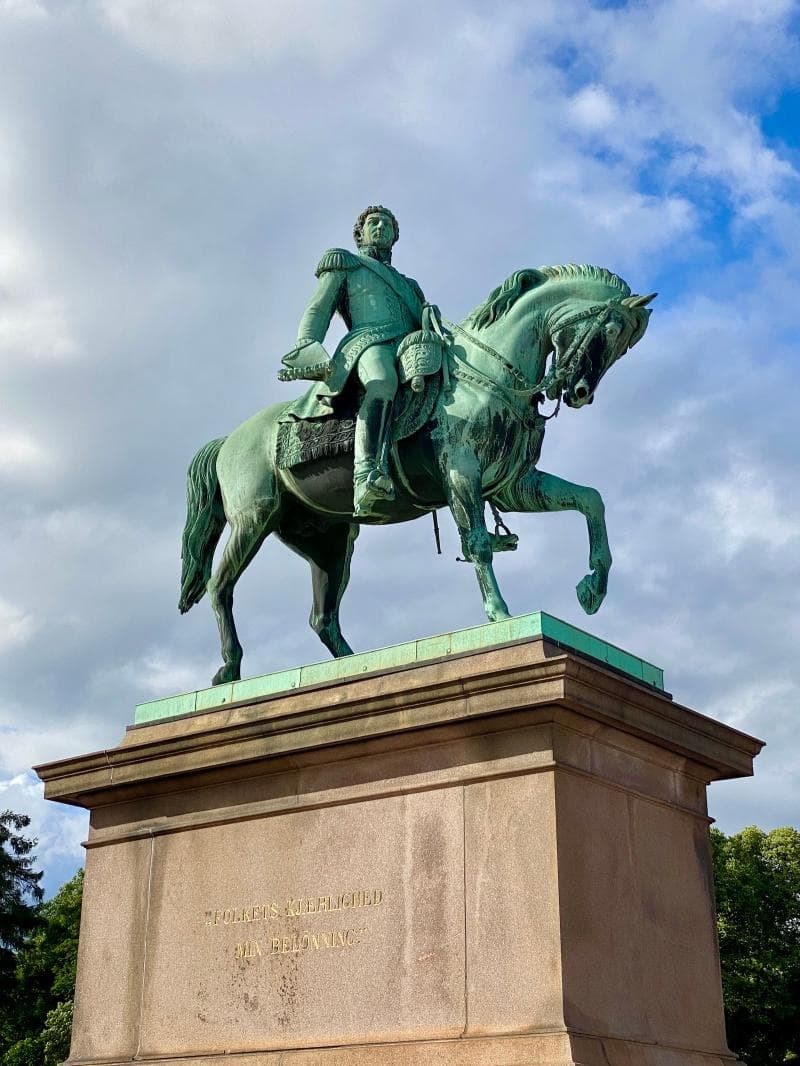
Beyond national holidays, Palace Square is the traditional venue for formally greeting foreign heads of state, adding a layer of international diplomacy to its ceremonial importance [5, 14]. Daily, the square attracts onlookers for the precise and colorful Changing of the Guard ceremony, performed by His Majesty the King's Guard, typically at 1:30 PM [6, 7, 15]. The square also features a prominent equestrian statue of King Charles XIV John, sculpted by Brynjulf Bergslien and erected in 1875, commemorating the monarch who initiated the palace's construction [12, 25].
Stories, Fun Facts & Local Details
One of the most charming aspects of Palace Square is its inherent accessibility, reflecting the Norwegian approach to monarchy. Unlike many European palaces guarded by high walls, Oslo's Royal Palace and its square are openly integrated into the city, inviting public interaction [23]. This openness fosters a unique connection between the citizens and the Royal Family, who are often seen as approachable figures rather than distant rulers.
The statue of King Charles XIV John at the heart of the square serves as a constant reminder of the palace's origins and the historical ties between Norway and Sweden [12, 25]. It's a popular spot for photographs and a silent observer of the countless events that have unfolded on the square. The Palace Park, encompassing the square, was deliberately designed in a Romantic style with winding paths and green lawns, intended for public enjoyment from its inception [5, 6]. This long-standing tradition of public access highlights a core value of Norwegian society – the belief that royal spaces should also be communal spaces.
Visitor Perspective
For any traveler exploring Oslo, a visit to Palace Square is an essential experience. Standing on the square, one can truly appreciate the grandeur of the Royal Palace at the end of Karl Johans gate, feeling the pulse of Norwegian history and contemporary life [11, 23]. The vastness of the square offers excellent vantage points for observing the Changing of the Guard, a spectacle of military precision and tradition that captivates audiences daily [6, 7].
Beyond the ceremonies, the square invites a leisurely stroll, allowing visitors to soak in the atmosphere and reflect on its significance. It's a place where you can witness a blend of everyday life and royal custom, children playing in the surrounding park while royal guards stand vigil. The open, unpretentious elegance of the square and its integration with the city make it a profoundly authentic and memorable part of any Oslo itinerary, offering a tangible link to Norway's past and present. The best part? It's a completely free and accessible experience, allowing everyone to connect with this vital piece of Norwegian heritage [7].
Coordinates: 10.7276, 59.9169
View on Google Maps💬 How Travelers Describe This Place
Based on community votes
Must See
950Beautiful
287Photogenic
255Unique
231Interesting
86
Traveler Stories
Discover memorable experiences shared by travelers who have visited this place.
No traveler stories yet.
Be the first traveler to share what made this place memorable.

Tour
By
Spot
Discover amazing places around the world. Your journey starts here.
Explore
© 2026 TourBySpot. All rights reserved.