St. Peter's Abbey
Salzburg, Austria
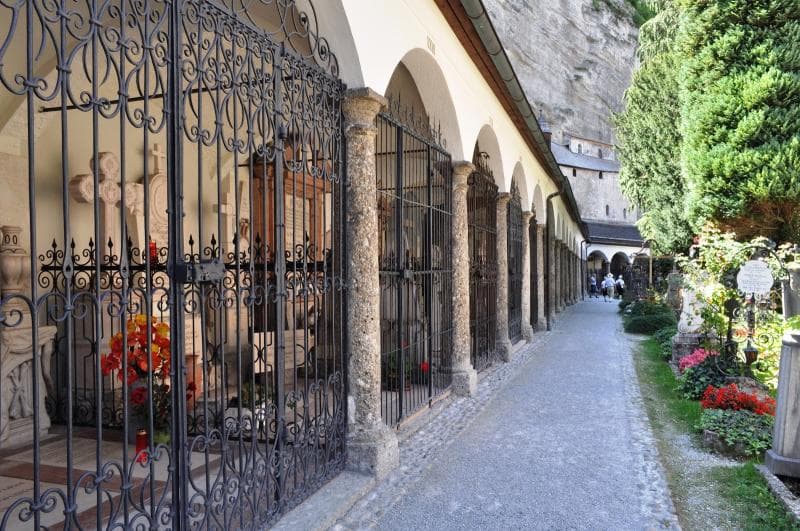
Explore St. Peter's Abbey in Salzburg, Austria – the oldest monastery in the German-speaking world, featuring ancient catacombs, a historic cemetery, and unique architecture.
Overview
St. Peter's Abbey, nestled at the foot of the Mönchsberg mountain in Salzburg, Austria, stands as a profound testament to centuries of continuous monastic life and cultural heritage. It is widely recognized as the oldest continuously existing monastery in the German-speaking world, a Benedictine institution founded in 696 AD. [3, 4, 7, 13, 18, 21] More than just a monastery, it's a sprawling complex that invites exploration into its historic abbey church, the serene St. Peter's Cemetery, and the enigmatic catacombs carved directly into the rock face. [4, 7, 12, 13] The architectural landscape of the abbey beautifully illustrates its long history, showcasing a blend of Romanesque, Gothic, Baroque, and Rococo styles that have evolved through various reconstructions and renovations over the centuries. [7, 9, 11, 14, 16, 17]
History & Cultural Background
The origins of St. Peter's Abbey trace back to the vision of Saint Rupert, Bishop of Worms, who founded the monastery in 696 AD with the primary goal of advancing missionary efforts in the Eastern Alps. [3, 4, 7, 16, 19] This makes it a pivotal site in the Christianization of the region. For nearly three centuries, until 987 AD, the roles of abbot and Archbishop of Salzburg were unified in one person. [3] During the Middle Ages, St. Peter's was renowned for its exceptional school and scriptorium, a center for writing and learning. [3, 4, 8] It also holds the distinction of being the mother monastery for Admont Abbey. [3, 4] A significant period in its history was the establishment of the Benedictine University of Salzburg in 1623 by Archbishop Paris Lodron, which remained closely connected to the abbey until its dissolution in 1810. [3, 4] In a remarkable testament to its resilience, the abbey was elevated to the status of an archabbey in 1927. [3, 4] Although its monks were temporarily driven away during the National Socialist era, the monastery itself was not dissolved, allowing the Benedictine community to return and continue its legacy immediately after the war. [4]
What Makes It Special
What truly sets St. Peter's Abbey apart is its unparalleled historical continuity; it has been a living monastic community without interruption since its foundation. [3, 4, 7, 13, 18, 21] Within its hallowed grounds lies St. Peter's Cemetery, often regarded as one of the most beautiful and oldest cemeteries globally, featuring ancient tombstones and arcades. [4, 7, 13, 14] Carved into the adjacent Festungsberg hill are the mysterious catacombs, an ancient network of caves that served as early Christian meeting places rather than primary burial sites. [7, 13, 14, 18] The abbey also houses Austria's oldest library, a treasure trove containing around 100,000 volumes, including the precious Verbrüderungsbuch from 784 AD, though access is typically restricted to special guided tours. [3, 4, 8, 16, 17] Furthermore, St. Peter's Abbey holds immense musical significance as the location where Mozart's celebrated Mass in C Minor premiered in 1783, with his wife, Constanze, singing the lead soprano role. [5, 8, 9, 14, 16, 21] The complex is also home to St. Peter Stiftskulinarium, reputed to be the oldest restaurant in Central Europe, with its first mention dating back to 803 AD, and an historic abbey bakery from the 12th century, still baking bread in its original wood-fired oven. [4, 14, 15]
Stories, Fun Facts & Local Details
Beyond its historical grandeur, St. Peter's Abbey weaves itself into local lore and popular culture. Fans of 'The Sound of Music' will instantly recognize the cemetery and its catacombs, which served as a dramatic escape route for the Trapp family in the beloved film. [4, 7, 11, 18, 19] The cemetery is also the final resting place for several notable figures, including Mozart's beloved sister, Nannerl, and the esteemed composer Michael Haydn. [4, 7, 14, 16, 18, 19] A charming fun fact connects the young Mozart to the abbey; at just 13 years old, he composed the Dominicus Mass for Abbot Dominikus Hagenauer in 1769, a composition lauded for its elegance. [7, 11, 19] The catacombs themselves, with their origins in late antiquity, offer a fascinating glimpse into early Christian life, having primarily served as gathering places and hermitages. [7, 13, 14, 18] Even the abbey's bakery has a story, historically supplied by the ingenious Almkanal, an underground water system providing power for its mill. [4]
Visitor Perspective
A visit to St. Peter's Abbey offers a rich, multi-layered experience. Most travelers begin with the solemn beauty of St. Peter's Cemetery, a peaceful space adorned with elaborate gravestones and crypts. [4, 7] From there, the unique catacombs, carved into the rock face, can be explored for a small admission fee, though they may have limited accessibility. [4, 7, 13] The Abbey Church, a masterpiece of architectural evolution, is typically open to visitors outside of service hours, allowing time to appreciate its Baroque high altar, intricate stucco work, and historical significance. [4, 7, 9, 11, 16] For those seeking a cultural and culinary delight, the Baroque Hall within the St. Peter Stiftskulinarium regularly hosts Mozart Dinner Concerts, offering an immersive experience that combines classical music with a historical dining ambiance. [4, 7, 11] While the historic library is generally not open to the public, its presence highlights the abbey's enduring commitment to scholarship and knowledge. [17] The blend of sacred spaces, historical narratives, and cultural vibrancy makes St. Peter's Abbey an essential stop for any curious traveler in Salzburg. [9, 12]
Coordinates: 13.0448, 47.797
View on Google Maps💬 How Travelers Describe This Place
Based on community votes
Photogenic
800Beautiful
658Unique
589Must See
374Interesting
90
Traveler Stories
Discover memorable experiences shared by travelers who have visited this place.
No traveler stories yet.
Be the first traveler to share what made this place memorable.
Things to see at St. Peter's Abbey



Tour
By
Spot
Discover amazing places around the world. Your journey starts here.
Explore
© 2026 TourBySpot. All rights reserved.