Salzburg Cathedral
Salzburg, Austria
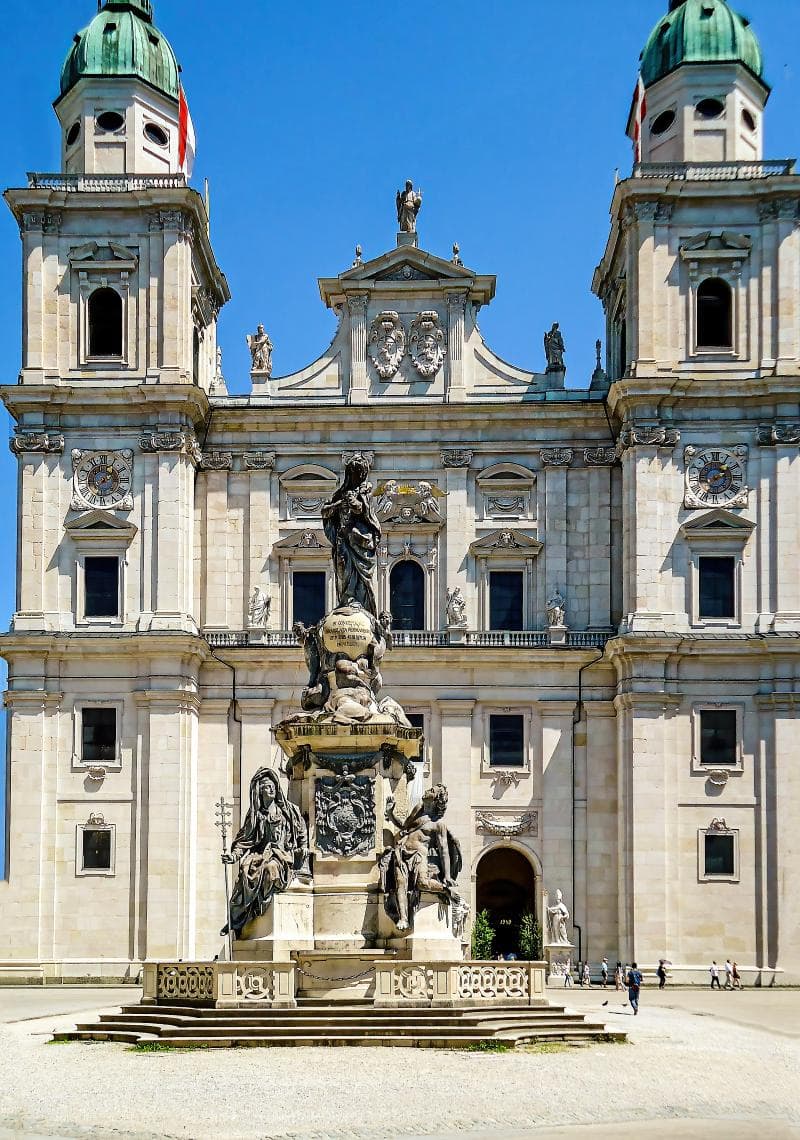
Explore Salzburg Cathedral, a Baroque masterpiece in Salzburg, Austria, where Mozart was baptized. Discover its rich history and stunning architecture.
Overview
Salzburg Cathedral, known in German as Salzburger Dom, stands as a magnificent testament to early Baroque architecture in the heart of Salzburg, Austria. This grand cathedral is the principal sacred building of the Roman Catholic Archdiocese of Salzburg and is dedicated to its patron saints, Rupert and Vergilius. With its commanding dome and twin towers, the cathedral defines the city's iconic skyline and is an integral part of Salzburg's Old Town, a designated UNESCO World Heritage Site.
Crafted predominantly from gleaming Untersberger marble, its striking facade welcomes visitors to a spiritual and cultural journey. As the largest early Baroque church north of the Alps, its scale and ornate details reflect the power and wealth of the Prince-Archbishops who once governed the region.
History & Cultural Background
The history of Salzburg Cathedral is a rich tapestry woven with cycles of destruction and rebirth, spanning over twelve centuries. The site's Christian heritage dates back to 774, when Saint Vergilius consecrated the first cathedral, a Carolingian basilica. This initial structure was a significant edifice for its time, measuring 66 meters long and 33 meters wide.
Through the centuries, the cathedral faced numerous challenges. It was destroyed by fire in 842 after a lightning strike, only to be rebuilt with determination. A devastating fire in 1167 led to its reconstruction under Archbishop Conrad III, who envisioned an even more splendid Romanesque cathedral, considered the mightiest north of the Alps. However, disaster struck again in 1598 when another fire ravaged large sections of the church. This led to Archbishop Wolf Dietrich's controversial decision to demolish the remaining parts, clearing the way for a grander vision.
The current Baroque masterpiece, a design by Italian architect Santino Solari, was commissioned by Archbishop Markus Sittikus von Hohenems, with construction commencing in 1614. Its consecration by Archbishop Paris Lodron in 1628 marked a new era for Salzburg, establishing the cathedral as the first early Baroque church in the region. The cathedral's resilience was tested once more in 1944 when an aerial bomb during World War II severely damaged its dome and parts of the altar area. Following extensive restoration, it was reconsecrated in 1959. The three major consecration dates – 774, 1628, and 1959 – are proudly inscribed on the gate grilles, symbolizing its enduring legacy.
What Makes It Special
Salzburg Cathedral is distinguished by its architectural grandeur and profound religious symbolism. Its magnificent main facade, crafted from Untersberger marble, is adorned with statues of the Apostles Peter and Paul, alongside the city's revered patron saints, Rupert and Virgil. The gable proudly displays the coats of arms of its builders, Markus Sittikus and Paris Lodron.
Perhaps one of its most compelling features are the three monumental bronze entrance doors, each symbolizing a cardinal virtue: Faith, Love, and Hope. Notably, the central door, representing Love, is slightly larger than the others. Inside, visitors are drawn to the 14th-century bronze baptismal font, a relic that predates the Baroque structure. It was in this very font that the prodigious Wolfgang Amadeus Mozart, and later Joseph Mohr, the lyricist of 'Silent Night,' were baptized. The cathedral also houses the crypt, containing the relics of Saints Rupert and Virgil, and features multiple elaborate pipe organs that Mozart himself once played, filling the sacred space with transcendent sound. The cathedral's acoustic richness is further enhanced by its seven bells, whose harmonious tones are considered among the most beautiful in Austria.
Stories, Fun Facts & Local Details
Beyond its architectural majesty, Salzburg Cathedral holds fascinating stories and unique details. It is here that Wolfgang Amadeus Mozart's full baptismal name, Johannes Chrysostomus Wolfgangus Theophilus Mozart, is recorded in the historic registers. For those with a keen eye, ancient scribbles, approximately 370 years old, can still be found etched into the marble at the entrance, a silent testament to a watchful soldier's idle moments.
The cathedral's impressive bell ensemble includes 'Salvator,' the second largest bell in Austria. Each of the seven bells has its own name, adding a personal touch to their grand chorus. A lesser-known detail lies in the handles of the three entrance doors, which are subtly shaped like the figures of Bishops Rupert and Virgil themselves. An interesting anecdote suggests that the cathedral's dome, rebuilt after its 1944 damage, has a slight asymmetry on one side, reportedly to accommodate an internal fire escape. The Baroque squares surrounding the cathedral serve as a dynamic stage for cultural events, most famously hosting performances of 'Jedermann' during the renowned Salzburg Festival and the enchanting Christmas market, creating a vibrant connection between faith, art, and community.
Visitor Perspective
For the curious traveler, visiting Salzburg Cathedral offers a deeply enriching experience. An admission fee is collected, which directly supports the preservation and maintenance of this magnificent historical monument. To enhance the exploration, audio guides and guided tours are available, providing insights into its rich history and intricate details.
A highlight for many is the 'Music at Noon' event, where visitors can experience the cathedral's world-famous organs in action. Additionally, the Domgrabungen, an excavation site beneath the cathedral, unveils the foundations of earlier churches, offering a unique glimpse into its layered past. The Cathedral Museum further enriches the visit by showcasing a wealth of art treasures spanning 1300 years of church history. The cathedral's central location in Salzburg's Old Town makes it easily accessible, inviting travelers to step inside and immerse themselves in centuries of history, art, and spirituality.
Coordinates: 13.04694, 47.79778
View on Google Maps💬 How Travelers Describe This Place
Based on community votes
Photogenic
698Must See
476Beautiful
465Unique
276Interesting
126
Traveler Stories
Discover memorable experiences shared by travelers who have visited this place.
No traveler stories yet.
Be the first traveler to share what made this place memorable.
Things to see at Salzburg Cathedral



Tour
By
Spot
Discover amazing places around the world. Your journey starts here.
Explore
© 2026 TourBySpot. All rights reserved.