Crypt
Salzburg, Austria
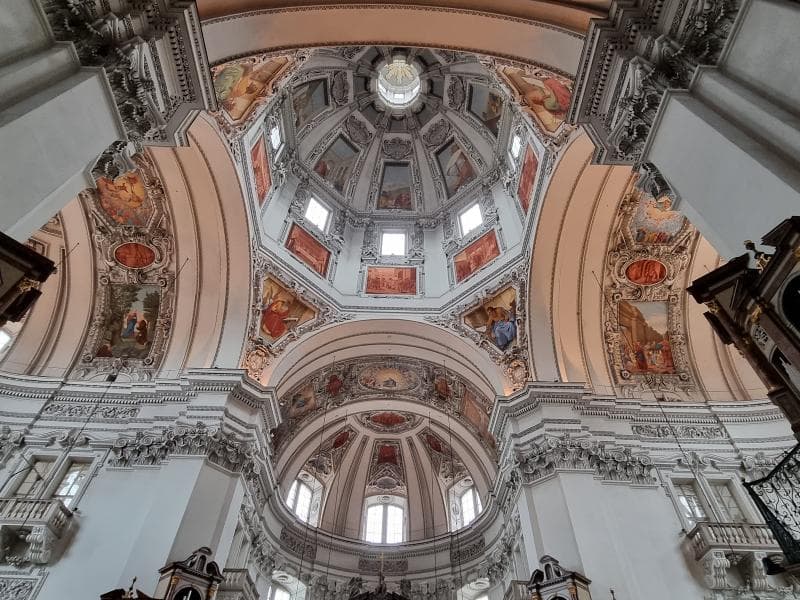
Explore the solemn Crypt beneath Salzburg Cathedral, Austria. Discover the burial place of Archbishops, ancient foundations, and the haunting 'Vanitas' art installation, connecting centuries of history.
Overview
Deep beneath the majestic Baroque facade of Salzburg Cathedral in Salzburg, Austria, lies the Crypt, a solemn and historically rich sub-spot that offers a profound journey through time. More than just a burial site, the Crypt is a fascinating confluence of architectural layers, spiritual reverence, and contemporary art. It serves primarily as the final resting place for many of Salzburg's Archbishops, connecting visitors directly to centuries of ecclesiastical history.
As you descend into this underground realm, you'll encounter remnants of earlier cathedrals, bearing witness to the city's enduring Christian heritage. The Crypt also houses a contemplative chapel and a thought-provoking art installation, transforming it into a space that evokes both historical wonder and quiet introspection.
History & Cultural Background
The Crypt in its present accessible form is a relatively modern creation, dating back to the reopening of the Cathedral in 1959. However, the tradition of burying Archbishops beneath the Cathedral dates back much further. Before 1959, the area consisted of vaults accessible only from the Cathedral floor, which had served as burial places for the Salzburg Archbishops since at least 1619, beginning with Prince-Archbishop Marcus Sitticus von Hohenems.
The current Crypt was shaped by the devastation of World War II. A bomb strike in 1944 caused the Cathedral's dome to collapse, also destroying the underlying vaults. During the subsequent clean-up and reconstruction work in 1956-1958, foundations and wall remains of the predecessors of the Baroque Cathedral came to light. This discovery led to the decision to construct a concrete ceiling, creating an accessible crypt where these historical layers could be preserved and viewed.
Further enhancing its historical depth, the excavations also uncovered the choir crypt of the late Romanesque cathedral, which was built between 1181 and 1200 and demolished in 1598. This older section, known as the 'Conradinian Crypt,' had long been forgotten. In 2009, a corridor was created, connecting it with the main Baroque Crypt, allowing visitors to explore this even more ancient part of Salzburg's past.
What Makes It Special
The Salzburg Cathedral Crypt stands out for its unique blend of functions and historical revelations. Firstly, it is a sacred burial ground, housing the tombs of 22 Archbishops of Salzburg. This makes it a tangible link to the ecclesiastical leaders who shaped the city's spiritual and temporal destiny over centuries.
Secondly, the Crypt is a living archaeological site. Walking through its various sections, visitors can observe the foundations and wall remains of previous cathedral structures, offering a rare glimpse into the architectural evolution of this significant religious site. The seamless integration of the Baroque crypt with the older Romanesque 'Conradinian Crypt' allows for a direct comparison of different construction eras.
Adding another layer of meaning is the 'Vanitas' art installation by French artist Christian Boltanski. This thought-provoking shadow play, situated in the 'Conradinian Crypt,' engages directly with the themes of impermanence and the passage of time, perfectly suiting the historical and solemn nature of the space.
Stories, Fun Facts & Local Details
One of the most compelling aspects of the Crypt is its role as the eternal resting place for the Archbishops of Salzburg. Since the early 17th century, nearly all Archbishops have been interred here, a tradition that underscores the enduring importance of this site. Among them is Prince-Archbishop Markus Sittikus von Hohenems, who laid the cornerstone for the Baroque Cathedral in 1614.
The 'Vanitas' installation in the 'Conradinian Crypt' is a powerful artistic statement. It features twelve slender metal sheet figures illuminated by candles, casting flickering shadows on the walls. Accompanying this visual is the projection of a vague angel of death slowly circling in the apse, combined with a constant repetition of time announcements. Boltanski himself remarked, 'I want people to hear and feel time here,' emphasizing that while humans can achieve much, they cannot fight against time – 'God is the master of time.' This modern 'danse macabre' offers a profound moment of reflection on human existence within a deeply historical context.
It's also a testament to resilience: the current Crypt's very existence is a direct consequence of the Cathedral's reconstruction after being severely damaged during World War II, literally rising from the ashes to reveal older foundations that would otherwise have remained hidden.
Visitor Perspective
A visit to the Salzburg Cathedral Crypt is a journey into quiet contemplation and historical discovery. The atmosphere is undeniably solemn, yet profoundly peaceful, inviting visitors to reflect on the passage of time and the rich history embedded within these ancient walls. The cool, quiet air provides a respite from the bustling city above, allowing for a deeper connection to Salzburg's spiritual past.
The Crypt is generally open to visitors from Monday to Saturday from 10:00 AM to 5:00 PM, and on Sundays and religious holidays from 1:00 PM to 5:00 PM. However, it is important to note that it may be closed without notice for organizational or technical reasons, and it always remains closed during church services and concerts held in the main Cathedral. While guided tours are permitted in the first room and the 'Conradinian' section, other areas are reserved for adoration and commemoration, underscoring the Crypt's ongoing role as a place of prayer. It's an essential experience for those seeking to understand the layers of history and spirituality that define Salzburg.
Coordinates: 13.0467, 47.7979
View on Google Maps💬 How Travelers Describe This Place
Based on community votes
Interesting
948Photogenic
913Beautiful
595Must See
358Unique
196
Traveler Stories
Discover memorable experiences shared by travelers who have visited this place.
No traveler stories yet.
Be the first traveler to share what made this place memorable.

Tour
By
Spot
Discover amazing places around the world. Your journey starts here.
Explore
© 2026 TourBySpot. All rights reserved.